组成图示
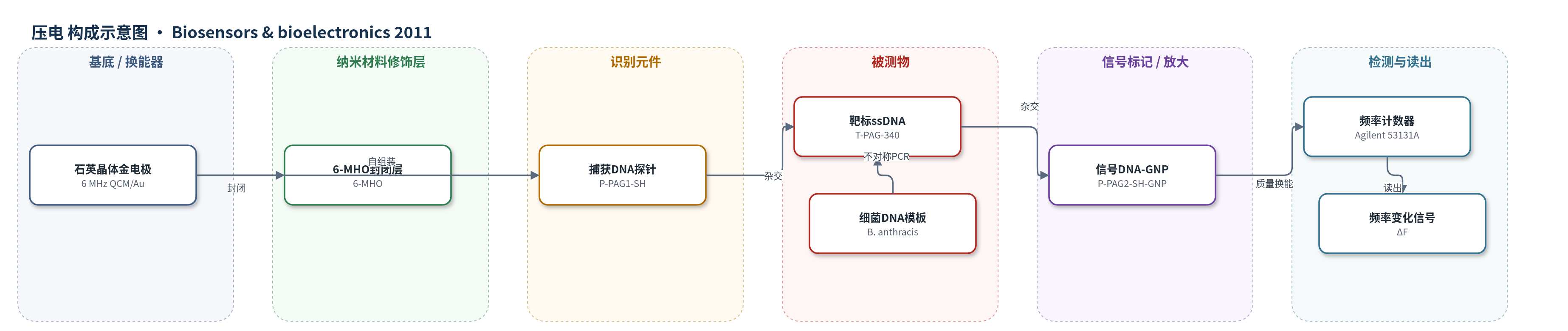
点击图片查看大图 · 依据论文自动绘制
传感器类型
压电(QCM)生物传感器
检测对象
炭疽杆菌(Bacillus anthracis)营养细胞特异性DNA片段(Ba813 168 bp、pag 340 bp);样品基质:炭疽杆菌营养细胞培养物/菌液经不对称PCR扩增后的单链DNA样品
检测原理
巯基捕获DNA探针通过Au–S键自组装固定于QCM金表面,并用6-MHO封闭非特异位点。炭疽杆菌营养细胞经不对称PCR扩增得到单链靶标DNA(Ba813 168 bp或pag 340 bp)。靶标与表面捕获探针杂交,使QCM表面质量增加,依据压电换能原理引起共振频率下降。随后加入与靶标另一端互补的巯基DNA探针功能化30 nm金纳米颗粒(GNPs),杂交后引入大质量GNPs,进一步增加表面质量并放大频率下降。频率变化量随靶标DNA量及细菌浓度增加而增大,在3.5×10^2–3.5×10^7 CFU/ml范围内与细菌浓度对数呈线性关系,实现实时检测。
检测灵敏度
LOD: 3.5 × 10^2 CFU/ml;线性范围: 3.5 × 10^2–3.5 × 10^7 CFU/ml
效应效果
该传感器可在30 min内实时检测,对炭疽杆菌特异性DNA响应明显,而对苏云金芽孢杆菌、枯草芽孢杆菌、蜡样芽孢杆菌和大肠杆菌等阴性菌信号接近基线;人工阴性寡核苷酸响应仅+0.3 Hz,GNP放大后约-3 Hz。平行实验(n=3)偏差小。传感器在-20 ℃保存2个月后响应接近新传感器,经0.1 M HCl处理2 min可再生。与琼脂糖凝胶电泳法相比,QCM法LOD为3.5×10^2 CFU/ml,凝胶电泳法为3.5×10^3 CFU/ml,灵敏度提高约一个数量级,且无需溴化乙锭,具有无污染、快速、特异、稳定和应用价值。
传感器的构成
- 基底/换能器:6 MHz AT-cut石英晶体,铬层20 nm,金电极50 nm,提供压电换能与金表面
- 识别元件:巯基捕获DNA探针P-BA1-SH或P-PAG1-SH,5′端含10T和巯基,经Au–S自组装固定并杂交靶标ssDNA
- 封闭剂:1 mM 6-巯基己醇(6-MHO)乙醇溶液,封闭金表面非特异位点,降低非特异吸附
- 反应介质:0.3 M NaCl、10 mM磷酸缓冲液(pH 7.4),用于探针修饰与杂交
- 信号放大元件:巯基信号DNA探针P-BA2-SH/P-PAG2-SH功能化30 nm金纳米颗粒(GNPs),互补靶标另一端并增加质量
- 读出系统:流动池、蠕动泵、振荡器、频率计数器(Agilent 53131A)和计算机,实时监测频率变化
中文摘要
自2001年美国炭疽孢子生物恐怖袭击以来,快速检测炭疽杆菌备受关注。本文开发了一种DNA探针功能化石英晶体微天平(QCM)生物传感器,用于检测炭疽杆菌(Bacillus anthracis)。该传感器基于识别其特异性DNA序列,即染色体Ba813基因的168 bp片段和pXO1质粒pag基因的340 bp片段。巯基DNA探针通过Au–S键自组装固定于QCM金表面,与不对称PCR获得的单链靶标DNA杂交。杂交使传感器表面质量增加,导致QCM共振频率下降。为放大信号,将互补于靶标DNA另一端的巯基DNA片段功能化金纳米颗粒(GNPs)。结果表明,该传感器可特异性识别炭疽杆菌靶标DNA片段,并能区别于苏云金芽孢杆菌等最接近种;检出限(LOD)达3.5×10^2 CFU/ml炭疽杆菌营养细胞,仅需不对称PCR扩增而无需培养富集。该传感器具有稳定、无污染、实时传感等优点,可用于炭疽杆菌快速检测。
英文摘要
The rapid detection of Bacillus anthracis, the causative agent of anthrax disease, has gained much attention since the anthrax spore bioterrorism attacks in the United States in 2001. In this work, a DNA probe functionalized quartz crystal microbalance (QCM) biosensor was developed to detect B. anthracis based on the recognition of its specific DNA sequences, i.e., the 168 bp fragment of the Ba813 gene in chromosomes and the 340 bp fragment of the pag gene in plasmid pXO1. A thiol DNA probe was immobilized onto the QCM gold surface through self-assembly via Au-S bond formation to hybridize with the target ss-DNA sequence obtained by asymmetric PCR. Hybridization between the target DNA and the DNA probe resulted in an increase in mass and a decrease in the resonance frequency of the QCM biosensor. Moreover, to amplify the signal, a thiol-DNA fragment complementary to the other end of the target DNA was functionalized with gold nanoparticles. The results indicate that the DNA probe functionalized QCM biosensor could specifically recognize the target DNA fragment of B. anthracis from that of its closest species, such as Bacillus thuringiensis, and that the limit of detection (LOD) reached 3.5 × 10(2)CFU/ml of B. anthracis vegetative cells just after asymmetric PCR amplification, but without culture enrichment. The DNA probe functionalized QCM biosensor demonstrated stable, pollution-free, real-time sensing, and could find application in the rapid detection of B. anthracis.