组成图示
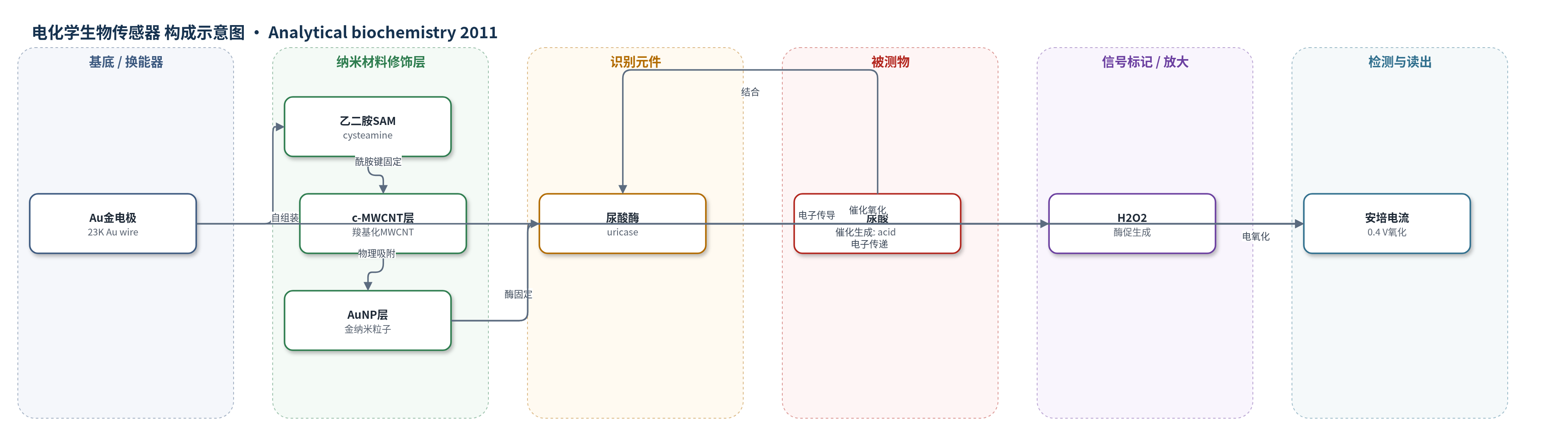
点击图片查看大图 · 依据论文自动绘制
传感器类型
电化学生物传感器
检测对象
尿酸(uric acid, UA);样品基质:血清(serum)及 Tris–HCl 缓冲液
检测原理
该传感器以尿酸酶为识别元件,以 AuNP/c-MWCNT 修饰的 Au 电极为换能界面。尿酸酶催化尿酸氧化为尿囊素并生成 H2O2;生成的 H2O2 在 0.4 V 下于电极表面发生电氧化,产生 O2、H+ 和电子,形成安培电流。c-MWCNT 通过 cysteamine SAM 共价固定于 Au 表面,增大有效面积并促进电子传递;AuNP 物理吸附于 c-MWCNT 表面,显著增强 H2O2 的电催化氧化能力。因此,电流响应随尿酸浓度升高而增大,在 0.01–0.8 mM 范围内呈线性。
检测灵敏度
LOD: 0.01 mM;线性范围: 0.01–0.8 mM;灵敏度: 0.44 mA mM–1;r = 0.998
效应效果
该传感器响应时间 7 s,线性范围 0.01–0.8 mM,灵敏度 0.44 mA mM–1,LOD 0.01 mM。血清加标回收率为 98.0% 和 96.5%(10、20 mg/L),批内和批间 CV 分别小于 5.6% 和 4.7%。与标准酶法比色法相比,11 份血清样本相关系数 r = 0.998。葡萄糖、胆固醇、尿素、胆红素、NADH 等 18 种常见干扰物在 1 mM 下基本无干扰;抗坏血酸在 3.4 mM 时仅抑制 7%。传感器可重复使用 200 次以上,4 °C 保存 120 d,45 d 后保留 75% 响应。作者认为其适合血清尿酸快速、经济、特异性检测。
传感器的构成
- 基底电极:Au 金线电极(23K Au wire),经抛光和超声清洗,作为工作电极与电子传导基底
- 自组装单分子层:cysteamine(乙二胺)SAM,在 Au 表面形成氨基功能化界面,用于共价连接 c-MWCNT
- c-MWCNT修饰层:c-MWCNT(羧基化多壁碳纳米管),经 H2SO4/HNO3 分散并用 EDC/NHS 活化,与 SAM 氨基形成酰胺键,增大表面积并促进电子传递
- AuNP催化层:AuNP(金纳米粒子,平均约 19.25 nm),物理吸附于 c-MWCNT 表面,增强 H2O2 电催化氧化
- 识别元件:uricase(尿酸酶,EC 1.7.3.3),固定于 AuNP/c-MWCNT/Au 表面,催化尿酸氧化生成 H2O2
- 信号分子:H2O2(过氧化氢),由尿酸酶催化尿酸生成,在 0.4 V 下氧化产生电流
- 反应介质:50 mM Tris–HCl 缓冲液(pH 7.5),维持尿酸酶活性与电化学测量环境
中文摘要
本研究通过碳二亚胺连接将尿酸酶(uricase,EC 1.7.3.3)固定于沉积在金电极上的金纳米粒子(AuNP)/多壁碳纳米管(MWCNT)层,构建了一种安培法尿酸生物传感器。该传感器在 0.4 V 下通过氧化酶促生成的过氧化氢(H2O2)测定尿酸。在 50 mM Tris–HCl 缓冲液(pH 7.5)、40 °C 条件下,传感器在 7 s 内达到最佳响应,线性工作范围为 0.01–0.8 mM,检出限为 0.01 mM。该传感器用于测定健康人和痛风患者血清中的尿酸水平,加入 10 和 20 mg/L 尿酸的回收率分别为 98.0% 和 96.5%。批内和批间变异系数分别小于 5.6% 和 4.7%。与标准酶法比色法相比,血清尿酸值相关系数 r = 0.998。多种血清物质基本无干扰。传感器可重复使用 200 次以上,并在 4 °C 下保存 120 天。
英文摘要
An amperometric uric acid biosensor was fabricated by immobilizing uricase (EC 1.7.3.3) onto gold nanoparticle (AuNP)/multiwalled carbon nanotube (MWCNT) layer deposited on Au electrode via carbodiimide linkage. Determination of uric acid was performed by oxidation of enzymically generated H(2)O(2) at 0.4V. The sensor showed optimal response within 7s at 40°C in 50mM Tris-HCl buffer (pH 7.5). The linear working range of the biosensor was 0.01-0.8mM. The limit of detection (LOD) was 0.01mM. The sensor measured uric acid levels in serum of healthy individuals and persons suffering from gout. The analytical recoveries of the added uric acid, 10 and 20mgL(-1), were 98.0% and 96.5%, respectively. Within- and between-batch coefficients of variation were less than 5.6% and less than 4.7%, respectively. A good correlation (r=0.998) was obtained between serum uric acid values by the standard enzymic colorimetric method and the current method. A number of serum substances had practically no interference. The sensor was used in more than 200 assays and had a storage life of 120 days at 4°C.