组成图示
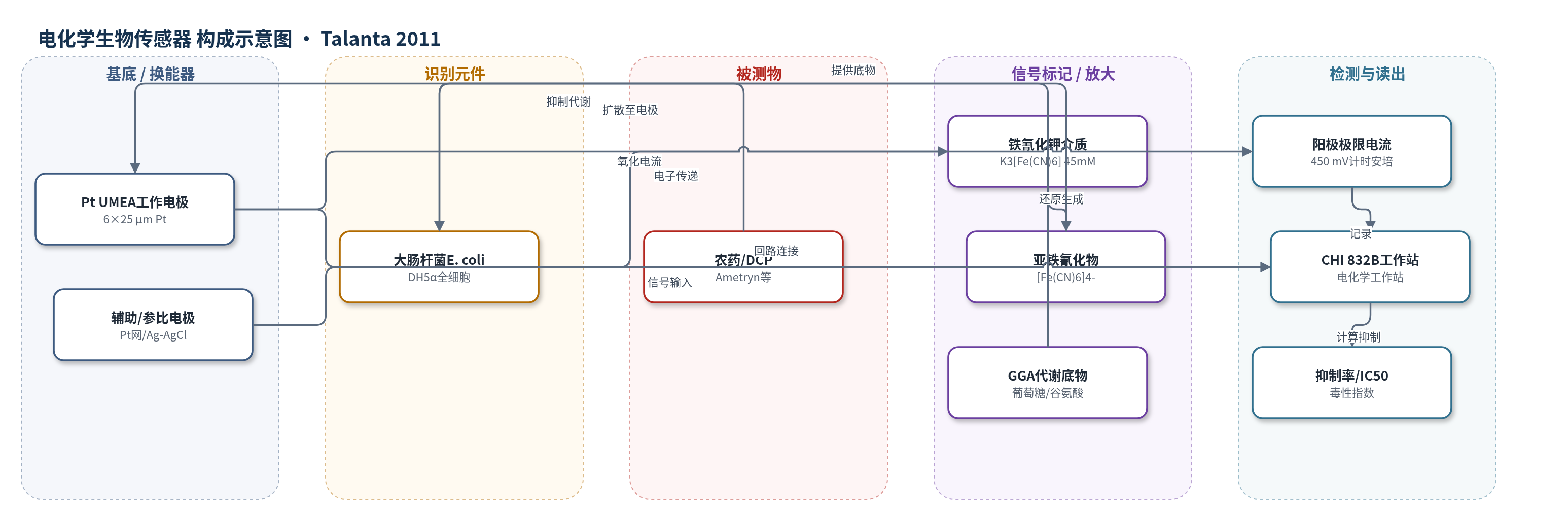
点击图片查看大图 · 依据论文自动绘制
传感器类型
电化学生物传感器
检测对象
3,5-二氯酚(3,5-dichlorophenol, DCP)、阿灭灵(Ametryn)、芬苯磷胺(Fenamiphos)、硫丹(Endosulfan);样品基质:水溶液(含0.5% DMSO助溶)及大肠杆菌孵育上清(PBS/LB体系)
检测原理
以大肠杆菌为全细胞生物催化剂,在厌氧、37 °C、含 GGA 底物和 45 mM 铁氰化钾的体系中孵育。正常细胞氧化葡萄糖/谷氨酸,电子经呼吸链传递给铁氰化钾,将其还原为亚铁氰化物;农药或 DCP 抑制细胞代谢,使亚铁氰化物生成减少。孵育后取上清,在 Pt UMEA 上施加 450 mV,亚铁氰化物被氧化,产生阳极极限电流。UMEA 将多个 25 μm Pt 微电极的极限电流叠加,放大低浓度代谢产物信号。通过样品、空白、正/负对照电流计算抑制率,抑制率随毒物浓度升高而增大,进而拟合 IC50。
检测灵敏度
IC50: 8.0 mg/L (DCP);6.5 mg/L (Ametryn);22 mg/L (Fenamiphos);5.7 mg/L (Endosulfan)
效应效果
方法对三种农药的 IC50 与文献 EC50 基本一致:Endosulfan 5.7 mg/L(Toxalert 5.63 mg/L)、Fenamiphos 22 mg/L(Toxalert 31.63 mg/L)、Ametryn 6.5 mg/L(Toxalert 18.64 mg/L)。对 DCP 的 IC50 为 8.0 mg/L,低于活性污泥 9.8 mg/L 和 V. fischeri Cellsense 37.5 mg/L,但高于 Microtox 3.2 mg/L。电化学法不受浊度干扰,适合废水/悬浮液;Cellsense 固定时间长且重现性较差。AFM 显示细胞表面粗糙、斑块、裂解,破坏程度 Fenamiphos < Ametryn < Endosulfan,与 IC50 一致。作者认为方法灵敏、快速、低成本,适合农药毒性初筛。
传感器的构成
- 换能器电极:Pt 超微电极阵列(UMEA,6×25 μm Pt 微电极)作为工作电极,Pt 网辅助电极,Ag/AgCl 参比电极,用于计时安培检测
- 生物识别元件:大肠杆菌 E. coli DH5α 细胞悬液(A600≈5.0)作为全细胞生物催化剂,响应毒物代谢抑制
- 电子受体/介质:K3[Fe(CN)6](45 mM)替代 O2 接受微生物电子,被还原为亚铁氰化物
- 代谢底物/电子供体:标准 GGA 溶液(150 mg/L 葡萄糖、150 mg/L 谷氨酸)提供微生物氧化代谢底物
- 样品基质:PBS 缓冲液及待测农药/DCP 溶液,厌氧 37 °C 孵育 60 min
- 信号标记物:代谢生成的亚铁氰化物 [Fe(CN)6]4-,在 450 mV 被氧化产生阳极极限电流
- 读出系统:CHI 832B 电化学工作站,计时安培法记录 10 s 内阳极极限电流并计算抑制率
中文摘要
本文报道一种基于电化学生物传感器的农药毒性快速检测方法,以大肠杆菌(E. coli)为模式微生物。该方法用铁氰化钾替代天然电子受体氧气,作为电子受体/介质,显著加速微生物氧化代谢。毒性检测通过测量毒物对微生物代谢活性的影响实现;代谢产生的亚铁氰化物在超微电极阵列(UMEA)上的安培电流与毒性直接相关,并可被 UMEA 放大。通过比较有无毒素时的电化学信号得到抑制率,提出基于计时安培法的直接毒性评估(DTA)方法。以3,5-二氯酚(DCP)为参考毒物,60 min 孵育 IC50 为 8.0 mg/L;对阿灭灵(Ametryn)、芬苯磷胺(Fenamiphos)和硫丹(Endosulfan)的 IC50 分别为 6.5、22 和 5.7 mg/L,与文献 EC50 一致。原子力显微镜(AFM)显示三种农药诱导大肠杆菌表面粗糙、斑块、细胞壁消失和裂解,破坏程度为芬苯磷胺<阿灭灵<硫丹。结果表明该方法灵敏、快速、低成本,可用于农药毒性筛查。
英文摘要
We reported a rapid toxicity assay method using electrochemical biosensor for pesticides, Escherichia coli (E. coli) was taken as a model microorganism for test. In this method, we adopted ferricyanide instead of natural electron acceptor O(2), and then microbial oxidation was substantially accelerated. Toxicity assays measured the effect of toxic materials on the metabolic activity of microorganisms. The current signal of ferrocyanide produced from the metabolism was proven to be directly related to the toxicity, which could be amplified by ultramicroelectrode array (UMEA). The ratio of the electrochemical signals, recorded in the presence and absence of toxin, provided an index of inhibition. Accordingly, a direct toxicity assessment (DTA) based on chronoamperometry was proposed to detect the effect of toxic chemicals on microorganisms. 3,5-Dichlorophenol (DCP) was taken as the reference toxicant, its IC50 was estimated to be 8.0mg/L. Three pesticides were examined using this method. IC50 values of 6.5mg/L for Ametryn, 22 mg/L for Fenamiphos and 5.7 mg/L for Endosulfan were determined and in line with EC50 values reported in the literature. Atomic force microscopy (AFM) was also used for morphology characterization of E. coli induced by three pesticides. These results confirmed the present electrochemical method used is reliable. In addition, the electrochemical method is a sensitive, rapid and inexpensive way for toxicity assays of pesticides.