组成图示
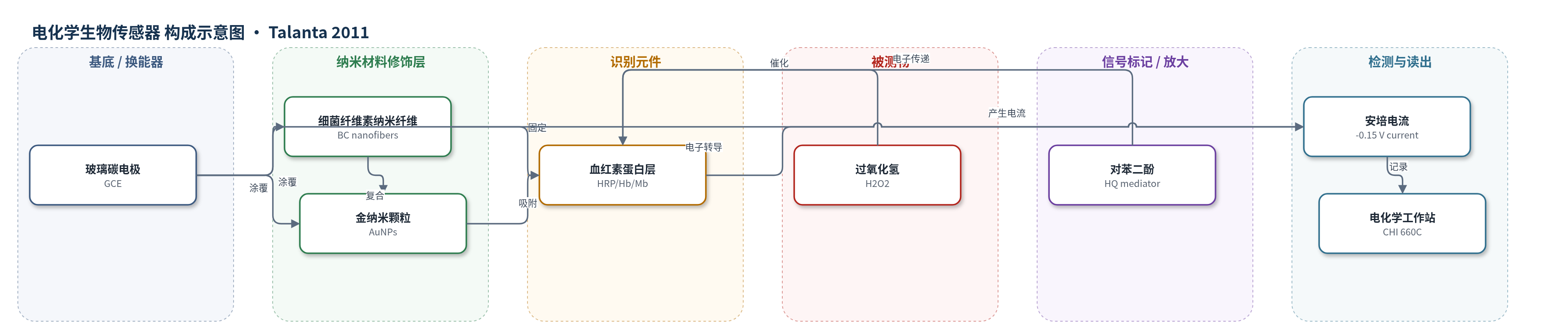
点击图片查看大图 · 依据论文自动绘制
传感器类型
电化学生物传感器
检测对象
过氧化氢(H2O2);样品基质:磷酸盐缓冲液(PBS)及消毒剂样品
检测原理
HRP 等血红素蛋白被固定在 Au–BC 纳米复合膜中,其血红素中心在 H2O2 作用下被氧化,氧化态蛋白进一步氧化介质 HQ 生成 HQ(Ox)。HQ(Ox) 在 -0.15 V 的 GCE 表面获得电子还原为 HQ,形成可测量的还原电流。AuNPs 作为导电桥和电子传递中心,补偿 BC 的低导电性并促进电子转移;BC 纳米网络提供多孔传质通道和生物相容微环境,使蛋白保持近天然构象。H2O2 浓度越高,酶催化循环越快,稳态安培电流越大,从而实现定量检测。
检测灵敏度
HRP: LOD: 0.1 μM (S/N = 3);线性范围: 0.3 μM–1.0 mM;灵敏度: 610 μA mM−1 cm−2;R^2 = 0.998
效应效果
HRP/Au–BC/GCE 对 H2O2 的响应在 1 s 内稳定,快于文献中 2.5 s、5 s 和 10 s 的 HRP 传感器。选择性方面,1 mM 葡萄糖、柠檬酸和尿酸(相对 0.1 mM H2O2 为十倍过量)加入后电流无明显变化。稳定性方面,传感器在 pH 7.4 PBS 中 4 ℃ 保存 20 d 后仍保留 87% 以上初始响应。实际消毒剂样品稀释 20 倍后测得 H2O2 为 47.7 ± 0.6 mM(n=3),与高锰酸钾滴定法 49.77 ± 0.03 mM(n=3)接近。与表 1 中其他 H2O2 传感器相比,其线性范围更宽、检出限更低,作者认为 Au–BC 纳米复合材料具有生物传感器和生物催化应用潜力。
传感器的构成
- 基底/换能器电极:玻璃碳电极(GCE),抛光后作为工作电极,提供电子转导
- 纳米材料修饰层:细菌纤维素纳米纤维(BC nanofibers)与金纳米颗粒(AuNPs)构成的 Au–BC 纳米复合膜,提供生物相容网络、导电通路和大比表面积
- 识别/催化元件:辣根过氧化物酶(HRP)、血红蛋白(Hb)或肌红蛋白(Mb)固定于 Au–BC 膜中,催化 H2O2 还原
- 电子介质:对苯二酚(HQ),在溶液中作为电子媒介,传递血红素蛋白与电极间电子
- 缓冲介质:0.1 M 磷酸盐缓冲液(PBS, pH 7.4)和 0.5 mM HQ,维持酶活性并提供反应环境
- 检测体系:Ag/AgCl(3 M KCl)参比电极、铂丝对电极和电化学工作站(CHI 660C),用于三电极安培测量
中文摘要
本文开发了一种金纳米颗粒–细菌纤维素纳米纤维(Au–BC)纳米复合材料,用作酶固定化和生物传感器制备基质。该材料兼具金纳米颗粒(AuNPs)和细菌纤维素纳米纤维(BC)的生物相容性、导电性和大比表面积。辣根过氧化物酶(HRP)、血红蛋白(Hb)和肌红蛋白(Mb)被成功固定在 Au–BC 修饰的玻璃碳电极(GCE)表面。在介质对苯二酚(HQ)存在下,固定化血红素蛋白表现出对过氧化氢(H2O2)还原的电催化活性,紫外–可见和红外光谱表明蛋白在 Au–BC 中保持近天然二级结构。传感器响应与 AuNPs 含量相关,说明 AuNPs 在 BC 网络中起重要作用。最优条件下,HRP 传感器对 H2O2 的安培响应在 1 s 内达到稳定,线性范围为 0.3 μM–1.00 mM,检出限为 0.1 μM(S/N=3)。其高性能表明 Au–BC 纳米复合材料优于其他固定化基质。
英文摘要
A novel matrix, gold nanoparticles-bacterial cellulose nanofibers (Au-BC) nanocomposite was developed for enzyme immobilization and biosensor fabrication due to its unique properties such as satisfying biocompatibility, good conductivity and extensive surface area, which were inherited from both gold nanoparticles (AuNPs) and bacterial cellulose nanofibers (BC). Heme proteins such as horseradish peroxidase (HRP), hemoglobin (Hb) and myoglobin (Mb) were successfully immobilized on the surface of Au-BC nanocomposite modified glassy carbon electrode (GCE). The immobilized heme proteins showed electrocatalytic activities to the reduction of H(2)O(2) in the presence of the mediator hydroquinone (HQ), which might be due to the fact that heme proteins retained the near-native secondary structures in the Au-BC nanocomposite which was proved by UV-vis and IR spectra. The response of the developed biosensor to H(2)O(2) was related to the amount of AuNPs in Au-BC nanocomposite, indicating that the AuNPs in BC network played an important role in the biosensor performance. Under the optimum conditions, the biosensor based on HRP exhibited a fast amperometric response (within 1s) to H(2)O(2), a good linear response over a wide range of concentration from 0.3 μM to 1.00 mM, and a low detection limit of 0.1 μM based on S/N=3. The high performance of the biosensor made Au-BC nanocomposite superior to other materials as immobilization matrix.