组成图示
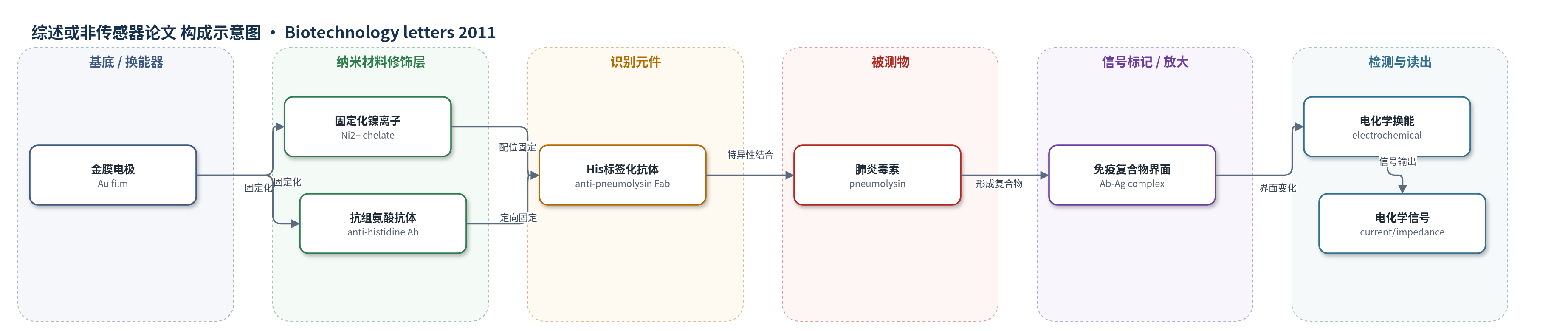
点击图片查看大图 · 依据论文自动绘制
传感器类型
综述或非传感器论文
检测对象
多组氨酸标签蛋白(poly-histidine tagged proteins)、肺炎毒素(pneumolysin)、胰岛素样生长因子-I(IGF-I)、磷酸化肽(phosphorylated peptides);样品基质:原文未明确,涉及细胞裂解液、蛋白/肽样品、膜印迹样品
检测原理
本文综述的核心机制是固定化过渡金属离子(如 Ni2+、Co2+、Cu2+、Zn2+、Fe3+)与多组氨酸标签中咪唑环的配位作用。在纯化中,His 标签蛋白被 IMAC 吸附,咪唑或低 pH 竞争洗脱。在传感/分析应用中,His 标签化抗体或蛋白可经 Ni-His 配位或抗组氨酸抗体定向固定于金膜、膜或芯片表面;目标物结合后引起界面质量、电荷或电子转移特性变化,进而通过电化学、SPR、ELISA 或质谱读出。信号随目标物浓度增加而增强,但原文未给出统一放大策略;部分应用依赖亲和捕获、酶标抗体或量子点标记提高灵敏度。
检测灵敏度
—
效应效果
原文未报告单一传感器的选择性、RSD、回收率或 LOD 等性能数据。综述指出 IMAC 与 His 标签组合具有平台化、通用、低成本、快速开发和高选择性,通常可获得纯度高于 95% 的目标蛋白,并能减少多步纯化。金属螯合配体在宽缓冲和温度范围稳定,金属离子负载和蛋白装载容量高;选用 Co2+ 可降低大肠杆菌 SlyD 共纯化。His 标签也可能导致聚集、构象改变、寡聚化或功能改变,因此治疗应用需精确去标签。作者认为该相互作用可拓展至生物传感器、免疫分析、亲和膜、量子点偶联和质谱富集,具有通用检测价值。
传感器的构成
- 基底/换能器电极:金膜(Au film),用于蛋白固定化与电化学换能
- 固定化定向层:固定化镍离子(Ni2+)或抗组氨酸抗体,通过镍-组氨酸配位或组氨酸-抗组氨酸抗体相互作用定向固定 His 标签蛋白
- 识别元件:多组氨酸标签化抗肺炎毒素抗体片段(His-tagged anti-pneumolysin Fab),特异性结合肺炎毒素
中文摘要
含多组氨酸融合标签蛋白的固定化金属亲和层析(IMAC)是实验室规模从粗细胞裂解液中纯化重组蛋白的高效工具。然而,对于需要精确去除融合标签的关键治疗应用,若要成功纯化大量目标蛋白,还必须同时考虑蛋白质量、纯化效率、成本效益以及最优亲和标签的选择与设计。尽管本文讨论了诸多影响因素,但预计蛋白分离领域最核心的选择性提升将继续推动 IMAC 用于解决新的纯化难题。此外,该技术的平台属性使其成为纯化性质未知蛋白的理想选择。最后,固定化金属离子与多组氨酸融合标签之间的独特相互作用,已在生物传感器、免疫分析及其他分析技术领域催生新的发展。
英文摘要
Immobilized metal affinity chromatography (IMAC) of proteins containing poly-histidine fusion tags is an efficient research tool for purifying recombinant proteins from crude cellular feedstocks at laboratory scale. Nevertheless, to achieve successful purification of large amounts of the target protein for critical therapeutic applications that demand the precise removal of fusion tags, it is important to also take into consideration issues such as protein quality, efficiency, cost effectiveness, and optimal affinity tag choice and design. Despite the many considerations described in this article, it is expected that enhanced selectivity, the primary consideration in the field of protein separation, will continue to see the use of IMAC in solving new purification challenges. In addition, the platform nature of this technology makes it an ideal choice in purifying proteins with unknown properties. Finally, the unique interaction between immobilized metal ions and poly-histidine fusion tag has enabled new developments in the areas of biosensor, immunoassay, and other analytical technologies.