组成图示
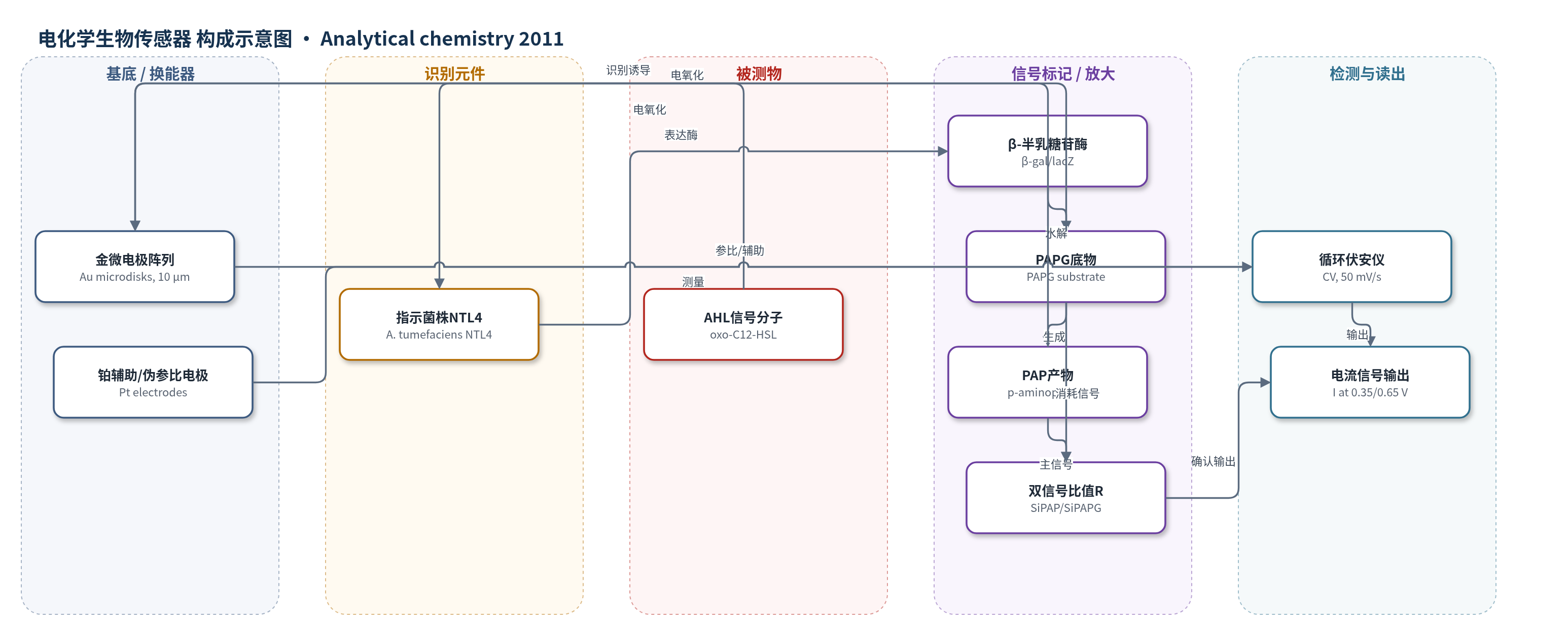
点击图片查看大图 · 依据论文自动绘制
传感器类型
电化学生物传感器
检测对象
N-酰基高丝氨酸内酯(AHLs,模型 oxo-C12-HSL/3-oxo-C12-HSL);样品基质:液体培养物、人工唾液、P. aeruginosa 培养上清
检测原理
AHL 进入样品后被指示菌株 Agrobacterium tumefaciens NTL4 识别,激活 AHL 响应启动子,诱导 lacZ/β-gal 表达,形成全细胞生物放大。β-gal 将 PAPG 不可逆水解为 PAP。PAP 在金微电极表面发生可逆两电子氧化,约 0.35 V vs Pt 产生氧化峰,峰电流随 PAP 浓度增加;PAPG 在约 0.65 V vs Pt 氧化,随酶促消耗其峰电流下降。循环伏安法同时记录两个信号,并计算双信号比值 R=(SiPAP/SiPAPG)/(BiPAP/BiPAPG) 进行归一化。AHL 浓度越高,β-gal 表达越多,PAP 峰越高、PAPG 峰越低,R 越大。微电极阵列提高传质速率,使 20 μL 样品在 2 h 孵育后数秒内完成测量。
检测灵敏度
LOD: 2 pM(液体培养物,0.5 mg/mL PAPG,PAP 产生信号,2 h 和 5 h);LOD: 3 pM(R-LOD,液体培养物,5 h);LOD: 14 pM(R-LOD,人工唾液,2 h);LOD: 10 pM(R-LOD,人工唾液,5 h);LOD: 8 pM(人工唾液,PAP 产生信号,2 h);LOD: 0.7 nM(人工唾液,PAPG 消耗信号,2 h);LOD: 0.1 nM(人工唾液,PAPG 消耗信号,5 h);LOD: 10 pM(PAP 直接检测)
效应效果
重现性良好,多数浓度 %CV 低于 5%,所有条件 %CV 低于 8%。方法无需前处理或预浓缩,20 μL 样品、2 h 孵育即可检测低 pM 至低 nM oxo-C12-HSL。双信号确认提高可靠性,阴性对照无响应。P. aeruginosa 过夜上清 1:10 稀释估算约 4.5–4.8 nM,1:100 为 3.6–4.6 nM;5×10^7 CFU/mL 富集 5 h 相当于 5–5.5 nM。作者认为其比 HPLC-MS 和报告菌株薄层色谱法更快、更简便,适合临床样品 AHL 快速筛查。
传感器的构成
- 基底/换能器电极:硅片热氧化层上 Ti/Ni/Au 金属化,金微电极阵列(Au microdisks,半径 10 μm)与 Pt 伪参比/辅助电极,用于循环伏安法电化学换能。
- 识别元件:工程化指示菌株 Agrobacterium tumefaciens NTL4 (pZLR4),含 AHL 响应启动子控制的 traG::lacZ/β-gal 报告基因,用于识别 AHL 并诱导 β-gal 表达。
- 信号底物:4-aminophenyl β-D-galactopyranoside (PAPG),β-gal 底物且电活性,用于被水解并在约 0.65 V vs Pt 产生氧化信号。
- 信号产物:p-aminophenol (PAP),β-gal 水解 PAPG 产生的电活性产物,在约 0.35 V vs Pt 氧化,用于主电化学信号。
- 孵育/反应体系:样品(液体培养物、人工唾液或 P. aeruginosa 上清)与 NTL4 和 PAPG 混合,30°C 孵育 2 h,使 AHL 诱导 β-gal 并水解 PAPG。
中文摘要
N-酰基高丝氨酸内酯(AHLs)由革兰氏阴性菌产生,以细胞密度依赖方式调控基因表达。例如,铜绿假单胞菌等病原菌只有在 AHL 达到阈值浓度时才诱导毒力因子表达,提示细菌群体已足以引发感染。本研究使用携带 β-半乳糖苷酶(β-gal)报告基因、且该基因受群体感应启动子控制的指示菌株 Agrobacterium tumefaciens NTL4 (pZLR4),开发了一种检测 AHLs 的电化学生物传感器。研究以 N-(3-氧代)-十二酰基-L-高丝氨酸内酯(oxo-C12-HSL)为模型分子,该 AHL 曾在感染铜绿假单胞菌的囊性纤维化患者中被检出。传感器以 4-氨基苯基-β-D-半乳糖吡喃苷(PAPG)为底物,通过循环伏安法检测 β-gal 活性;同时监测 PAPG 消耗和 p-氨基苯酚(PAP)生成,实现芯片上双信号确认。该传感器重现性高,可在加标液体培养和人工唾液中准确检测低皮摩尔至低纳摩尔范围的 oxo-C12-HSL,并检测铜绿假单胞菌培养上清中天然释放的 AHLs。检测仅需 2 h,无需样品前处理或预浓缩,比传统方法更简便、快速。
英文摘要
n-Acyl homoserine lactones (AHLs) are produced by gram-negative bacteria to regulate gene expression in a cell density dependent manner. For instance, expression of virulence factors by pathogens such as Pseudomonas aeruginosa is induced only when a threshold concentration of AHLs is reached, which indicates that the bacterial population is big enough to promote infection. In this study, the indicator strain Agrobacterium tumefaciens NTL4 (pZLR4), which carries a β-galactosidase (β-gal) reporter gene under the control of a quorum sensing promoter, was used to develop an electrochemical biosensor to detect AHLs using the model n-(3-oxo)-dodecanoyl-L-homoserine lactone (oxo-C12-HSL), an AHL previously detected in cystic fibrosis patients infected with P. aeruginosa. The substrate 4-aminophenyl β-D-galactopyranoside was used to detect β-gal activity by cyclic voltammetry. Furthermore, simultaneous monitoring of substrate consumption and p-aminophenol production by β-gal allowed on-chip result verification by dual-signal confirmation. The sensor exhibited high reproducibility and accurately detected oxo-C12-HSL in a low picomolar to low nanomolar range in spiked liquid cultures and artificial saliva, as well as AHLs naturally released by P. aeruginosa in culture supernatants. Moreover, detection took just 2 h, required no sample pretreatment or preconcentration steps, and was easier and faster than traditional methods.