组成图示
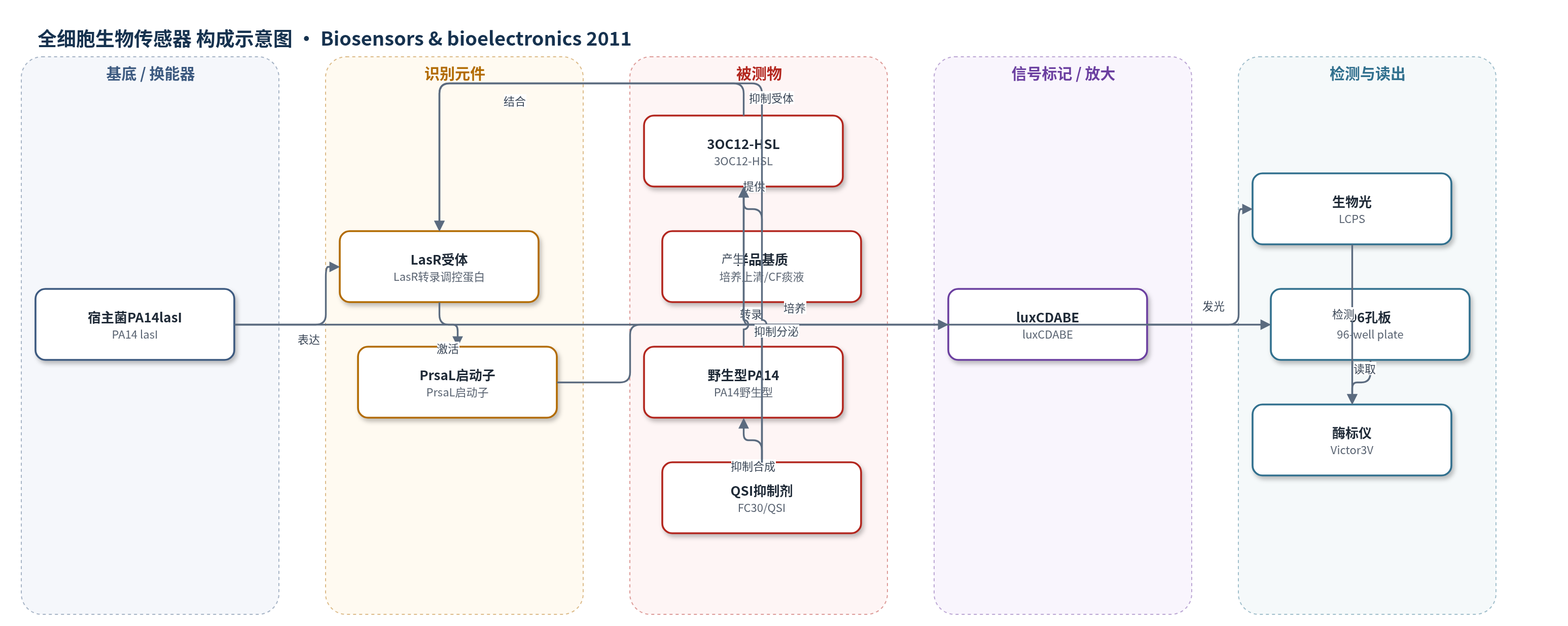
点击图片查看大图 · 依据论文自动绘制
传感器类型
全细胞生物传感器
检测对象
N-3-氧代十二酰基高丝氨酸内酯(3OC12-HSL);样品基质:铜绿假单胞菌培养上清、囊性纤维化(CF)患者痰液上清
检测原理
PA14-R3以铜绿假单胞菌PA14 lasI突变株为宿主,该菌表达LasR受体但不能合成3OC12-HSL。当样品中的3OC12-HSL进入细胞并与LasR结合后,LasR-3OC12-HSL复合物激活LasR依赖的PrsaL启动子,驱动luxCDABE发光操纵子转录。luxCDABE编码的荧光素酶系统利用内源底物产生生物发光,发光强度以每秒光计数(LCPS)表示,并按OD600细胞密度归一化。随着3OC12-HSL浓度升高,PrsaL转录激活增强,发光信号相应增加;在152 pM–12 nM范围内呈线性,在1.4 nM–3 μM范围内与浓度对数呈线性。该过程通过启动子转录放大和发光酶级联实现信号放大,无需外源底物。
检测灵敏度
LOD: 10 pM;线性范围: 152 pM–12 nM;对数线性范围: 1.4 nM–3 μM
效应效果
PA14-R3对3OC12-HSL选择性高:C6-HSL和C8-HSL在100 μM以下无响应,C4-HSL和C10-HSL检测限分别为10 μM和100 μM,较3OC12-HSL的10 pM高6和7个数量级。CF痰液成分不干扰检测,阴性痰液不激活传感器,含痰液样品响应与Sputasol对照相当。20例CF患者中15例痰液检出铜绿假单胞菌,8例测得3OC12-HSL为7–237 nM,与细菌载量无明显相关。PrsaL::luxCDABE整合于染色体,系统稳定、重现性好,可在96孔板中约4 h完成微体积定量。共培养QSI筛选中,10 μM FC30使PAO1的3OC12-HSL产量降低约50%,并使PA14-R3/PA14共培养发光降低约50%,验证了高通量筛选能力。
传感器的构成
- 宿主菌/换能器:Pseudomonas aeruginosa PA14 lasI 突变株,表达 LasR 且不产生 3OC12-HSL,作为识别与信号转导平台
- 识别元件:LasR 转录调控蛋白,特异性结合 3OC12-HSL 并激活 PrsaL
- 报告基因/信号标记物:luxCDABE 发光操纵子,受 PrsaL 控制,产生生物发光
- 遗传元件:PrsaL::luxCDABE 转录融合,将 3OC12-HSL 识别事件转化为发光输出
- 载体/整合系统:mini-CTX 质粒经 Flp 重组整合至 attB 中性位点,实现单拷贝稳定表达
- 检测体系:LB 培养基与 96 孔板微体积培养,支持细胞生长与发光测量
- 校准标准:已知浓度 3OC12-HSL 标准曲线,用于定量样品中信号分子浓度
中文摘要
N-3-氧代十二酰基高丝氨酸内酯(3OC12-HSL)是人类病原菌铜绿假单胞菌产生的主要群体感应(QS)信号分子,与医院感染及囊性纤维化(CF)患者肺部慢性生物膜感染密切相关,是开发抗假单胞菌药物的潜在靶点。然而,现有群体感应抑制剂(QSI)筛选系统多针对3OC12-HSL信号识别而非其合成或分泌,且CF痰液中3OC12-HSL浓度低,限制了大规模研究。本文构建并表征了一种新型全细胞生物传感器PA14-R3,用于3OC12-HSL的定量检测。PA14-R3可在皮摩尔至微摩尔宽浓度范围内快速、直接定量3OC12-HSL,操作简便、成本低、可靠性高,适用于不同来源样品(包括CF痰液)中3OC12-HSL水平的高通量检测。基于PA14-R3与野生型PA14共培养,还建立并验证了一种新型高通量QSI筛选系统,可识别靶向3OC12-HSL合成、分泌及信号识别等关键过程的化合物。
英文摘要
N-3-oxo-dodecanoyl-homoserine lactone (3OC(12)-HSL) is the main quorum sensing (QS) signal produced by the human pathogen Pseudomonas aeruginosa, a major cause of hard-to-treat nosocomial infections and years-lasting chronic biofilm infections in the lungs of cystic fibrosis (CF) patients. 3OC(12)-HSL-dependent QS is considered a promising target for novel anti-pseudomonads drugs. However, the screening systems employed to date for the identification of QS inhibitors (QSI) were aimed at the identification of inhibitors of 3OC(12)-HSL signaling rather than of the synthesis or the export of this molecule. Moreover, the low concentration of 3OC(12)-HSL in CF sputum has hampered large scale studies aimed at addressing the role of this molecule in the CF lung infection. Here we describe the construction and characterization of PA14-R3, a new whole-cell biosensor for the quantitative detection of 3OC(12)-HSL. PA14-R3 provides fast and direct quantification of 3OC(12)-HSL over a wide range of concentrations (from pM to μM), and proved to be an easy-to-handle, cost-effective and reliable biosensor for high-throughput screening of 3OC(12)-HSL levels in samples of different origin, including CF sputum. Moreover, the specific features of PA14-R3 made it possible to develop and validate a novel high-throughput screening system for QSI based on the co-cultivation of PA14-R3 with the PA14 wild-type strain. With respect to previous screening systems for QSI, this approach has the advantage of being cost-effective and allowing the identification of compounds targeting, besides 3OC(12)-HSL signaling, any cellular process critical for QS response, including 3OC(12)-HSL synthesis and secretion.