组成图示
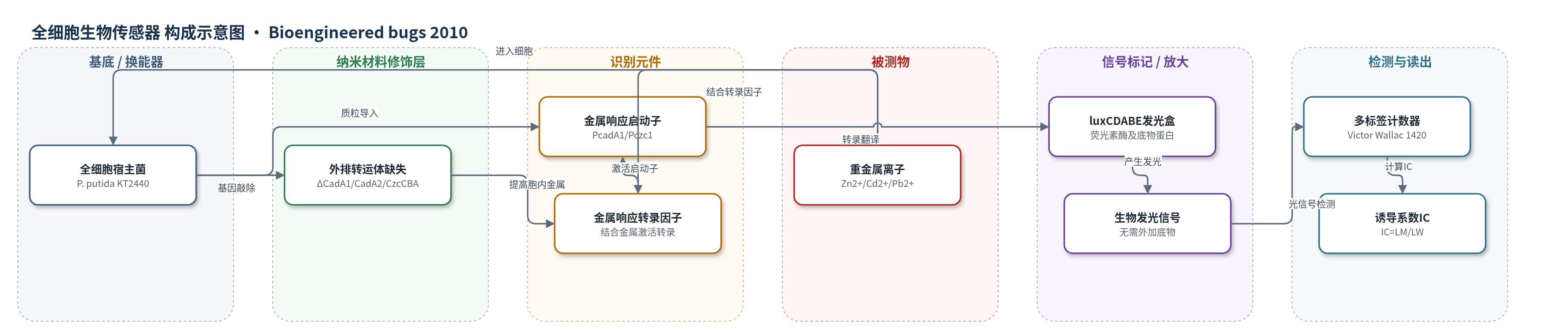
点击图片查看大图 · 依据论文自动绘制
传感器类型
全细胞生物传感器
检测对象
锌离子 Zn2+、镉离子 Cd2+、铅离子 Pb2+;样品基质为水溶液/土壤悬浮液(人工加标土壤)
检测原理
重金属离子进入全细胞宿主菌后,在正常菌株中会被 CadA1、CadA2、CzcCBA1 和 CzcCBA2 等外排泵排出;在突变株 KT2440.2431 中这些外排转运体被敲除,金属离子在胞内积累。积累的 Zn2+、Cd2+ 或 Pb2+ 与金属响应转录因子结合,使 PcadA1 或 Pczc1 启动子激活,驱动 luxCDABE 发光操纵子转录翻译。荧光素酶及其底物合成蛋白表达后催化底物氧化,产生生物发光。发光强度随胞内金属浓度升高而增强,以诱导系数 IC=LM/LW 表示,从而实现重金属浓度的定量检测。该策略通过破坏金属稳态实现信号放大,降低检测限。
检测灵敏度
LOD: P. putida KT2440.2431(pDNPczc1lux) Zn2+ 0.05 (0.02) μM; Cd2+ 0.09 (0.05) μM; Pb2+ 0.02 (0.02) μM;P. putida KT2440.2431(pDNPcadA1lux) Zn2+ 0.12 (0.08) μM;Cd2+ 0.02 μM(3 h);Cd2+ 0.008 μM(更长孵育);Zn2+ 0.05 μM (3.3 μg/l)
效应效果
与野生型相比,KT2440.2431(pDNPczc1lux) 对 Pb2+、Cd2+、Ni2+ 和 Zn2+ 的检测浓度分别降低 45 倍、12 倍、10 倍和 3 倍;KT2440.2431(pDNPcadA1lux) 对 Zn2+ 的检测浓度比野生型低约 8 倍,且仅被 Zn2+ 诱导,具有锌特异性。该菌株检测 Zn2+ 的浓度比现有其他锌生物报告器低约 50 倍。在人工加标土壤中,野生型 KT2440(pDNPcad1lux) 可检测含 65 mg/kg Zn2+ 的土壤,突变型可检测低至 20 mg/kg Zn2+;在 654 mg/kg Zn2+ 加标土壤稀释系列中,突变型比野生型低约 10 倍检测锌。数据为至少三次独立实验的均值±标准差,未报告 RSD。检测限低于欧盟水和土壤中锌、铅限值,可用于环境风险评估。
传感器的构成
- 基底/换能器:Pseudomonas putida KT2440 或外排缺陷突变株 KT2440.2431,作为全细胞传感基质,介导金属离子进入、积累与响应。
- 遗传修饰层:低拷贝质粒 pDNPcadA1lux 或 pDNPczc1lux,携带金属响应启动子与 luxCDABE 报告基因融合盒。
- 识别元件:PcadA1 或 Pczc1 启动子及金属响应转录因子,识别 Zn2+/Cd2+/Pb2+ 并启动报告基因转录。
- 信号标记物:luxCDABE 发光操纵子(来自 Photorhabdus luminescens),表达荧光素酶及底物合成蛋白,产生生物发光。
- 反应介质:重金属 MOPS 培养基(HMM)及 MilliQ 水/土壤悬浮液,用于培养、诱导和样品基质。
- 读出装置:Victor Wallac 1420 多标签计数器,测量 96/384 孔板中发光强度并计算诱导系数 IC。
中文摘要
全细胞细菌生物报告器是量化环境样品中污染物生物可利用性的便捷方法。尽管已构建多种重金属生物报告器,但由于灵敏度和特异性不足,其在环境样品分析中的应用有限。本研究通过干扰宿主菌天然金属稳态系统,提高细菌生物报告器的检测限。通过敲除假单胞菌 Pseudomonas putida KT2440 中四种主要 Zn/Cd/Pb 外排转运体,使金属离子在胞内积累,基于 KT2440 的 Zn/Cd/Pb 生物传感器检测限最多提高 45 倍。通过更换传感元件可改变生物报告器的特异性:以 P. putida cadA1 基因启动子作为传感元件,可获得锌特异性生物报告器。所构建的转运体缺陷 P. putida 报告菌株检测 Zn2+ 的浓度比现有其他锌生物报告器低约 50 倍。所得检测限显著低于水和土壤中锌、铅的允许限值,可用于环境中重金属的可靠检测。
英文摘要
Whole-cell bacterial bioreporters represent a convenient testing method for quantifying the bioavailability of contaminants in environmental samples. Despite the fact that several bioreporters have been constructed for measuring heavy metals, their application to environmental samples has remained minimal. The major drawbacks of the available bioreporters include a lack of sensitivity and specificity. Here, we report an improvement in the limit of detection of bacterial bioreporters by interfering with the natural metal homeostasis system of the host bacterium. The limit of detection of a Pseudomonas putida KT2440-based Zn/Cd/Pb-biosensor was improved by a factor of up to 45 by disrupting four main efflux transporters for Zn/Cd/Pb and thereby causing the metals to accumulate in the cell. The specificity of the bioreporter could be modified by changing the sensor element. A Zn-specific bioreporter was achieved by using the promoter of the cadA1 gene from P. putida as a sensor element. The constructed transporter-deficient P. putida reporter strain detected Zn(2+) concentrations about 50 times lower than that possible with other available Zn-bioreporters. The achieved detection limits were significantly below the permitted limit values for Zn and Pb in water and in soil, allowing for reliable detection of heavy metals in the environment.