组成图示
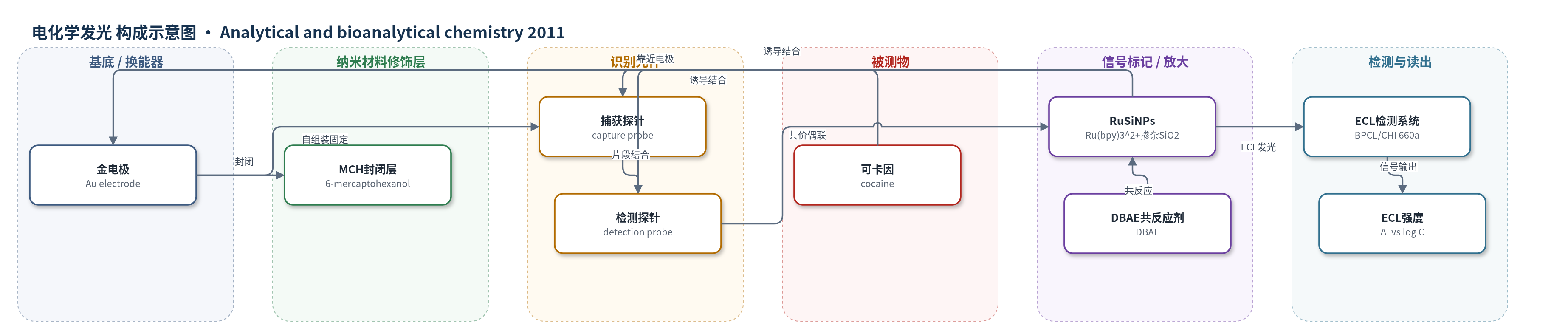
点击图片查看大图 · 依据论文自动绘制
传感器类型
电化学发光(ECL)生物传感器
检测对象
可卡因(cocaine);样品基质:纸币提取液(banknote extract)、PBS标准溶液
检测原理
该传感器将单个可卡因适配体切割为捕获探针和检测探针。捕获探针5′端硫醇自组装固定于金电极,检测探针3′端共价标记RuSiNPs。无 cocaine 时,两片段仅弱相互作用,RuSiNPs远离电极,ECL背景低。加入 cocaine 后,cocaine 与两个适配体片段形成三元复合物并稳定结合,使检测探针携带的 RuSiNPs 被固定并靠近电极表面。在 PBS 中加入 DBAE 共反应剂,循环伏安扫描至约1.20 V 氧化 Ru(bpy)3^2+,产生 ECL。cocaine 浓度越高,形成的复合物越多,靠近电极的 RuSiNPs 越多,ECL 增强值 ΔI 与 cocaine 浓度对数成正比。信号放大主要来自 RuSiNPs 的多钌发光及目标诱导片段结合拉近发光体。
检测灵敏度
LOD: 3.7×10⁻¹² mol/L(S/N=3);线性范围: 1.0×10⁻¹¹ to 1.0×10⁻⁹ mol/L;斜率: 742.5 a.u./log C;R = 0.9916
效应效果
该传感器选择性良好:5.0×10⁻¹¹ mol/L可卡因与5.0×10−9 mol/L海洛因、咖啡因对照中,仅可卡因显著增强ECL。连续循环伏安扫描8次RSD为6.5%,4°C保存10天信号稳定。纸币加标Level 1(4.85×10⁻¹⁰ mol/L)和Level 2(9.70×10⁻¹⁰ mol/L)回收率分别为89%和92%,RSD为4.4%和5.2%(表1;正文Level 1为4.7%)。作者称其检出限比同原理电化学传感器低10倍,优于固相萃取和荧光法,适用于纸币及复杂基质痕量可卡因分析。
传感器的构成
- 基底/换能器电极:金电极(Au electrode),经氧化铝抛光和0.50 mol/L H2SO4循环活化,作为ECL工作电极。
- 识别元件(捕获探针):5′-己烷硫醇标记的可卡因适配体捕获探针(capture probe,5′-HS(CH2)6-AGACAAGGAAAA-3′),通过硫醇-金键自组装固定于金表面。
- 封闭剂:6-巯基己醇(6-mercaptohexanol, MCH),封闭金表面非特异性吸附位点。
- 识别元件(检测探针):3′-氨基可卡因适配体检测探针(detection probe,5′-TCCTTCAATGAAGTGGGTGG-NH2-3′),与RuSiNPs共价偶联,在cocaine存在下与捕获探针形成三元复合物。
- 信号标记物:Ru(bpy)3^2+掺杂二氧化硅纳米颗粒(RuSiNPs,直径约55±5 nm),作为ECL发光标记。
- ECL共反应剂:2-(二丁基氨基)乙醇(2-(dibutylamino)ethanol, DBAE),作为ECL共反应剂增强发光。
中文摘要
本文报道了一种基于适配体片段诱导结合的电化学发光(ECL)“三明治”生物传感器,用于检测可卡因(cocaine)。该传感器利用单个可卡因适配体可被切割为两个片段、并在目标物存在下重新折叠形成稳定复合物的特性构建。其中,5′端带有己烷硫醇的捕获探针通过硫醇–金键自组装固定于金电极表面;3′端标记有含三(2,2′-联吡啶)钌(II)掺杂二氧化硅纳米颗粒(RuSiNPs)的检测探针则作为发光标记探针。由于两个片段间相互作用较弱,无 cocaine 时电极表面 ECL 信号较低;加入 cocaine 后,目标物诱导两个片段结合并稳定三元复合物,使 RuSiNPs 被固定并靠近电极表面,ECL 信号增强。增强 ECL 强度与 cocaine 浓度对数在 1.0×10⁻¹¹–1.0×10⁻⁹ mol/L 范围内呈线性关系,检出限为 3.7×10⁻¹² mol/L。该传感器成功应用于纸币上痕量 cocaine 的检测,结果令人满意。
英文摘要
A novel electrochemiluminescence (ECL) "sandwich" biosensor has been developed to detect cocaine. The sandwich biosensor was fabricated on the basis of the fact that a single aptamer could be split into two fragments and the two dissociated parts could form a folded, associated complex in the presence of targets. One of these (capture probe), which had hexane-thiol at its 5'-terminus, was immobilized on a gold electrode via thiol-gold binding. The other one (detection probe) was labeled with the ECL reagent tris(2,2'-bipyridyl)ruthenium(II)-doped silica nanoparticles (RuSiNPs) at its 3'-terminus. Owing to the weak interaction between the two fragments, the sensor exhibited a low ECL signal in the absence of cocaine. After the target cocaine had been added to the solution, it induced association of the two fragments and stabilized the associated complexes, leading to immobilization of RuSiNPs on the electrode surface, and the ECL detected on the electrode surface was enhanced. The enhanced ECL intensity was directly proportional to the logarithm of the cocaine concentration in the range from 1.0 × 10(-9) to 1.0 × 10(-11) mol/L, with a detection limit of 3.7 × 10(-12) mol/L. The biosensor was applied to detect trace amounts of cocaine on banknotes with satisfactory results.