组成图示
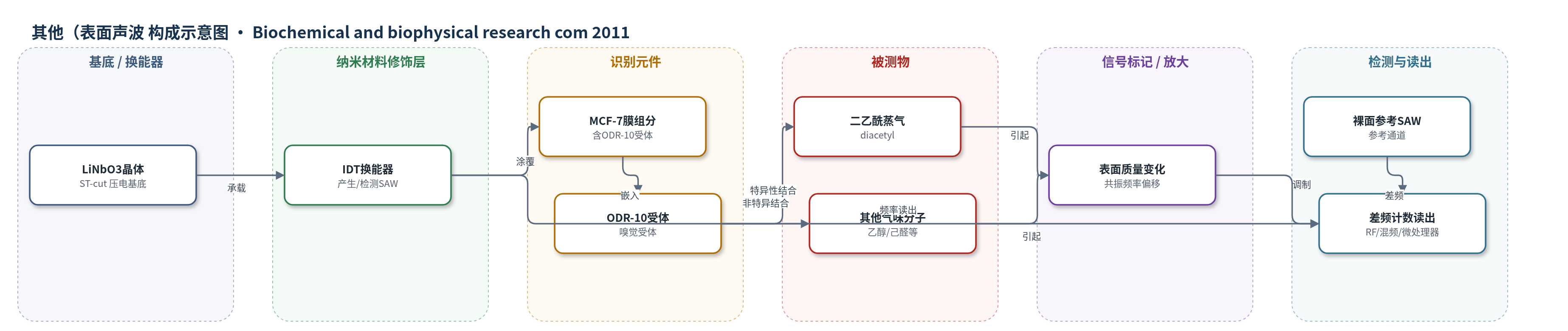
点击图片查看大图 · 依据论文自动绘制
传感器类型
其他(表面声波(SAW)生物传感器)
检测对象
二乙酰(diacetyl)、乙醇(ethanol)、丁醇(butanol)、戊二酮(pentanedione)、己醛(hexanal)、异戊酸异戊酯(isoamyl acetate);样品基质为气相气味蒸气(Tedlar袋/密封检测室)
检测原理
该传感器以ST-cut LiNbO3晶体为压电基底,IDT在表面激发并检测SAW。含ODR-10的MCF-7膜组分涂覆于IDT间敏感区,使受体保留在类膜环境中。当气味分子(尤其是二乙酰)与ODR-10结合时,受体构象及膜界面质量/黏弹性质发生变化,导致SAW传播特性改变,表现为共振频率偏移。工作传感器与裸面参考传感器构成差频检测,RF放大器、混频器、低通滤波器、比较器和微处理器频率计数器将频率差转换为计数信号。气味浓度越高,结合量或界面质量变化越大,频率偏移越大,从而获得剂量依赖响应。
检测灵敏度
LOD: 10^-10 mM;线性范围: 10^-10–10^-4 mM;灵敏度: 2 kHz/ng
效应效果
该传感器对ODR-10天然配体二乙酰具有明显选择性:在1 nM气味测试中,ODR-10涂覆传感器对二乙酰的频率偏移比未涂传感器大4倍,而乙醇、丁醇、戊二酮、己醛和异戊酸异戊酯响应显著较小,可能来自非特异吸附。膜组分涂覆重复性较好,14次涂覆间频率偏移差异小于2 kHz。二乙酰剂量响应在10^-10至10^-4 mM范围内呈浓度依赖,灵敏度为2 kHz/ng,最低检测浓度10^-10 mM,较此前报道低10倍。作者认为该SAW生物传感器可高效表征嗅觉受体气味响应谱,并有望用于食品、生物医学和环境保护等领域。
传感器的构成
- 基底/换能器:ST-cut LiNbO3压电晶体,承载表面声波并实现质量变化到频率变化的换能
- 换能电极:IDT叉指换能器,产生和检测中心频率120.1 MHz的SAW
- 识别元件:MCF-7细胞膜组分(含异源表达ODR-10嗅觉受体),涂覆于IDT间敏感区,维持受体膜环境并识别气味分子
- 参考通道:裸面SAW传感器,作为参考消除环境漂移
- 信号处理电路:Cascade RF放大器、混频器、低通滤波器、比较器、微处理器频率计数器,输出差频/方波并计数
- 样品引入/检测室:密封六角瓶(带进出气口)、Tedlar袋和注射泵,引入气味蒸气并用N2清洗
中文摘要
嗅觉受体负责感知气味分子,是哺乳动物中最大的G蛋白偶联受体(GPCR)家族,在化学信号检测与向脑信号转导中发挥重要作用。目前仅有少数嗅觉受体被功能表征,主要原因是缺乏高灵敏、高效的受体功能检测工具。本文报道一种新型表面声波(SAW)生物传感器,用于高灵敏嗅觉受体功能检测。研究将秀丽隐杆线虫嗅觉受体ODR-10异源表达于人乳腺癌MCF-7细胞质膜上,作为模型系统;随后提取含ODR-10的细胞膜组分并涂覆整合到SAW传感器表面。通过记录SAW共振频率偏移,监测ODR-10对不同气味分子的响应。结果表明,ODR-10可特异性响应其天然配体二乙酰(diacetyl),并在不同浓度下呈现剂量依赖响应。该传感器灵敏度为2 kHz/ng,可检测低至10^-10 mM的浓度,较此前报道低10倍。该传感器可用于表征嗅觉受体气味响应谱,为GPCR功能研究及食品、生物医学和环保应用提供数据支持。
英文摘要
Olfactory receptors, which are responsible for sensing odor molecules, form the largest G protein-coupled receptor (GPCR) family in mammalian animals. These proteins play an important role in the detection of chemical signals and signal transduction to the brain. Currently, only a limited number of olfactory receptors have been characterized, which is mainly due to the lack of sensitive and efficient tools for performing functional assays of these receptors. This paper describes a novel surface acoustic wave (SAW)-based biosensor for highly sensitive functional assays of olfactory receptors. An olfactory receptor of Caenorhabditis elegans, ODR-10, was expressed on the plasma membrane of human breast cancer MCF-7 cells, which was used as a model system for this study. For specific odorant response assays, the membrane fraction of MCF-7 cells containing ODR-10 was extracted and integrated with our SAW sensors. The response of ODR-10 to various odorants was monitored by recording the resonance frequency shifts of SAWs applied to the sensor. Our results show that heterologously expressed ODR-10 receptors can specifically respond to diacetyl, its natural ligand. Dose-dependent responses were obtained by performing measurements using various concentrations of diacetyl. The sensitivity of this biosensor is 2kHz/ng and can detect concentrations as low as 10(-10)mM, which is 10× lower than what has previously been reported. This biosensor can be used to characterize odorant response profiles of olfactory receptors and provide information rich data for functional assays of olfactory receptors. In addition to providing a greater understanding of the biological mechanisms of GPCRs, such data holds great potential in many other fields such as food industry, biomedicine, and environmental protection.