组成图示
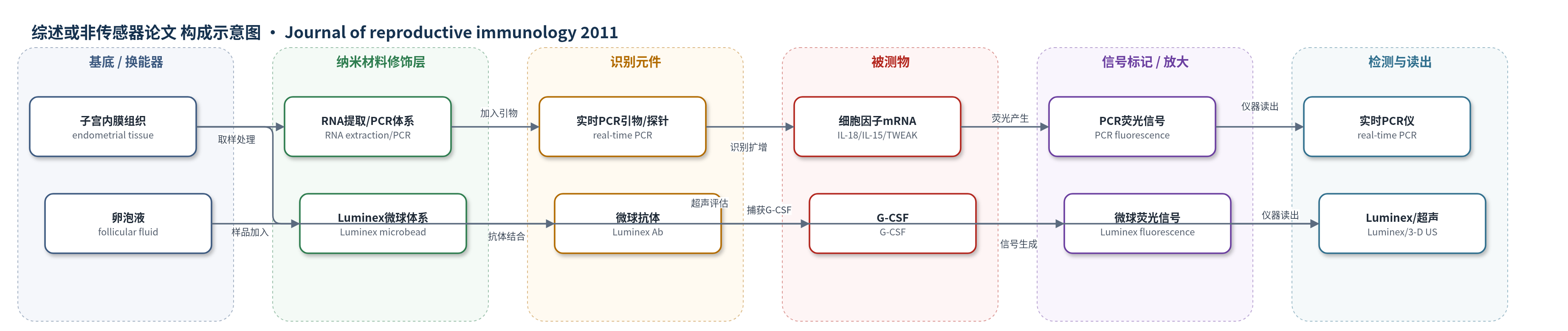
点击图片查看大图 · 依据论文自动绘制
传感器类型
综述或非传感器论文
检测对象
白细胞介素-18(IL-18)、白细胞介素-15(IL-15)、肿瘤坏死因子弱凋亡诱导剂(TWEAK):子宫内膜组织;粒细胞集落刺激因子(G-CSF):卵泡液
检测原理
本文并非单一传感器,而是多种生物标志物检测策略。子宫内膜侧通过实时PCR检测IL-18、IL-15、TWEAK/Fn-14 mRNA:RNA经提取后,引物/探针特异性结合模板,PCR循环中指数扩增,荧光信号随模板拷贝数增加而增强,从而反映子宫内膜免疫与血管状态。卵泡液侧采用Luminex微球多重夹心免疫分析:微球表面捕获抗体结合G-CSF,检测抗体或荧光标记物形成夹心复合物,微球荧光强度随G-CSF浓度升高而增强,可同步检测多种细胞因子。三维超声通过血流指数辅助评估uNK募集和血管生成。
检测灵敏度
相关系数: r = 0.71(卵泡液G-CSF两个周期间相关性);未报告LOD、线性范围、灵敏度斜率。
效应效果
卵泡液G-CSF区分种植与未种植胚胎AUCROC=0.82(0.73–0.89,p=0.0001),高于形态学0.65–0.70;低G-CSF(<20 pg/ml)与高G-CSF(>24 pg/ml)种植率9%对44%(p<0.001)。200胚胎队列中仅Luminex微球技术达所需灵敏度,优于ELISA。83名改良自然IVF/ICSI女性中,G-CSF预测活产AUCROC=0.81(p<0.0001),联合第2天形态评分AUCROC=0.86(p<0.0001);高G-CSF组每次取卵活产率38%,低组5%(p<0.0001)。两周期G-CSF相关r=0.71(p=0.008)。
传感器的构成
- 样品基质:子宫内膜组织(endometrial tissue)与卵泡液(follicular fluid),分别用于mRNA和细胞因子蛋白检测
- 核酸定量体系:实时PCR(real-time PCR)反应体系,用于扩增并定量IL-18、IL-15、TWEAK/Fn-14 mRNA
- 蛋白定量体系:Luminex微球多重夹心免疫分析(microbead-based multiplex sandwich immunoassay),用于检测卵泡液G-CSF等27种细胞因子/趋化因子
- 辅助读出:三维超声(3-D ultrasonography)评估子宫内膜下血流指数,辅助判断uNK募集与血管生成
中文摘要
识别最佳子宫容受性和卵母细胞能力的生物标志物有望提高辅助生殖技术(ART)效率。IVF/ICSI种植失败患者与可育对照相比,子宫内膜白细胞介素-15(IL-15)和白细胞介素-18(IL-18)表达不同,并与局部子宫自然杀伤细胞(uNK,CD56+)募集及血管生成相关。肿瘤坏死因子弱凋亡诱导剂(TWEAK)在小鼠中可保护胚胎,人类研究提示其可调节uNK细胞的IL-18相关细胞毒性。在非受孕周期黄体中期子宫内膜组织中,通过实时PCR定量IL-18、TWEAK和IL-15 mRNA,可记录子宫容受性阶段的生理事件,有助于理解反复IVF/ICSI失败机制:必要细胞因子耗竭或过量导致局部细胞毒性均可损害胚胎种植。卵泡液粒细胞集落刺激因子(G-CSF)浓度可作为受精前卵母细胞能力的生物标志物。人和动物模型还提示子宫内膜可作为胚胎质量的生物传感器。
英文摘要
Identification of biomarkers of optimal uterine receptivity to the implanting embryo as well as biomarkers of oocyte competence would undoubtedly improve the efficiency of assisted reproductive technology (ART). Expression of IL-15 and IL-18 has been shown to be different in patients with failed implantation after IVF/ICSI compared with fertile controls and both correlate with local uNK (CD56+) recruitment and angiogenesis. Tumor necrosis factor weak inducer of apoptosis (TWEAK) has been described in mice as a potent early immune regulator able to protect the conceptus. The results of our studies in human suggest that TWEAK modulates the IL-18 related cytotoxicity of uNK cells. Quantification of IL-18, TWEAK and IL-15 mRNA expression by real-time PCR in endometrial tissue collected in mid-luteal phase of non-conception cycles allowed documentation of physiological events that occur at the time of uterine receptivity. Such information may be useful for the physician especially in patients where embryos fail to implant. Cytokine quantification may assist in understanding the mechanisms leading to repeated IVF/ICSI failure: either depletion of cytokines necessary for the apposition-adhesion, or an excess of cytokines leading to local cytotoxicity, may impair the implantation of the embryo. Other new data suggest that a pre-conception dialogue mediated by the oocyte and the follicular fluid and the oocyte may contribute to later implantation success. Follicular concentration of G-CSF appears as a useful biomarker of oocyte competence before fertilization. Moreover both in human and animal models, evidence of a role of the endometrium as a biosensor of the embryo is emerging.