组成图示
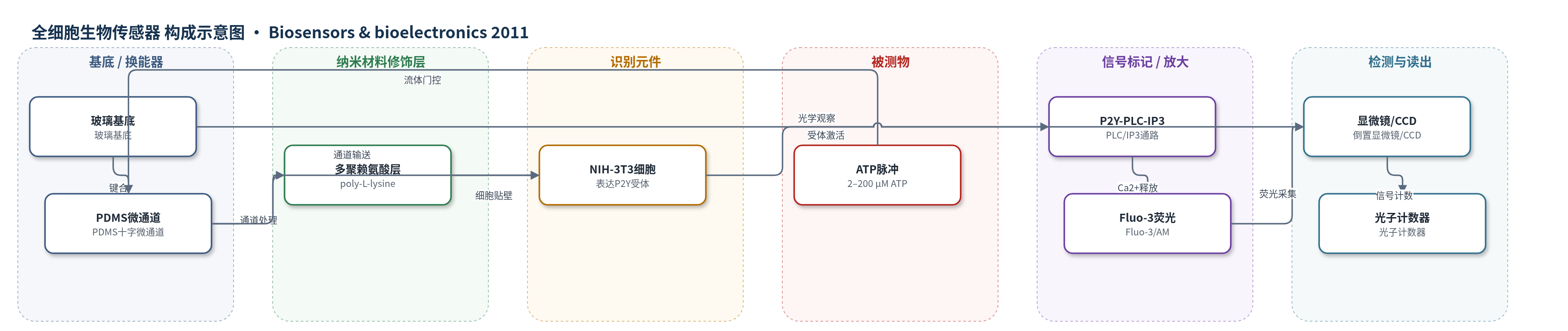
点击图片查看大图 · 依据论文自动绘制
传感器类型
全细胞生物传感器
检测对象
ATP(三磷酸腺苷,ATP);样品基质:液体环境中的 ATP 溶液(Tyrode's buffer 模拟)
检测原理
ATP 溶液在负压控制下经流体门控注射进入十字形微通道,形成毫秒级脉冲并到达贴壁 NIH-3T3 细胞。ATP 与细胞表面 P2Y 受体(主要为 P2Y2)结合后,激活 G 蛋白偶联受体通路,使磷脂酶 C(PLC)水解 PIP2 生成 IP3 和 DG;IP3 结合内质网 IP3 受体,促使内质网释放 Ca2+,细胞内 Ca2+ 浓度升高。预加载的 Fluo-3/AM 进入细胞后被酯酶水解为 Fluo-3,与 Ca2+ 结合后荧光增强。倒置显微镜、CCD 和光子计数器记录荧光变化,钙峰幅度随 ATP 浓度增加而增大。100 ms 短脉冲和 50 s 间隔使受体脱敏最小化,从而维持重复检测能力。
检测灵敏度
灵敏度: 2 μM;P2Y2 EC50: ∼1 μM
效应效果
该传感器在 100 ms、50 s 间隔的 20 μM ATP 脉冲下钙峰幅度保持相近,另 6 个细胞结果一致,重复使用性能良好。脉冲发生器峰高 RSD 为 0.2%(n=20),100 ms 脉冲上升/下降时间为 17±0.3 ms 和 18±0.2 ms(n=10),最小溶液交换时间约 7 ms。缓冲液脉冲不引起钙瞬变且细胞形态不变,剪切应力干扰小。2 μM ATP 可产生显著钙响应;温度低于 28 °C 时毫秒刺激无响应,25 °C 响应时间 2.15±0.80 s(n=8),37 °C 毫秒刺激约 500 ms。50 ms 的 20 μM ATP 脉冲可产生与持续刺激相近的钙响应。作者认为该 μCBB 适合检测脉冲式 ATP 样品并延长使用时间。
传感器的构成
- 基底/微流控结构:玻璃基底与 PDMS 十字形微通道(宽120 μm、高40 μm),由 SU-8 模具成型并等离子键合,提供细胞培养与样品流动通道
- 储液/进样结构:石英管储液池连接样品、缓冲液及废液口,配合负压系统实现流体门控注射
- 细胞粘附层:0.1% poly-L-lysine 处理微通道,促进 NIH-3T3 细胞贴壁
- 识别元件:单个 NIH-3T3 成纤维细胞,表达内源 P2Y 受体(RT-PCR 显示 P2Y2 为主),识别 ATP
- 信号标记物:Fluo-3/AM 钙荧光指示剂,进入细胞后水解为 Fluo-3,结合 Ca2+ 产生荧光
- 样品/缓冲液:Tyrode's buffer 与 ATP 溶液(2、20、200 μM),作为流动相和模拟被测物
- 读出系统:倒置显微镜、CCD 相机与光子计数器,采集钙荧光信号
中文摘要
细胞基生物传感器的应用常受细胞表面受体在激动剂持续刺激下发生脱敏的限制。本文报道了一种用于液体环境中检测三磷酸腺苷(ATP)的微流控细胞基生物传感器(μCBB)。该传感器集成了毫秒级化学脉冲发生器,并以单个表达内源性 P2Y 受体的 NIH-3T3 细胞作为识别元件。研究采用 ATP 溶液模拟输入信号,通过控制十字形微流控芯片两个出口处的负压,基于流体门控注射产生 ATP 脉冲。当以 100 ms 脉冲、50 s 间隔引入 ATP 时,细胞钙峰幅度保持在相近水平,表明受体脱敏被显著抑制。因此,该 μCBB 可用于检测脉冲式样品并延长使用时间。作者进一步测定了传感器对 ATP 的灵敏度,并比较了毫秒级 ATP 脉冲与长时间持续刺激下细胞钙响应的差异。
英文摘要
The use of cell-based biosensors is usually limited by agonist-induced desensitization of cell-surface receptors. In this work, a microfluidic cell-based biosensor (μCBB) was developed for the detection of ATP in liquid environments. It consists of a millisecond chemical pulse generator for sample introduction in a pulsatile manner and a single NIH-3T3 cell expressing endogenous P2Y receptors as the sensing element. ATP solutions were used to simulate input signals for investigating the μCBB. By controlling negative pressures on two outlets of a cross-shaped microfluidic chip, pulses of ATP solutions were generated based on hydrodynamic gated injection. With ATP pulses of 100 ms every 50s, the amplitude of the resulting calcium spikes maintained at a similar level, suggesting that the receptor desensitization was minimized. Consequently, the developed μCBB could be used for detecting pulsatile samples with extended use times. The sensitivity of the μCBB for detecting ATP was further determined and the cellular responses to millisecond ATP pulses were investigated in comparison to long-term stimulations.