组成图示
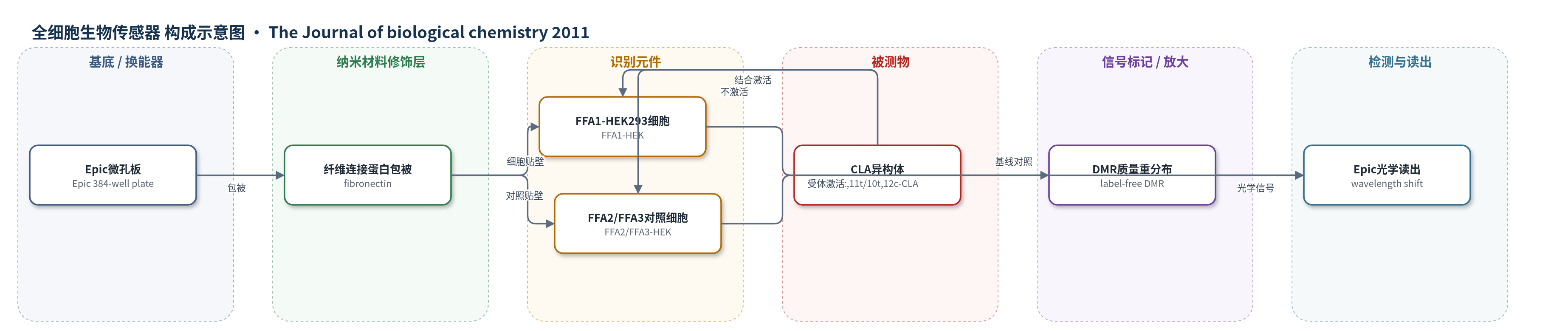
点击图片查看大图 · 依据论文自动绘制
传感器类型
全细胞生物传感器
检测对象
共轭亚油酸异构体(conjugated linoleic acids, CLAs;cis-9,trans-11-CLA、trans-10,cis-12-CLA),样品基质为细胞培养缓冲液(HBSS)及重组细胞/胰岛培养体系
检测原理
CLA 异构体与细胞膜上的 FFA1/GPR40 结合后,激活 Gq/11 偶联受体,触发磷脂酶 C 通路,使细胞内 Ca2+ 升高和肌醇磷酸积累,并引起细胞内蛋白质量重分布。Corning Epic 生物传感器以活细胞为识别与换能单元,通过光学检测细胞附近质量/折射率变化,将受体激活整合为无标签 DMR 信号。随着 CLA 浓度增加,DMR 信号呈浓度依赖性增强;FFA2/FFA3 细胞无响应,FFA1 拮抗剂 PPTQ 可阻断信号,TUG424 交叉脱敏可消除二次响应,说明信号来源于 FFA1 特异性激活。该体系无化学放大,信号放大主要来自细胞信号转导的整合效应。
检测灵敏度
原文未报告LOD、线性范围、灵敏度斜率或相关系数。
效应效果
两种 CLA 异构体在 FFA1 表达细胞中均引起浓度依赖性 Ca2+ 升高和肌醇磷酸积累,50 ng/ml PTX 预处理不影响;10 μM PPTQ 可完全阻断信号,TUG424 交叉脱敏后二次响应消失,说明 FFA1 特异性。DMR 检测中 CLA 效能高于 TUG424,且在 FFA2/FFA3 细胞中无响应,选择性良好。CLA 仅在 12 mM 高糖下增强 INS-1E 细胞和野生型小鼠胰岛的葡萄糖刺激胰岛素分泌;FFA1 敲除小鼠中 9c,11t-CLA 效应消失、10t,12c-CLA 效应明显减弱,提示部分 FFA1 非依赖机制。作者认为 FFA1 是 CLA 促胰岛素分泌的分子靶点,对 2 型糖尿病药物开发有价值。
传感器的构成
- 基底/换能器:Corning Epic 384-well microplate 与 Epic reader,承载活细胞并光学检测动态质量重分布(DMR)
- 修饰层:fibronectin 包被微孔板,促进 HEK293/1321N1 细胞贴壁
- 识别元件:FFA1-HEK293 或 FFA1-1321N1 细胞膜上稳定/诱导表达的人 FFA1(GPR40)受体
- 对照识别元件:FFA2-HEK 与 FFA3-HEK 细胞,用于脂肪酸受体选择性对照
- 信号标记物:无标签(label-free),受体激活引起细胞内蛋白质量重分布
- 读出:Epic reader 光学波长位移/DMR 信号,3600 s 实时监测
中文摘要
在膳食成分中,共轭亚油酸(CLAs)因可减少脂肪储存并增加肌肉量而受到关注,但其对葡萄糖稳态的作用机制仍不清楚。本研究证明,CLAs 可特异性激活细胞表面受体 FFA1(GPR40),该受体是治疗 2 型糖尿病的新兴靶点。作者利用稳定表达 FFA1 的多种重组细胞体系,以及包括无标签、非侵入性动态质量重分布(DMR)技术(Corning Epic 生物传感器)在内的多种功能检测,发现 cis-9,trans-11-CLA 和 trans-10,cis-12-CLA 两种异构体均能在体外激活 FFA1,且浓度足以解释体内 FFA1 激活。两种 CLA 异构体均显著增强内源性表达 FFA1 的 INS-1E 细胞及野生型小鼠原代胰岛 β 细胞在高糖条件下的葡萄糖刺激胰岛素分泌,但在 FFA1 敲除小鼠中该效应消失或明显减弱。研究建立了 CLAs 与胰岛素生成之间的机制联系,并揭示 CLAs 是常用营养补充剂中具有促胰岛素分泌作用的成分,对开发 FFA1 调节剂治疗 2 型糖尿病具有重要意义。
英文摘要
Among dietary components, conjugated linoleic acids (CLAs) have attracted considerable attention as weight loss supplements in the Western world because they reduce fat stores and increase muscle mass. However, a number of adverse effects are also ascribed to the intake of CLAs such as aggravation of insulin resistance and the risk of developing diabetes. However, the mechanisms accounting for the effects of CLAs on glucose homeostasis are incompletely understood. Herein we provide evidence that CLAs specifically activate the cell surface receptor FFA1, an emerging therapeutic target to treat type 2 diabetes. Using different recombinant cellular systems engineered to stably express FFA1 and a set of diverse functional assays including the novel, label-free non-invasive dynamic mass redistribution technology (Corning® Epic® biosensor), both CLA isomers cis-9, trans-11-CLA and trans-10, cis-12-CLA were found to activate FFA1 in vitro at concentrations sufficient to also account for FFA1 activation in vivo. Each CLA isomer markedly increased glucose-stimulated insulin secretion in insulin-producing INS-1E cells that endogenously express FFA1 and in primary pancreatic β-cells of wild type but not FFA1-/- knock-out mice. Our findings establish a clear mechanistic link between CLAs and insulin production and identify the cell surface receptor FFA1 as a molecular target for CLAs, explaining their acute stimulatory effects on insulin secretion in vivo. CLAs are also revealed as insulinotropic components in widely used nutraceuticals, a finding with significant implication for development of FFA1 modulators to treat type 2 diabetes.