组成图示
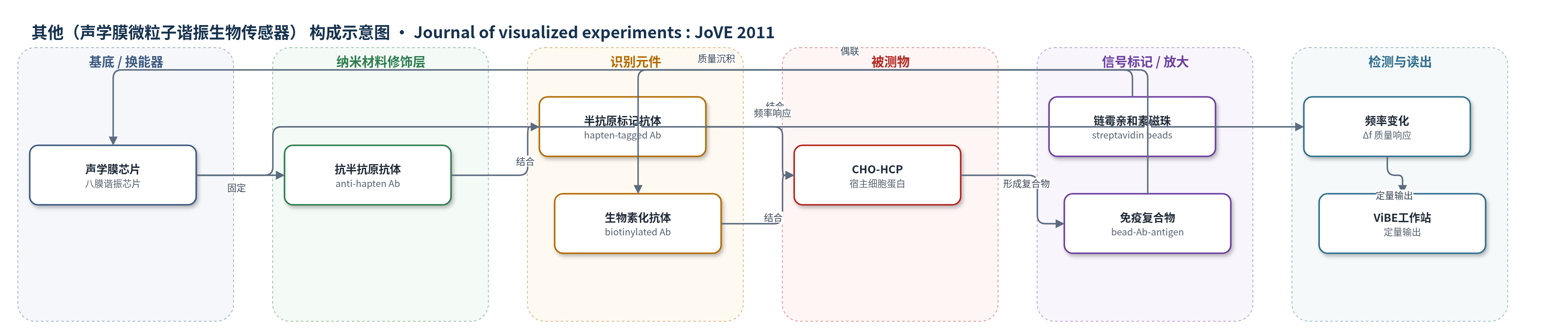
点击图片查看大图 · 依据论文自动绘制
传感器类型
其他(声学膜微粒子谐振生物传感器)
检测对象
CHO-HCP(Chinese Hamster Ovary host cell protein,仓鼠宿主细胞蛋白)、残余蛋白A(Residual Protein A)、产品滴度(Product titer)、Gadd34;样品基质:生物反应器/纯化工艺样品、肿瘤组织/细胞裂解液。
检测原理
AMMP 采用夹心免疫识别与谐振质量换能。芯片表面固定抗半抗原抗体,半抗原标记抗体结合后暴露识别位点;生物素化抗体偶联在链霉亲和素磁性微球上,在样品溶液中与 CHO-HCP 结合形成微球-抗体-抗原复合物。复合物经半抗原/抗半抗原作用沉积到膜表面,使声学膜有效质量增加,振荡频率发生可定量变化。频率偏移随结合质量增大而改变,从而反映抗原浓度。磁性微球提供较大质量信号,溶液相捕获提高低丰度目标回收,芯片可用稀酸再生实现连续分析。
检测灵敏度
—
效应效果
文中强调 AMMP 在复杂样品中提供高灵敏度、高重现性和自动化操作,可减少人工时间。对 GST-Gadd34 标准曲线,ViBE 平台使用相同抗体比 AlphaScreen 灵敏约一个数量级;在肿瘤异种移植样品中,ViBE 可获得敏感且可重复结果,而 AlphaScreen 信号随蛋白量增加被淬灭。产品滴度分析无需样品处理,仅在含超过 1000 万个细胞的无离心样品中完成定量。残余蛋白A试剂盒可用 30 分钟孵育快速检测,或延长孵育获得更宽动态范围,作者称其通常优于用户手中等效 ELISA。芯片稀酸再生支持 96 孔板多列连续分析。
传感器的构成
- 换能器基底:BioScale ViBE 八膜声学谐振芯片(acoustic membrane sensor chip),提供独立流道并随表面质量变化改变振荡频率。
- 表面功能化层:抗半抗原抗体(anti-hapten antibody)固定于膜表面,用于捕获半抗原标记抗体。
- 识别元件:半抗原标记抗体(hapten-tagged antibody)与生物素化抗体(biotinylated antibody)分别识别并夹心结合 CHO-HCP。
- 磁性微球捕获层:链霉亲和素偶联磁性微球(streptavidin magnetic beads)结合生物素化抗体,在溶液中捕获抗原。
- 封闭层:生物素化牛血清白蛋白(biotinylated BSA)封闭微球表面,降低非特异结合。
- 信号质量元件:磁性微球-抗体-抗原复合物(bead-antibody-antigen complex)结合芯片后增加膜表面质量,产生频率响应。
- 读出系统:ViBE 工作站检测振荡频率变化并定量抗原浓度。
中文摘要
针对特殊蛋白的定制检测常受限于 ELISA、Western blot 等耗时手动方法。本文介绍 BioScale 声学膜微粒子(AMMP)技术在 ViBE 平台上开发定制仓鼠宿主细胞蛋白(CHO-HCP)夹心免疫分析的流程。AMMP 通过测量微粒子结合到传感器表面引起的振荡频率变化来定量抗原浓度。系统由功能化八传感器芯片、抗体标记磁性微球、半抗原标记抗体和含目标抗原的样品组成。传感器为谐振器件,含八个独立流道膜,膜表面质量增加导致频率变化。芯片以抗半抗原抗体功能化;检测抗体经半抗原标记,捕获抗体经生物素标记并偶联链霉亲和素磁性微球,形成夹心复合物后通过半抗原/抗半抗原作用结合芯片。每次运行后可用稀酸再生,实现 96 孔板多列连续分析。该协议可推广至多种免疫分析开发。
英文摘要
Custom assays for unique proteins are often limited to time consuming manual detection and quantitation techniques such as ELISA or Western blots due to the complexity of development on alternate platforms. BioScale's proprietary Acoustic Membrane MicroParticle (AMMP) technology allows sandwich immunoassays to be easily developed for use on the ViBE platform, providing better sensitivity, reproducibility, and automated operation. Provided as an example, this protocol outlines the procedure for developing a custom Chinese Hamster Ovary- Host Cell Protein (CHO-HCP) assay. The general principles outlined here can be followed for the development of a wide variety of immunoassays. An AMMP assay measures antigen concentration by measuring changes in oscillation frequency caused by the binding of microparticles to the sensor surface to calculate. It consists of four major components: (1) a cartridge that contains a functionalized eight sensor chip (2) antibody labeled magnetic microparticles, (3) hapten tagged antibody that binds to the surface of the functionalized chip (4) samples containing the antigen of interest. BioScale's biosensor is a resonant device that contains eight individual membranes with separate fluidic paths. The membranes change oscillation frequency in response to mass accumulating on the surface and this frequency change is used to quantitate the amount of added mass. To facilitate use in a wide variety of immunoassays the sensor is functionalized with an anti-hapten antibody. Assay specific antibodies are modified through the covalent conjugation of a hapten tag to one antibody and biotin to the other. The biotin label is used to bind the antibody to streptavidin coupled magnetic beads which, in combination with the hapten-tagged antibody, are used to capture the analyte in a sandwich. The complex binds to the chip through the anti-hapten/hapten interaction. At the end of each assay run the sensors are cleaned with a dilute acid enabling the sequential analysis of columns from a 96-well plate. Here, we present the method for developing a custom CHO-HCP AMMP assay for bioprocess development. Developing AMMP assays or modifying existing assays into AMMP assays can provide better performance (reproducibility, sensitivity) in complex samples and reduced operator time. The protocol shows the steps for development and the discussion section reviews representative results. For a more in-depth explanation of assay optimization and customization parameters contact BioScale. This kit offers generic bioprocess development assays such as Residual Protein A, Product titer, and CHO-HCP.