组成图示
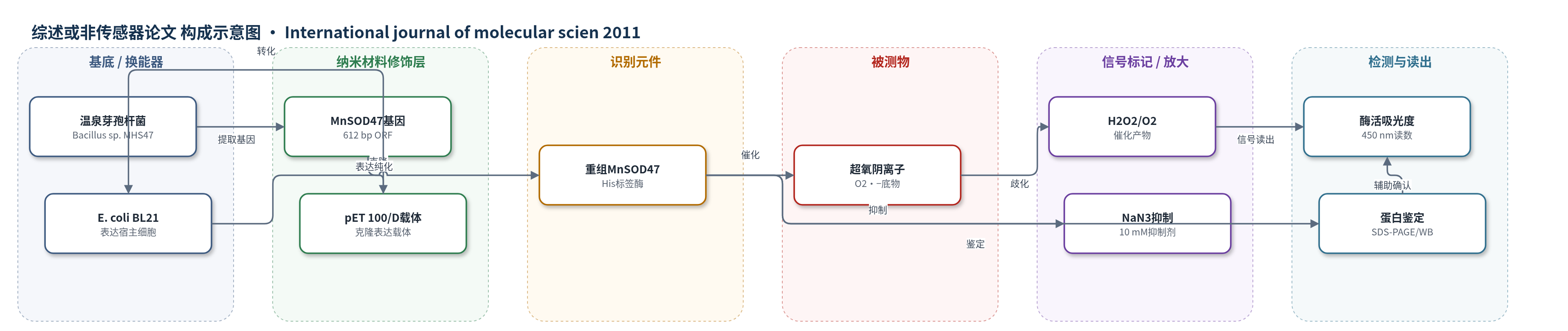
点击图片查看大图 · 依据论文自动绘制
传感器类型
综述或非传感器论文
检测对象
超氧阴离子自由基(superoxide radical, O2•−);样品基质为黄嘌呤氧化酶/次黄嘌呤酶促反应缓冲液,非临床或环境实际样品。
检测原理
本文未构建传感器,而是表征重组MnSOD47的酶学机制。MnSOD47以锰离子为活性中心,催化超氧阴离子O2•−发生歧化反应,生成H2O2和O2。在酶活测定体系中,黄嘌呤氧化酶/次黄嘌呤系统持续产生O2•−,MnSOD47消耗O2•−后,四氮唑盐被还原的程度降低,450 nm吸光度变化可反映酶活性。NaN3可抑制MnSOD47活性,而H2O2和KCN不抑制,符合锰超氧化物歧化酶的金属离子特征。该酶活变化可作为后续开发抗氧化剂或自由基检测传感器的生物识别基础,但本文未涉及电极、界面修饰或信号放大策略。
检测灵敏度
原文未报告LOD、线性范围、灵敏度斜率或相关系数。
效应效果
重组MnSOD47纯化后比活性3537.75 U/mg,回收率54.3%,纯化14倍。SDS-PAGE约27 kDa,归因于His标签;Western blot确认SOD身份。酶在pH 7–8.5、30–45 °C有活性,最适pH 7.5、37 °C;45 °C 40 min保留50%活性。NaN3抑制,H2O2/KCN不抑制,支持MnSOD属性。未报告选择性、抗干扰、重现性、回收率或方法对比。作者认为可用于MnSOD研究及抗氧化剂/自由基检测传感器开发,用于癌症风险评估。
传感器的构成
- 非传感器组成:本文未报道传感器装置,以下为本研究涉及的酶学材料链条
- 基因来源:Bacillus sp. MHS47 基因组DNA,提供MnSOD47编码序列
- 表达载体:pET 100/D TOPO 载体,用于MnSOD47基因克隆与表达
- 表达宿主:E. coli BL21(DE3),用于IPTG诱导表达重组MnSOD47
- 纯化材料:Ni-NTA/Ni-TED亲和层析树脂,用于His标签蛋白纯化
- 酶活检测:Cayman Chemical SOD Assay Kit,用于测定MnSOD47催化活性
中文摘要
本研究从热耐受芽孢杆菌Bacillus sp. MHS47中克隆、测序并表达超氧化物歧化酶基因MnSOD47。该基因开放阅读框为612 bp,对应203个推定氨基酸,与B. thuringiensis、B. anthracis、B. cereus、B. weihenstephanensis和B. pseudomycoides的锰超氧化物歧化酶序列具有较高同源性。保守的锰结合位点H28、H83、D165和H169表明MnSOD47具有MnSOD酶的典型特征。重组MnSOD47蛋白分子量约22.65 kDa,比活性为3537.75 U/mg。酶在pH 7–8.5范围内有活性,最适pH为7.5;在30–45 °C范围内有活性,最适温度为37 °C。抑制剂实验显示,NaN3可抑制其活性,而H2O2和KCN无抑制作用。这些数据有助于MnSOD研究、生物技术应用,并可能用于开发检测抗氧化剂和自由基活性的生物传感器,以及癌症风险评估与治疗研究。
英文摘要
A superoxide dismutase gene from thermotolerant Bacillus sp. MHS47 (MnSOD47) was cloned, sequenced, and expressed. The gene has an open reading frame of 612 bp, corresponding to 203 deduced amino acids, with high homology to the amino acid sequences of B. thuringiensis (accession no. EEN01322), B. anthracis (accession no. NP_846724), B. cereus (accession no. ZP_04187911), B. weihenstephanensis (accession no. YP_001646918), and B. pseudomycoides. The conserved manganese-binding sites (H28, H83, D165, and H169) show that MnSOD47 has the specific characteristics of the manganese superoxide dismutase (MnSOD) enzymes. MnSOD47 expressed an enzyme with a molecular weight of approximately 22.65 kDa and a specific activity of 3537.75 U/mg. The enzyme is active in the pH range 7-8.5, with an optimum pH of 7.5, and at temperatures in the range 30-45 °C, with an optimum temperature of 37 °C. Tests of inhibitors and metal ions indicated that the enzyme activity is inhibited by sodium azide, but not by hydrogen peroxide or potassium cyanide. These data should benefit future studies of MnSODs in other microorganisms and the biotechnological production of MnSOD47, and could also be used to develop a biosensor for the detection of antioxidants and free radical activity. In the future, this basic knowledge could be applicable to the detection of cancer risks in humans and therapeutic treatments.