组成图示
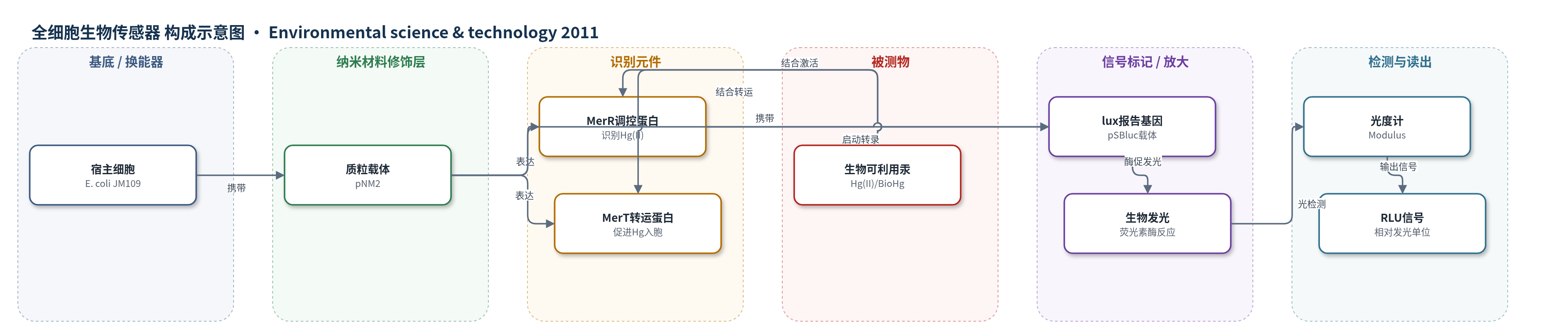
点击图片查看大图 · 依据论文自动绘制
传感器类型
全细胞生物传感器
检测对象
生物可利用汞(BioHg, Hg(II));样品基质:北极雪样(表面雪与底部雪融液)
检测原理
该传感器以工程化大肠杆菌 JM109 为全细胞换能平台。质粒 pNM2 携带来自 Cupriavidus metallidurans CH34 的 merR 与 merT 基因,以及驱动 lux 报告基因转录的操纵子/启动子。样品中的生物可利用 Hg(II) 首先被膜蛋白 MerT 识别并转运进入细胞;胞内 Hg(II) 与 MerR 调控系统相互作用,改变 mer 启动子的转录活性,诱导 lux 荧光素酶基因表达。MerT 提高 Hg(II) 入胞效率,从而增强信号灵敏度。荧光素酶催化底物氧化产生光子,发光强度随可进入细胞的 Hg(II) 浓度增加而增强,在 0.5–50 ng/L 范围内呈线性响应,最终由 Modulus 光度计以相对发光单位(RLU)读出。
检测灵敏度
LOD: 0.5 ng L-1;线性范围: 0.5–50 ng L-1
效应效果
该 mer-lux 传感器对 Hg(II) 高度特异:0–500 ng/L 下 Zn、Co、Pb、Cu、Ni、Cd 未显著诱导发光。分析重现性为 5%–15%。相比传统总汞仪器,可估计可跨膜 Hg(II) 比例。野外实测中,AMDE 期间表面雪总汞最高 148.9 ng/L,BioHg 最高 16.2 ng/L,但 AMDE 样品 BioHg/THg 低于 20%;新雪样品比例更高,底部雪比例随表面变化并显示向雪包底部迁移。作者估算 AMDEs 贡献约 20 t·y⁻¹ BioHg,干湿沉降贡献 135–225 t·y⁻¹,说明其适用于极地雪包汞生物可利用性现场监测。
传感器的构成
- 宿主细胞:E. coli JM109,作为全细胞传感平台,提供细胞膜与胞内表达环境。
- 质粒载体:pNM2,携带 merR、merT 与 lux 报告基因,实现 Hg(II) 响应型发光。
- 识别/转运元件:MerR 与 MerT,MerR 感知 Hg(II),MerT 促进 Hg(II) 进入细胞。
- 报告基因:lux 荧光素酶基因(pSBluc 载体),受 mer 操纵子/启动子调控,产生生物发光。
- 培养介质:LB 培养基 + 100 μg/mL 氨苄西林(ampicillin),维持细菌生长与质粒选择。
- 读出设备:Modulus 光度计,测量相对发光单位(RLU)。
中文摘要
极地地区受来自低纬度的汞(Hg)污染,严重威胁人与动物健康。大气汞耗竭事件(AMDEs)是汞从大气库向北极雪包转移的间歇过程。尽管沉积汞的命运已有诸多研究,但其形态仍不清楚,尤其是环境相关形态——生物可利用汞(BioHg)。本文利用细菌 mer-lux 生物传感器,测定了 2008 年北极野外考察中雪包表面与底部新沉积汞的生物可利用比例。在表面雪中,BioHg 与大气汞沉积相关,降雪事件比 AMDEs 贡献了更高比例的 BioHg。基于数据估算,AMDEs 可能向北极表面提供约 20 t·y⁻¹ 的 BioHg,而干湿沉降途径可能提供 135–225 t·y⁻¹ 的 BioHg。
英文摘要
Polar regions are subject to contamination by mercury (Hg) transported from lower latitudes, severely impacting human and animal health. Atmospheric Mercury Depletion Events (AMDEs) are an episodic process by which Hg is transferred from the atmospheric reservoir to arctic snowpacks. The fate of Hg deposited during these events is the subject of numerous studies, but its speciation remains unclear, especially in terms of environmentally relevant forms such as bioavailable mercury (BioHg). Here, using a bacterial mer-lux biosensor, we report the fraction of newly deposited Hg at the surface and at the bottom of the snowpack that is bioavailable. Snow samples were collected over a two-month arctic field campaign in 2008. In surface snow, BioHg is related to atmospheric Hg deposition and snow fall events were shown to contribute to higher proportions of BioHg than AMDEs. Based on our data, AMDEs represent a potential source of 20 t.y(-1) of BioHg, while wet and dry deposition pathways may provide 135-225 t.y(-1) of BioHg to Arctic surfaces.