组成图示
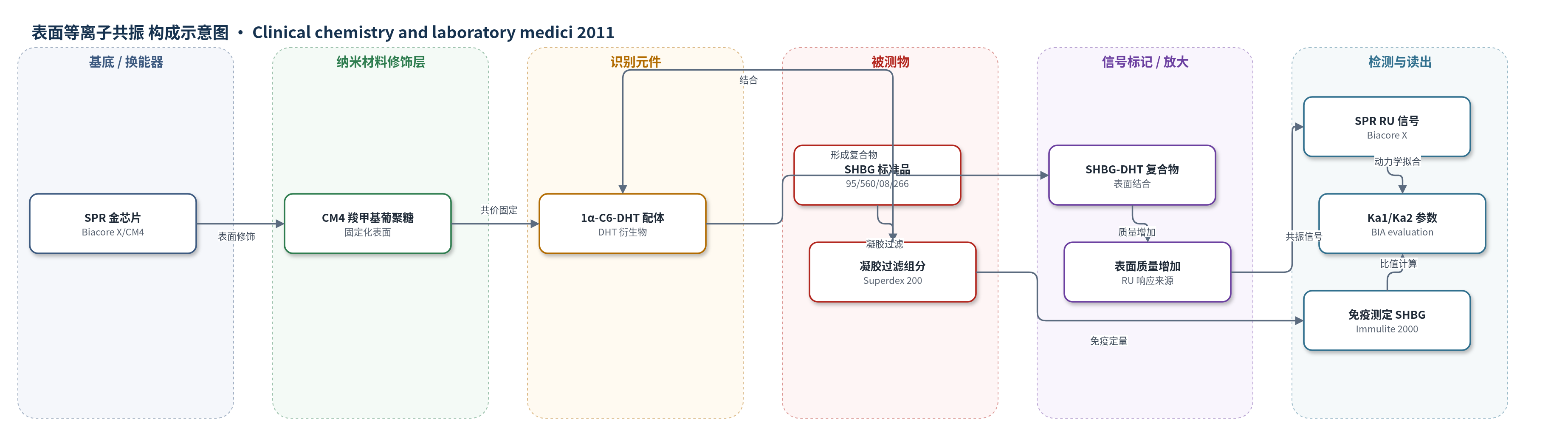
点击图片查看大图 · 依据论文自动绘制
传感器类型
表面等离子共振(SPR)生物传感器
检测对象
性激素结合球蛋白(SHBG, sex hormone-binding globulin);样品基质:WHO SHBG 标准品复溶液及凝胶过滤组分(人血清来源)
检测原理
CM4 芯片表面共价固定二氢睾酮衍生物 1α-C6-DHT 作为识别配体。经 Superdex 200 凝胶过滤富集的 SHBG 标准品组分以 PBS 缓冲液流过芯片表面,SHBG 与固定化 DHT 衍生物发生特异性结合。结合事件使芯片表面质量增加,引起表面等离子共振波长/角度偏移,Biacore X 以共振单位(RU)实时读出。由于 SHBG 为同源二聚体且结合呈两步过程,采用双价分析物模型拟合动力学,得到初始结合亲和常数 Ka1 与第二步结合常数 Ka2。信号大小随 SHBG 浓度和结合能力变化;结合容量以 RU/SHBG 浓度(nmol/L)均值表示,无额外信号放大。
检测灵敏度
原文未报告 LOD、线性范围、灵敏度斜率或 R^2。
效应效果
SPR 系统显示 08/266 各制备品的最大结合为 140–169 RU,明显高于 95/560 的 69 RU;类固醇结合容量为 4.47–5.37 RU/nmol/L,而 95/560 仅 2.67 RU/nmol/L,差异显著。08/266 的 Ka1 为 1.53–6.53×10^-8 L/mol,95/560 为 0.0147×10^-8 L/mol;Ka2 各样品间无显著差异。-20℃、4℃、20℃、37℃和 45℃保存 6 个月的 08/266 冻干样品结合容量与亲和常数无显著差异,提示冻干状态下热稳定性良好。SPR 固定化配体策略减少非特异吸附和长孵育影响,作者认为其可用于 SHBG 标准品结合特性评价。
传感器的构成
- 换能基底:Biacore X SPR 金芯片/CM4 芯片,提供表面等离子共振换能表面
- 修饰层:CM4 羧甲基葡聚糖(carboxymethyl dextran)表面,提供共价固定化化学位点
- 识别元件:1α-C6-DHT(1α-aminohexyl-17β-hydroxy-5α-androstan-3-one)固定化配体,特异性结合 SHBG
- 样品缓冲:PBS(含 1 mg/mL carboxymethyl dextran),维持结合条件并降低非特异吸附
- 再生剂:100 mmol/L H3PO4,解离 SHBG-DHT 复合物以再生芯片表面
- 定量读出:Immulite 2000 免疫测定,测定凝胶过滤组分 SHBG 浓度用于计算结合容量
中文摘要
背景:第1代性激素结合球蛋白(SHBG)国际标准95/560库存将尽,08/266被制备为替代标准。本研究比较95/560与08/266的类固醇结合能力。方法:将-20℃保存的95/560和08/266以及08/266加速热降解样品进行凝胶过滤,随后用表面等离子共振(SPR)生物传感器检测含SHBG组分与二氢睾酮衍生物的结合,并用免疫测定法测定各组分SHBG浓度,以生物传感器结合值与SHBG浓度之比的均值计算类固醇结合容量,同时计算SHBG-类固醇相互作用亲和常数。结果:95/560的最大生物分子相互作用低于08/266;其类固醇结合容量仅为新型标准的一半,且亲和常数较低;不同温度保存的08/266样品间无显著差异。结论:08/266的类固醇结合容量约为95/560的2倍;冻干08/266在最高45℃保存至少6个月后类固醇结合能力仍保持。
英文摘要
BACKGROUND: Stocks of 95/560, the 1st International Standard for sex hormone-binding globulin (SHBG), are running out, and 08/266 has been prepared as a replacement. We compared the steroid binding capacities of 95/560 and 08/266.
METHODS: 95/560 and 08/266 stored at -20 °C, and accelerated thermal degradation samples of 08/266 were subjected to gelfiltration. Binding of the SHBG-containing fractions to a dihydrotestosterone derivative was then investigated using a surface plasmon resonance biosensor. The SHBG content of the gelfiltration fractions was determined with an immunoassay. Steroid binding capacity of each standard was then calculated as the mean of the ratio of biosensor binding/SHBG concentration. Affinity constants for the SHBG steroid interaction were calculated.
RESULTS: Maximum achievable biomolecular interactions were lower for 95/560 than for the 08/266 preparations. 95/560 exhibited steroid binding capacity only half as high as any of the novel standards, as well as a lower affinity constant for the SHBG steroid interaction. No significant differences could be observed between the samples of 08/266 stored at different temperatures.
CONCLUSIONS: The steroid binding capacity of 08/266 is two times higher than that of 95/560. Steroid binding of lyophilized 08/266 is preserved at storage temperatures of up to 45 °C for at least 6 months.