组成图示
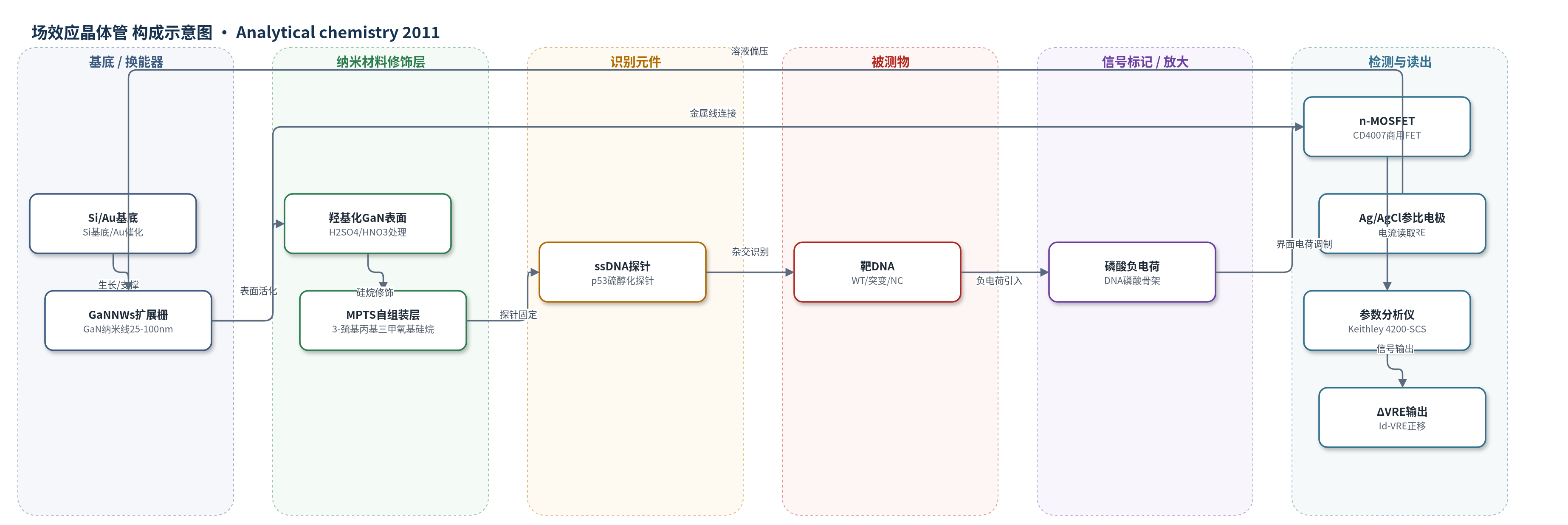
点击图片查看大图 · 依据论文自动绘制
传感器类型
场效应晶体管(FET)生物传感器
检测对象
人p53抑癌基因DNA(human p53 gene DNA,含WT、Arg248Gln、Arg249Ser、NC序列);样品基质为双链缓冲液(duplex buffer,30 mM Hepes + 100 mM potassium acetate),文中亦讨论复杂临床样本应用。
检测原理
传感器以固定于GaN纳米线表面的ssDNA探针识别靶DNA。完全互补靶标杂交后,双链DNA磷酸骨架在扩展栅表面引入更多负电荷,部分中和/捕获溶液中的可动阳离子,降低GaN表面阳离子积累并改变界面电荷密度。该界面电荷变化通过金属线耦合到商用n-MOSFET栅极,调制沟道有效电容C0、阈值电压Vth和载流子迁移率μ,使固定漏极电流Id下所需参考电极偏压VRE向正方向移动。ΔVRE随靶DNA浓度在宽范围内线性增加;降低缓冲液离子强度可增大Debye长度λD,提高电荷感知。纳米线表面态钝化/电荷再分布引起能带平坦化,进一步放大μ变化,实现无标记高灵敏检测。
检测灵敏度
LOD: below attomolar level concentrations(结论中表述为 sensitivity in the level of 10^-18 M);线性范围: 10^-19–10^-6 M(ΔVRE 与 CT 呈线性相关,约12个数量级);灵敏度: 较GaNTF-EGFET高约2个数量级,较其他FET DNA传感器分辨率高约3个数量级。
效应效果
该传感器在复杂序列体系中表现出高选择性和特异性:仅完全互补WT靶标产生明显正ΔVRE,单碱基错配Arg248Gln、Arg249Ser及非互补NC在10 h内基本无响应,WT响应时间小于30 min;空白缓冲液无显著响应,表明抗非特异干扰能力较好。与GaN薄膜EGFET相比,GaNNWs-EGFET在10^-19–10^-6 M范围内灵敏度提高约2个数量级,检测限低约6个数量级;GaNTF-EGFET检测限约皮摩尔级、范围10^-12–10^-6 M。作者认为其分辨率较其他FET DNA传感器高约3个数量级,适合复杂临床样本中p53突变DNA的实时无标记检测。
传感器的构成
- 基底/生长衬底:Si基底/Au催化层,用于生长GaNNWs,提供机械支撑与生长界面。
- 扩展栅纳米材料:氮化镓纳米线(GaNNWs,25–100 nm),浸入溶液作为工作电极WE/扩展栅,提供高比表面和表面敏感换能。
- 表面羟基化层:0.12 M H2SO4 + 0.52 M HNO3处理GaN表面,引入羟基以连接硅烷偶联剂。
- 硅烷自组装层:MPTS(3-mercaptopropyl trimethoxysilane)在GaN表面形成SAM,提供表面修饰与探针固定界面。
- 识别元件:硫醇化ssDNA探针(人p53序列,5′-HS-(CH2)6-ATGGGCCTCCGGTTC-3′),经Cleland's REDUCTACRYL处理后固定,识别靶DNA。
- 换能器:商用n-MOSFET(CD4007)FET器件,通过金属线与GaNNWs连接,将界面电荷变化转换为Id与Vth变化。
- 参比电极:Ag/AgCl(饱和KCl)RE,施加偏压VRE并稳定溶液电位。
中文摘要
本研究成功证明基于氮化镓纳米线(GaNNW)的扩展栅场效应晶体管(EGFET)生物传感器可在无标记、原位条件下实现特定DNA序列识别。该设计整合了GaN宽禁带半导体特性、纳米线高表面敏感性及EGFET高换能性能。通过将直接合成的GaNNW与商用FET器件简单组装,传感器达到亚阿摩尔级以下检测限,分辨率较其他FET DNA传感器高约3个数量级。针对人p53抑癌基因热点突变错配序列与完全互补靶标进行原位比较,显示即使存在非互补DNA链,传感器仍具优异选择性和特异性,提示可用于复杂临床样本。与GaN薄膜相比,纳米线EGFET在10^-19–10^-6 M宽检测范围内灵敏度提高约2个数量级,检测限低约6个数量级。研究揭示了纳米材料独特优势,并表明生物材料-半导体杂化界面能带对齐对有效电容和载流子迁移率具有积极影响。
英文摘要
In this study, we have successfully demonstrated that a GaN nanowire (GaNNW) based extended-gate field-effect-transistor (EGFET) biosensor is capable of specific DNA sequence identification under label-free in situ conditions. Our approach shows excellent integration of the wide bandgap semiconducting nature of GaN, surface-sensitivity of the NW-structure, and high transducing performance of the EGFET-design. The simple sensor-architecture, by direct assembly of as-synthesized GaNNWs with a commercial FET device, can achieve an ultrahigh detection limit below attomolar level concentrations: about 3 orders of magnitude higher in resolution than that of other FET-based DNA-sensors. Comparative in situ studies on mismatches ("hotspot" mutations related to human p53 tumor-suppressor gene) and complementary targets reveal excellent selectivity and specificity of the sensor, even in the presence of noncomplementary DNA strands, suggesting the potential pragmatic application in complex clinical samples. In comparison with GaN thin film, NW-based EGFET exhibits excellent performance with about 2 orders higher sensitivity, over a wide detection range, 10(-19)-10(-6) M, reaching about a 6-orders lower detection limit. Investigations illustrate the unique and distinguished feature of nanomaterials. Detailed studies indicate a positive effect of energy band alignment at the biomaterials-semiconductor hybrid interface influencing the effective capacitance and carrier-mobility of the system.