组成图示
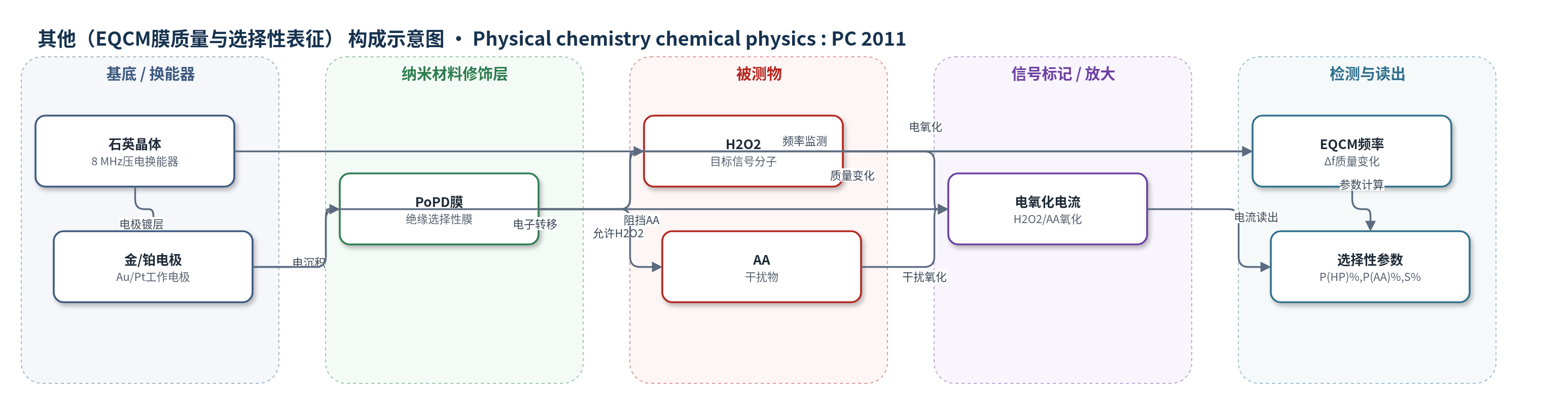
点击图片查看大图 · 依据论文自动绘制
传感器类型
其他(EQCM膜质量与选择性表征)
检测对象
过氧化氢(H2O2)、抗坏血酸(AA);样品基质:PBS 缓冲水溶液(模拟生物流体/神经化学环境)
检测原理
在 PBS(pH 7.4)中,邻苯二胺(oPD)在固定电位下发生电氧化,生成二聚体/低聚物并沉积为绝缘聚邻苯二胺(PoPD)膜。PoPD 膜的质量通过 EQCM 频率变化 Δf 按 Sauerbrey 方程换算。检测时,H2O2 和 AA 从溶液扩散穿过 PoPD 膜到达 Au/Pt 电极表面,发生电氧化并产生稳态电流。PoPD 对 H2O2 具有高表观渗透性,对 AA 具有强阻挡作用,因此 H2O2 电流随浓度增加,而 AA 电流被显著抑制;表观渗透率 P(HP)%、P(AA)% 和选择性 S% 随膜质量与电聚合电位变化。该文未采用酶、HCR、RCA 等信号放大策略。
检测灵敏度
原文未报告 LOD、线性范围、灵敏度斜率或分析物校准相关系数。
效应效果
PoPD 质量在 0.05–0.6 V(vs. SCE)随电位升高而增加,0.5–0.8 V 趋于平台;0.7 V 沉积质量约 348±26 ng,厚度约 3.7±0.3 nm,电荷效率约 2.6±0.3%。Au 与 Pt 电极初始电流和 Δf 无显著差异(p>0.5、p>0.45)。膜质量低于约 0.4 mg cm⁻² 时 P(AA)%>80%,约 0.6 mg cm⁻² 时降至约 2%,约 1.8 mg cm⁻² 时达 0.11±0.02%;S% 最低 0.09±0.01%。P(HP)% 随质量增加而升高,约 2 mg cm⁻² 时接近裸金属。0.7 V 膜比 0.4 V 膜对 AA 阻挡显著更好(p<0.001),IAA(1 mM) 降低约 2 倍。
传感器的构成
- 基底/换能器:石英晶体(quartz crystal, 8 MHz)压电换能器,通过频率变化 Δf 监测表面质量变化
- 工作电极:金或铂电极(Au/Pt, 0.20 cm²),作为电聚合基底和电化学检测界面
- 修饰层:聚邻苯二胺(PoPD)绝缘膜,由邻苯二胺(oPD)电聚合形成,作为抗干扰选择性膜
- 沉积前驱体:邻苯二胺(oPD, 100 mM)在 PBS(pH 7.4)中,电氧化生成 PoPD 低聚物并沉积
- 被测物/干扰物:过氧化氢(H2O2)与抗坏血酸(AA),用于评估膜表观渗透性与选择性
- 读出层:EQCM 频率变化与恒电位计时电流/循环伏安电流,用于计算质量、P(HP)%、P(AA)% 和 S%
中文摘要
本文采用电化学石英晶体微天平(EQCM)测定在中性缓冲单体溶液中、不同固定施加电位下电沉积的聚邻苯二胺(PoPD)层质量。该条件下形成绝缘型 PoPD,可用作生物传感器中的离子选择性/抗干扰膜。结果显示,固定电位从 0.05 到 0.6 V(vs. SCE)时,稳态总沉积质量随电位升高而系统性增加,并在 0.5–0.8 V 区间趋于平台。将 PoPD 质量与选择性参数比较表明,钝化型 PoPD 在生物传感器中阻挡干扰物的能力与表面沉积质量之间不存在简单关系;施加电聚合电位对 oPD 二聚体/低聚物电氧化的驱动作用,可能更直接地决定 PoPD 膜的选择性特征。结果还表明,表观渗透率(尤其是抗坏血酸 AA 的表观渗透率)对于揭示不同电沉积条件下 PoPD 膜之间的差异非常有用。
英文摘要
An electrochemical quartz-crystal microbalance (EQCM) was used to determine the mass of poly-(o-phenylenediamine) (PoPD) layers electro-deposited at different applied potentials in neutral buffered monomer solution, conditions that produce the insulating form of the polymer used as a permselective membrane in biosensor applications. There was a systematic increase in the total, steady state PoPD mass deposited for fixed applied potentials from 0.05 to 0.6 V vs. SCE, followed by a plateau up to 0.8 V. Comparison of PoPD mass and permselectivity parameters indicates that the ability of the passivating form of PoPD to block interference species in biosensor applications is not related in a simple way to the mass of material deposited on the surface. Instead, effects of the applied electropolymerisation potential in driving the electro-oxidation of oPD dimers and oligomers formed during the electro-deposition process are likely to have a more direct impact on the selectivity characteristics of the PoPD layer. The results highlight the usefulness of apparent permeabilities, especially of ascorbic acid, in revealing differences between PoPD layers electro-deposited under different conditions.