组成图示
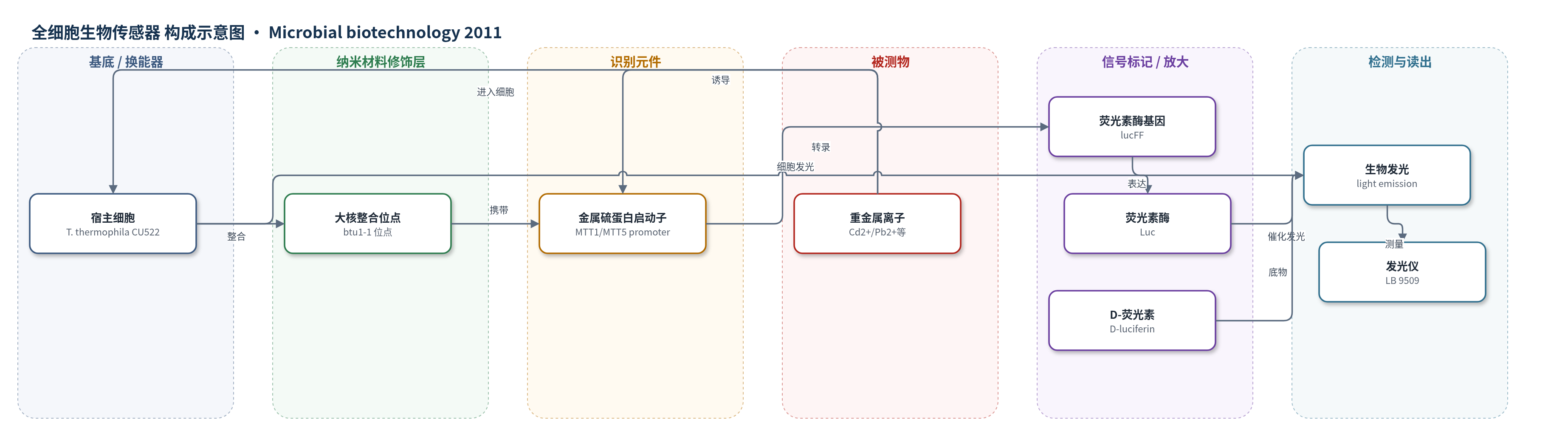
点击图片查看大图 · 依据论文自动绘制
传感器类型
全细胞生物传感器
检测对象
重金属离子(heavy metal ions,Cd2+、Cu2+、Zn2+、Pb2+、As5+、Hg2+);样品基质:污染土壤浸提液、环境水样/人工样品
检测原理
重金属离子进入无细胞壁的热四膜虫细胞后,激活 MTT1 或 MTT5 金属硫蛋白启动子,使下游 lucFF 荧光素酶基因发生转录和翻译。经过约2小时诱导,细胞内荧光素酶水平随生物可利用金属浓度升高而增加;加入 D-luciferin 后,荧光素酶催化其氧化反应并产生生物发光。发光强度以处理组与基础表达组的诱导系数表示,因此信号随金属浓度升高而增强,过高浓度因细胞毒性而下降。该过程利用基因表达作为生物放大,不需要电极或纳米材料。EDTA 螯合可显著降低诱导,用于区分金属依赖信号;高毒样品若抑制基础表达则提示假阴性,可通过稀释恢复验证。
检测灵敏度
LOD (Table 2, mol l-1): MTT1Luc: Cd2+ 25–50 × 10^-9; Cu2+ 2.5 × 10^-6; Zn2+ 0.5 × 10^-6; Pb2+ 0.5 × 10^-6; As5+ 50 × 10^-9; Hg2+ 25 × 10^-9。MTT5Luc: Cd2+ 5–25 × 10^-9; Cu2+ 1.5 × 10^-6; Zn2+ 1.5 × 10^-6; Pb2+ 50 × 10^-9; As5+ 25 × 10^-9; Hg2+ 25 × 10^-9。正文:最低可检测浓度约 5–50 nmol l-1(Cd2+、Pb2+、As5+、Hg2+)和约 1 mmol l-1(Zn2+、Cu2+)。
效应效果
MTT5Luc 诱导生物发光达基础水平10–60倍,MTT1Luc 为2–18倍;EDTA 螯合 Cd2+ 使诱导降低60–90%,说明主要响应生物可利用金属。pH 5或9、温度、氧化应激和培养基变化未显著诱导。水样加标 Cd2+ 后发光增加与加标量成比例,EDTA 可消除大部分增加;自然土壤样品响应与常规光谱分析一致,最强响应来自污染最重样品。与已发表 WCB 相比,MTT5Luc 对 Cd2+ 比 S. cerevisiae WCB 灵敏约200倍,对 As5+ 居前列,对 Hg2+ 和 Pb2+ 为前十中唯一真核成员;Cu2+ 比 S. cerevisiae CuMT 启动子 WCB 低约3–5倍。作者认为其成本低,适合环境初筛。
传感器的构成
- 宿主细胞/换能器:Tetrahymena thermophila CU522 活细胞,作为无细胞壁纤毛虫报告器,完成识别、转导与发光
- 识别元件:MTT1 或 MTT5 金属硫蛋白启动子(MTT1 promoter / MTT5 promoter),响应重金属诱导
- 报告基因:真核荧光素酶基因 lucFF,在金属诱导下转录表达荧光素酶
- 信号底物:D-luciferin(荧光素),进入细胞后与荧光素酶反应产生生物发光
- 检测缓冲液:0.01 mol l-1 Tris-HCl pH 6.8,维持金属生物可利用性并避免培养基螯合
- 可选裂解/通透试剂:Triton X-100、DMSO 或 Cell Culture Lysis Reagent (CCLR),用于通透或裂解细胞以定量荧光素酶
- 读出仪器:Berthold LB 9509 Junior 发光仪,测量生物发光并计算诱导系数
中文摘要
重金属是环境中最严重的污染物之一,亟需灵敏、快速的生物监测方法。生物可利用性、毒性和遗传毒性等关键参数无法仅靠化学分析测定,而必须使用活细胞。全细胞生物传感器将整个细胞作为单一报告器,同时包含生物受体和信号换能元件。本文报道了两种基于热四膜虫(Tetrahymena thermophila)MTT1 和 MTT5 金属硫蛋白启动子与真核荧光素酶基因 lucFF 融合的表达构建体,并将其稳定整合到 T. thermophila 大核,获得 MTT1Luc 和 MTT5Luc 转化株。这是首次报道纤毛原生动物作为重金属全细胞生物传感器。所设计的开启型生物测定可在约2小时内检测污染土壤或水样中的生物可利用重金属。作者利用人工和自然样品验证了传感器性能,并提出了识别假阳性和假阴性的方法。与已发表细胞生物传感器相比,基于 Tetrahymena 金属硫蛋白启动子的传感器表现出较高的真核金属传感灵敏度,部分指标可与原核生物传感器相当。
英文摘要
Heavy metals are among the most serious pollutants, and thus there is a need to develop sensitive and rapid biomonitoring methods for heavy metals in the environment. Critical parameters such as bioavailability, toxicity and genotoxicity cannot be tested using chemical analysis, but only can be assayed using living cells. A whole-cell biosensor uses the whole cell as a single reporter incorporating both bioreceptor and transducer elements. In the present paper, we report results with two gene constructs using the Tetrahymena thermophila MTT1 and MTT5 metallothionein promoters linked with the eukaryotic luciferase gene as a reporter. This is the first report of a ciliated protozoan used as a heavy metal whole-cell biosensor. T. thermophila transformed strains were created as heavy metal whole-cell biosensors, and turn on bioassays were designed to detect, in about 2 h, the bioavailable heavy metals in polluted soil or aquatic samples. Validation of these whole-cell biosensors was carried out using both artificial and natural samples, including methods for detecting false positives and negatives. Comparison with other published cell biosensors indicates that the Tetrahymena metallothionein promoter-based biosensors appear to be the most sensitive eukaryotic metal biosensors and compare favourably with some prokaryotic biosensors as well.