组成图示
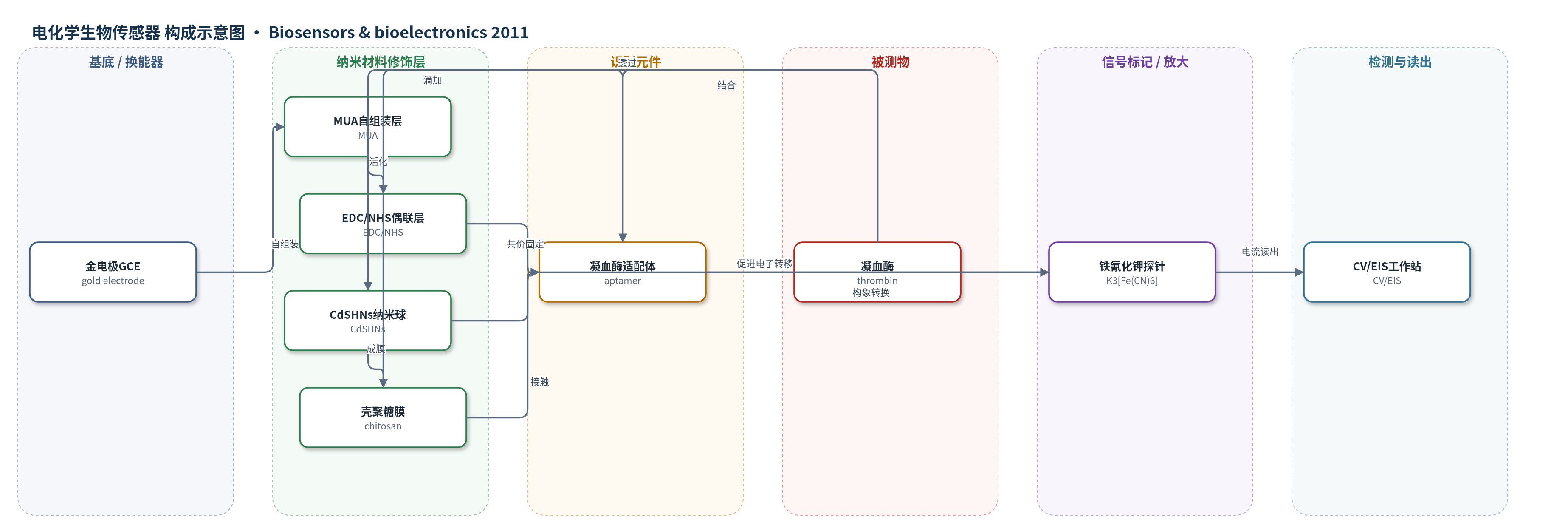
点击图片查看大图 · 依据论文自动绘制
传感器类型
电化学生物传感器
检测对象
凝血酶(thrombin);样品基质:人血清(human serum)
检测原理
金电极表面先固定MUA和22碱基凝血酶适配体,再滴加CdSHNs并覆盖壳聚糖膜。未结合凝血酶时,适配体呈发夹结构,其磷酸骨架负电荷阻碍K3[Fe(CN)6]在金电极表面的电子转移。当凝血酶加入后,与适配体特异性结合,诱导适配体由发夹结构转变为G-四链体,使适配体一端远离电极表面,电子转移恢复。CdSHNs一方面增大电极粗糙度和双电层电容,降低电荷转移电阻,另一方面促进适配体构象转换,从而放大氧化电流。在490 mV处,K3[Fe(CN)6]的氧化电流随凝血酶浓度增加而增大,实现电化学检测。
检测灵敏度
线性范围: 0–33 μg mL−1;灵敏度: 1.34 μA mL μg−1 cm−2;R^2 = 0.9956 (n = 12);未固定CdSHNs: 线性范围 2.75–27.5 μg mL−1,灵敏度 0.062 μA mL μg−1 cm−2
效应效果
该传感器对凝血酶具有良好特异性:1 μM BSA和1 μM溶菌酶几乎无干扰,0.1 mM IgG相对响应约10.8%。稳定性方面,在Tris–HCl缓冲液中保存10 d保留96.0%初始活性,空气中保存保留87.3%。5个独立制备电极在20 μg/mL凝血酶下的电流RSD为6.40%。4份人血清样品检测结果与荧光法一致,RSD为3.20%–4.89%。与未固定CdSHNs电极相比,线性范围由2.75–27.5 μg/mL扩展至0–33 μg/mL,灵敏度由0.062提高至1.34 μA mL μg−1 cm−2,作者认为其可用于临床血清凝血酶检测。
传感器的构成
- 基底/换能器电极:金电极(gold electrode, GCE),抛光后作为电子转导基底
- 自组装单分子层:11-巯基十一烷酸(MUA),在金表面形成自组装膜并提供羧基
- 偶联活化层:EDC/NHS磷酸缓冲液,活化MUA羧基以共价固定适配体
- 识别元件:22碱基凝血酶适配体(aptamer),以发夹结构识别凝血酶并发生构象转换
- 纳米信号放大层:硫化镉空心纳米球(CdSHNs),促进电子转移并促进适配体向G-四链体转换
- 固定/封闭膜:壳聚糖(chitosan)膜,防止适配体和CdSHNs脱落并允许凝血酶透过
- 电化学探针:铁氰化钾(K3[Fe(CN)6]),作为氧化还原探针提供电流信号
中文摘要
本文报道了一种利用22碱基适配体修饰硫化镉空心纳米球(CdSHNs)放大电化学信号的简便方法。以凝血酶为模型,采用循环伏安法、电化学阻抗谱和圆二色谱表征适配体与CdSHNs的相互作用。结果表明,CdSHNs可促进金电极与K3[Fe(CN)6]之间的电子转移,并在适配体与凝血酶结合后促进其由发夹结构向G-四链体构象转换。在最佳条件下,修饰电极可在0–33 μg/mL范围内定量检测凝血酶,灵敏度为1.34 μA mL μg−1 cm−2;而未固定CdSHNs的适配体修饰电极线性范围为2.75–27.5 μg/mL,灵敏度为0.062 μA mL μg−1 cm−2。该传感器具有良好的稳定性、特异性、重现性和准确性,为构建适配体生物传感器提供了有前景的平台。
英文摘要
A simple method to amplify the electrochemical signal by an aptamer with 22 bases modified with CdS hollow nanospheres (CdSHNs) was described. Using the thrombin as a model, the interaction between the aptamer and CdSHNs was characterized by cyclic voltammetry, electrochemical impedance spectroscopy and circular dichroism spectroscopy. CdSHNs promoted the electron transfer between the gold electrode and K(3)[Fe(CN)(6)] and facilitated the conformation conversion of the aptamer from hairpin to G-quadruplex after the aptamer interacted with thrombin. Under optimal conditions, the modified electrode could be used for the determination of thrombin from 0 to 33 μg mL(-1) and the sensitivity was 1.34 μA mL μg(-1)cm(-2), while the linear range of the modified electrode without the immobilization of CdSHNs was from 2.75 to 27.5 μg mL(-1) and the sensitivity was 0.062 μA mL μg(-1)cm(-2). This constructed biosensor also had a good stability, specificity, reproducibility and accuracy which could provide a promising platform for fabrication of aptamer based biosensors.