组成图示
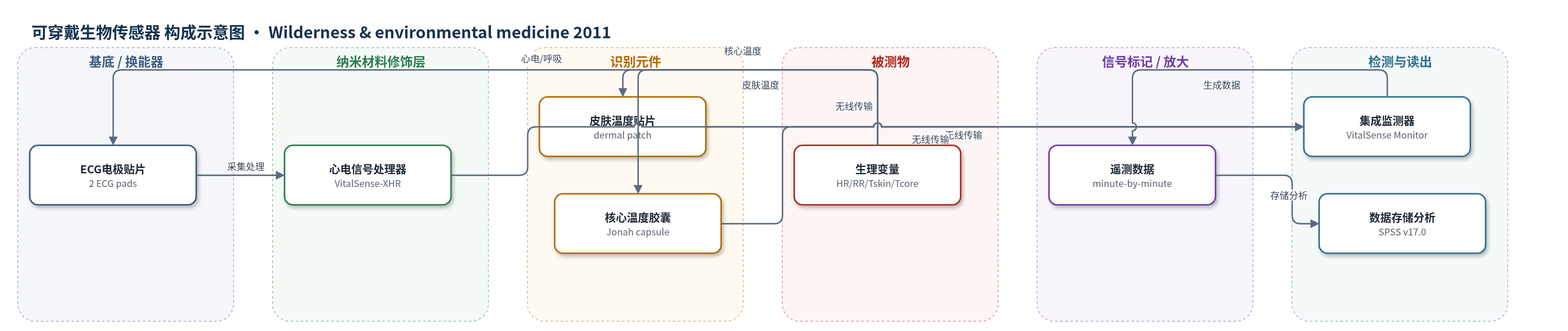
点击图片查看大图 · 依据论文自动绘制
传感器类型
可穿戴生物传感器
检测对象
心率(heart rate, HR)、呼吸率(respiration rate, RR)、皮肤温度(skin temperature, Tskin)、核心温度(core temperature, Tcore);样品基质:人体(高海拔登山者,野外环境)
检测原理
系统通过体表 ECG 电极贴片采集心脏去极化产生的心电信号,VitalSense-XHR 处理器对 ECG 信号进行提取与处理,输出心率,并同步监测呼吸率;dermal patch 利用热敏传感原理测量左手背皮肤温度;Jonah 可吞咽胶囊在消化道内测量核心温度。各传感器以分钟为单位无线传输至腰部 VitalSense Integrated Physiological Monitor,数据被集成、存储并用于统计分析。信号随生理状态变化:高海拔低氧和运动使心率与呼吸率升高,寒冷环境使皮肤温度下降,核心温度保持相对稳定。原文未报告化学放大或信号放大策略。
检测灵敏度
R^2 = 0.97(ECG-compared heart rate,厂商数据);R^2 = 0.82(CPAP-compared respiration,厂商数据)
效应效果
系统在约20 h内连续工作,1240 min逐分钟数据完整,无缺失分钟均值;出现389次“开路”和78次“恢复数据”,提示个别数据点可能异常,但所有数值处于预期生理范围。上升/下降时心率和呼吸率约为休息时的2倍,皮肤温度平均低约10°C,核心温度变化小于1.77°C;各变量间显著相关(p<0.01)。监测器约200 g,由1节AA锂电池供电。系统未针对该受试者进行实验室方法验证,但厂商报告心率R^2=0.97、呼吸率R^2=0.82,核心温度遥测系统此前经直肠探头验证。作者认为其可用于高山野外研究和登山医疗监测。
传感器的构成
- 换能/信号处理单元:VitalSense-XHR 无线心电信号处理器,贴于胸部,采集并处理 ECG 信号以输出心率与呼吸率
- 识别/传感元件:2 个 ECG 电极贴片,贴于胸部,采集体表心电信号
- 皮肤温度传感层:Philips Respironics dermal patch,贴于左手背,测量皮肤温度
- 核心温度传感元件:Jonah 可吞咽胶囊,经消化道测量核心温度
- 数据集成与读出单元:VitalSense Integrated Physiological Monitor,佩戴于腰部,接收并存储分钟级遥测数据
- 电源:AA 锂电池,为监测器连续供电约 20 小时
- 事件标记输入:monitor 上的 event marker button,用于标记帐篷、上升和下降转换
中文摘要
本研究为一项描述性病例报告,旨在利用便携式生物传感器系统在恶劣环境中实时采集数据,并在攀登阿根廷阿空加瓜山(西半球最高点)期间获得连续生理测量。在海拔5800 m营地至6962 m峰顶之间,对一名41岁、具有高海拔登山经验的男性进行逐分钟监测,记录心率(60–154次/min)、呼吸率(2–42次/min)、皮肤温度(11.7–36.1°C)和核心温度(36.9–38.7°C),共1240 min数据,其中休息/睡眠417 min、上升643 min、下降180 min。所有测量变量之间均呈显著相关(p<0.01)。监测中出现“开路”和“恢复数据”事件,提示可能存在个别异常数据;但1240 min中每分钟均有数据,且数值处于预期生理范围内。该研究展示了遥测技术在高山登山中监测生理变量的潜在应用。
英文摘要
The aim of this descriptive case study was to use an ambulatory biosensor system to capture data in real time in a harsh environment and to obtain continuous physiological measurements during an ascent of Argentina's Mt Aconcagua, the highest point in the Western Hemisphere. Between the 5800-m-high camp and the 6962-m summit, a 41-year-old male with previous high-altitude mountaineering experience was measured for minute-by-minute heart rate (60-154 beats/min), respiration rate (2-42 breaths/min), skin temperature (11.7-36.1°C), and core temperature (36.9-38.7°C) (1240 min of data: 417 min rest/sleep; 643 min ascent; 180 min descent). All of the measured variables were significantly correlated with each other (p < 0.01). There were incidences of "open leads" and "recovered data," indicating the potential for some aberrant data; however, data exist for each minute of the 1240 minutes of collection, and the values are within the expected physiological ranges. This study demonstrates the potential application of telemetry to monitor physiological variables during high altitude mountaineering.