组成图示
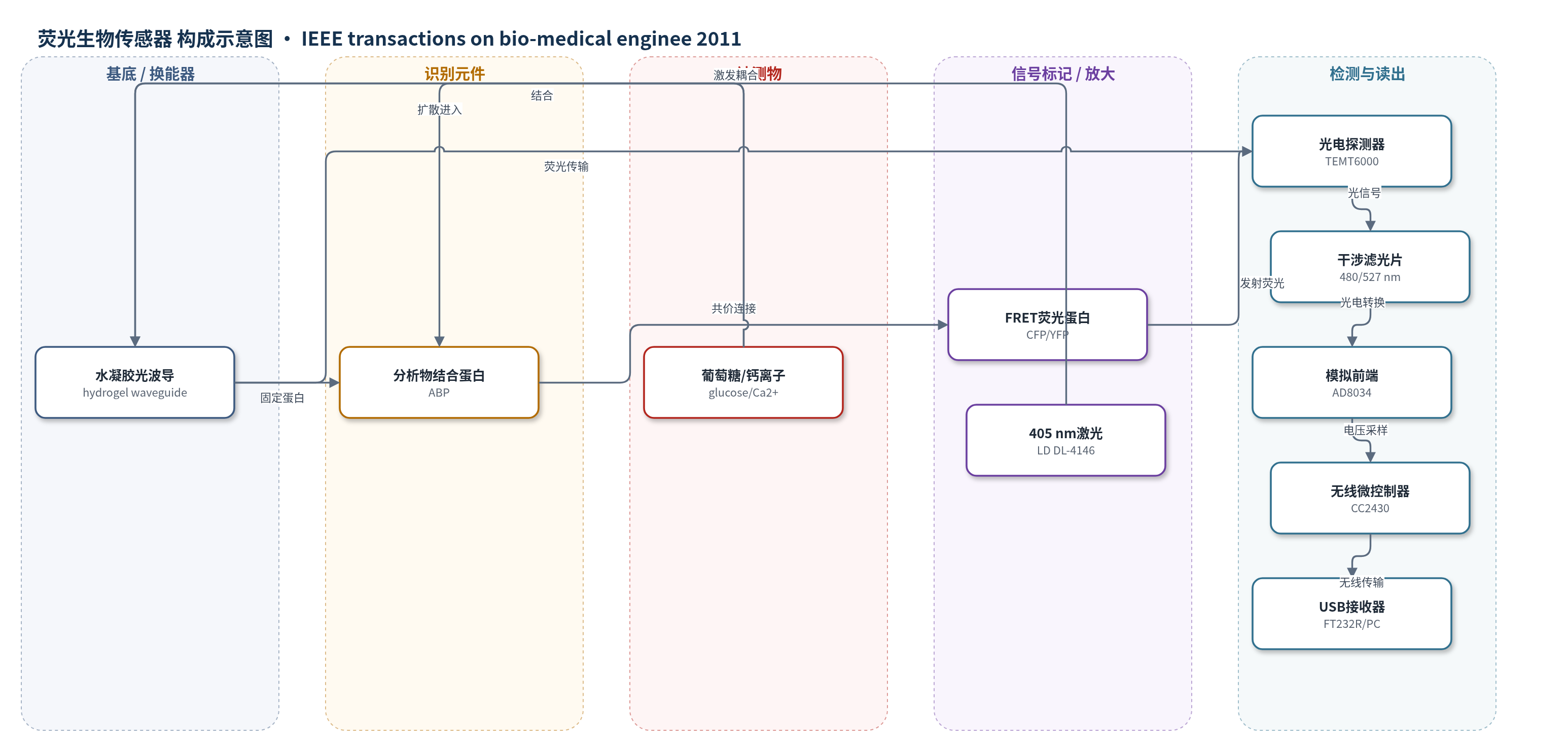
点击图片查看大图 · 依据论文自动绘制
传感器类型
荧光生物传感器
检测对象
葡萄糖(glucose)、钙离子(Ca2+);样品基质:模拟人组织间液(interstitial fluid)/缓冲液
检测原理
该传感器基于荧光共振能量转移(FRET)。青色荧光蛋白(CFP)和黄色荧光蛋白(YFP)共价连接在分析物结合蛋白(ABP)上,并包埋于水凝胶光波导中。当葡萄糖或钙离子扩散进入测量室并结合ABP时,ABP发生构象变化,改变CFP与YFP之间的相对距离,从而改变FRET效率。405 nm激光二极管从水凝胶端面激发CFP,CFP发射约480 nm荧光,YFP发射约527 nm荧光;两者相对强度随分析物浓度变化。四个光电探测器经干涉滤光片分别采集CFP、YFP及参考信号,模拟前端将光电流放大为电压,CC2430进行12位采样并计算FRET比值,再通过IEEE 802.15.4无线传输。信号放大主要依赖FRET比值读出和参考通道校正,而非酶催化或核酸扩增。
检测灵敏度
原文未报告LOD、线性范围、灵敏度斜率或相关系数。
效应效果
体外测试中,葡萄糖传感器在2 mM与10 mM模拟组织间液间切换,FRET信号可逆变化,时间常数约4–5 min;钙传感器在0与5 mM CaCl2间切换,表现类似。时序测试显示电压81 ms达稳态98%,延迟可缩短约70%。功耗方面,单次测量94 mA、392 ms,睡眠1.5 μA,平均22 μA,360 mAh电池支持22个月以上,优化后约40个月。电磁功率密度0.002 W/m2,低于ICNIRP 10 W/m2。猪皮下3 cm、接收器2 m的4 h测试中,超过98%遥测成功。平台可长期监测血糖并扩展至其他荧光分析物,仍需稳定性、校准和临床验证。
传感器的构成
- 传感基底/光波导:水凝胶圆柱棒(hydrogel waveguide),直径<1 mm、长约8 mm,固定蛋白并传导405 nm激发光与荧光
- 识别元件:分析物结合蛋白(ABP,glucose-binding protein或calcium-binding protein),结合葡萄糖或Ca2+后改变构象
- 荧光信号元件:青色荧光蛋白(CFP)与黄色荧光蛋白(YFP)共价连接于ABP,通过FRET产生480 nm和527 nm荧光
- 光学激发源:405 nm蓝紫激光二极管(DL-4146-101S, Sanyo)及驱动器(iC-WJ, iC-Haus),从水凝胶端面耦合激发光
- 光电检测层:四个光电探测器(TEMT6000, Vishay),位于水凝胶两侧,检测CFP、YFP及参考荧光
- 光学滤波:干涉滤光片(interference filters),置于光电探测器前,区分480 nm与527 nm波段
- 模拟前端:跨阻放大器(AD8034, Analog Devices)将光电流转为10^6 V/A电压,差分放大器与参考电压(ADR361)稳定信号
- 无线读出单元:CC2430(Texas Instruments)无线微控制器,12位ΣΔ ADC采样,IEEE 802.15.4-2003 2.4 GHz传输至USB接收器(FT232R, FTDI)和PC
- 电源与封装:Tadiran 1520锂电池(360 mAh, 4 V)、MAX643升压至5.5 V,测量室膜允许小分子扩散,PEEK封装
中文摘要
本文提出一种用于慢性荧光生物传感器长期监测的无线可编程植入电子平台。长期无线植入荧光强度传感器面临生物相容性、传感器长期稳定性以及低功耗微型化电子设计等挑战。该平台基于IEEE 802.15.4-2003协议实现双向遥测,可在极低功耗下运行,支持超过三年的电池寿命,并允许多个传感器无线组网。在单次荧光测量中,电路驱动激光二极管激发传感器,并采集四个光电探测器经放大后的信号。作者以水凝胶波导FRET生物传感器进行体外功能验证,仅更换分析物结合蛋白即可分别实现葡萄糖和钙离子监测。电子性能从时序、功耗、组织电磁场暴露和体内无线连接等方面评估。该平台最终目标是集成到完整血糖监测系统,植入糖尿病患者皮下至少一年,也可推广至其他基于荧光强度测量的生物传感器。
英文摘要
The development of a long-term wireless implantable biosensor based on fluorescence intensity measurement poses a number of technical challenges, ranging from biocompatibility to sensor stability over time. One of these challenges is the design of a power efficient and miniaturized electronics, enabling the biosensor to move from bench testing to long term validation, up to its final application in human beings. In this spirit, we present a wireless programmable electronic platform for implantable chronic monitoring of fluorescent-based autonomous biosensors. This system is able to achieve extremely low power operation with bidirectional telemetry, based on the IEEE802.15.4-2003 protocol, thus enabling over three-year battery lifetime and wireless networking of multiple sensors. During the performance of single fluorescent-based sensor measurements, the circuit drives a laser diode, for sensor excitation, and acquires the amplified signals from four different photodetectors. In vitro functionality was preliminarily tested for both glucose and calcium monitoring, simply by changing the analyte-binding protein of the biosensor. Electronics performance was assessed in terms of timing, power consumption, tissue exposure to electromagnetic fields, and in vivo wireless connectivity. The final goal of the presented platform is to be integrated in a complete system for blood glucose level monitoring that may be implanted for at least one year under the skin of diabetic patients. Results reported in this paper may be applied to a wide variety of biosensors based on fluorescence intensity measurement.