组成图示
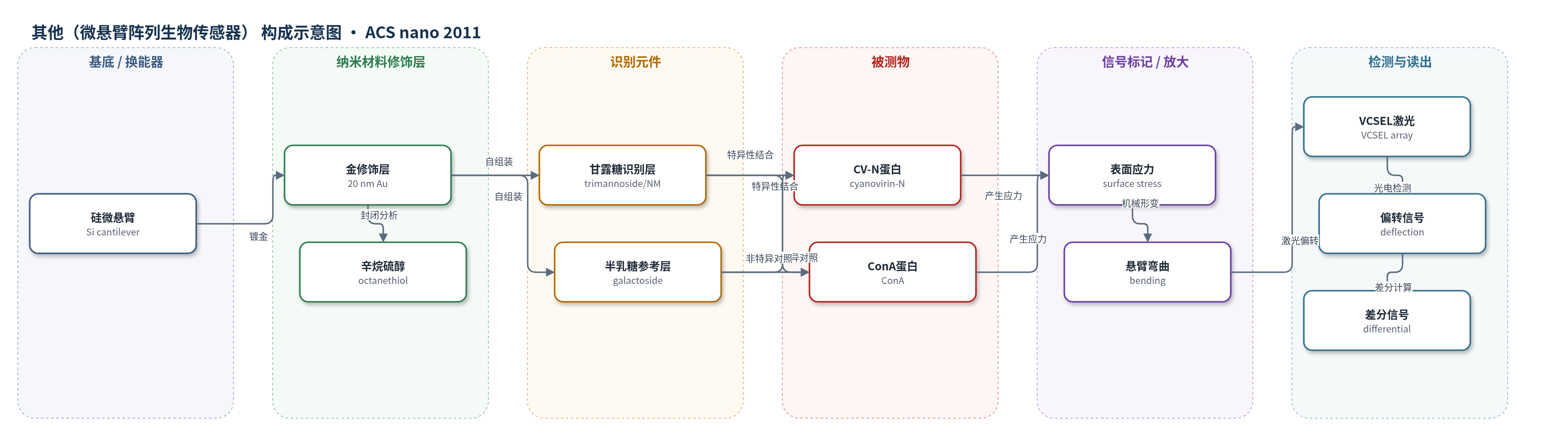
点击图片查看大图 · 依据论文自动绘制
传感器类型
其他(微悬臂阵列生物传感器)
检测对象
青病毒蛋白N(cyanovirin-N, CV-N)、刀豆蛋白A(Concanavalin A, ConA);样品基质:Tris缓冲液/蛋白溶液,含0.1 μM BSA背景
检测原理
传感器以金修饰硅微悬臂为换能器,表面自组装硫醇端基寡甘露糖作为识别元件,半乳糖作为参考。当样品中的CV-N或ConA与表面寡甘露糖结合时,发生特异性碳水化合物-蛋白识别;由于寡糖多价/多位点结合以及蛋白侧链与金表面之间的静电、疏水和空间作用,悬臂表面产生压缩性表面应力。该应力使硅-金双金属悬臂发生弯曲,弯曲方向与幅度取决于结合事件数量和强度。VCSEL激光照射悬臂末端,偏转被光电系统实时记录;通过甘露糖通道与半乳糖参考通道差分扣除非特异吸附。CV-N/ConA浓度越高,表面结合事件越多,差分偏转越大;结合等温线可用Langmuir模型拟合得到Kd。
检测灵敏度
LOD: 91 pM(CV-N,原文“10-6 mg/mL (91 pM)”);LOD: 9.6 nM(ConA,原文“1 μg/mL (9.6 nM)”)
效应效果
该传感器选择性良好:CV-N在三甘露糖悬臂上的偏转比半乳糖参考大3–4倍,九甘露糖信号比三甘露糖强约20%;自由甘露糖竞争使差分信号平均降低约三分之二。BSA无特异响应,CV-N自封闭可抑制非特异位点。6个独立阵列中86%的连续注射信号在30%标准差内可重复,且可干燥、-20 °C保存并复用。CV-N-三甘露糖Kd为1.06±0.69 μM,与文献1.5 μM一致;ConA Kd为15.3 μM。在0.1 μM BSA背景下,19.2 μM ConA仍给出55 nm信号。作者认为其无标记、实时、可扩展,适用于糖组学筛查。
传感器的构成
- 基底/换能器:硅微悬臂阵列(Si cantilever array, 500 μm×100 μm×1 μm),承载识别层并将表面应力转换为机械偏转
- 金属修饰层:20 nm 金层(Au),提供硫醇自组装界面并增强表面应力响应
- 识别元件:硫醇端基三甘露糖苷(trimannoside, TM)/九甘露糖苷(nonamannoside, NM)自组装单分子层,特异性结合CV-N/ConA
- 参考识别元件:硫醇端基半乳糖苷(galactoside, Gal)自组装层,作为非特异结合内部对照
- 封闭/密度分析试剂:辛烷硫醇(octanethiol, OT),结合残余金表面用于评估覆盖密度
- 信号读出:8通道VCSEL激光阵列与光电检测,实时测量悬臂偏转
中文摘要
碳水化合物测序与合成技术的进步揭示了糖组的巨大复杂性,其结构多样性超过蛋白质组和寡核苷酸。要理解糖类的生物学功能,必须鉴定并定量糖类与其他生物分子、尤其是蛋白质之间的相互作用。为此,作者开发了一种基于微悬臂阵列的碳水化合物生物传感器,其传感层由自组装的硫醇端基寡糖单分子层构成,可无标记、实时、选择性地检测碳水化合物-蛋白结合。研究以抗病毒蛋白青病毒蛋白N(cyanovirin-N, CV-N)与寡甘露糖的结合为模型;CV-N可识别并阻断HIV包膜糖蛋白gp120上的甘露糖。当CV-N结合固定在悬臂表面的寡甘露糖时,分子间作用引起表面应力,使悬臂发生机械弯曲;激光偏转信号随结合强度变化。偏转幅度和持续时间反映相互作用强度,比较不同寡糖悬臂可揭示结合偏好。结果表明,该传感器可稳健、无标记、可扩展地分析碳水化合物-蛋白相互作用,并检测皮摩尔浓度的碳水化合物结合蛋白。
英文摘要
Advances in carbohydrate sequencing technologies have revealed the tremendous complexity of the glycome. This complexity reflects the structural and chemical diversity of carbohydrates and is greater than that of proteins and oligonucleotides. The next step in understanding the biological function of carbohydrates requires the identification and quantification of carbohydrate interactions with other biomolecules, in particular, with proteins. To this end, we have developed a cantilever array biosensor with a self-assembling carbohydrate-based sensing layer that selectively and sensitively detects carbohydrate-protein binding interactions. Specifically, we examined binding of mannosides and the protein cyanovirin-N, which binds and blocks the human immunodeficiency virus (HIV). Cyanovirin-N binding to immobilized oligomannosides on the cantilever resulted in mechanical surface stress that is transduced into a mechanical force and cantilever bending. The degree and duration of cantilever deflection correlates with the interaction's strength, and comparative binding experiments reveal molecular binding preferences. This study establishes that carbohydrate-based cantilever biosensors are a robust, label-free, and scalable means to analyze carbohydrate-protein interactions and to detect picomolar concentrations of carbohydrate-binding proteins.