组成图示
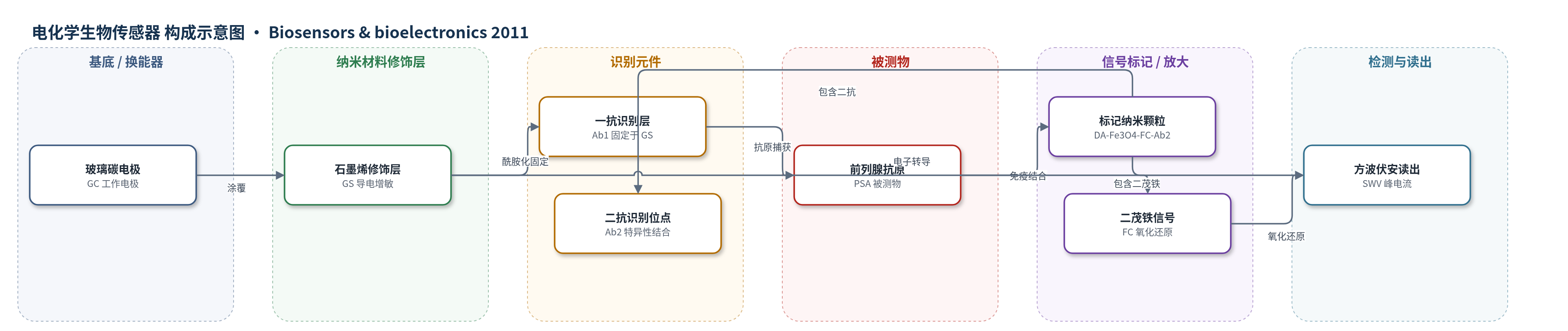
点击图片查看大图 · 依据论文自动绘制
传感器类型
电化学生物传感器
检测对象
前列腺特异性抗原(PSA);样品基质:血清、PBS缓冲液
检测原理
该传感器采用三明治免疫识别与电化学换能机制。抗PSA一抗(Ab1)经EDC/NHS酰胺化固定于石墨烯片(GS)修饰的玻璃碳电极表面,BSA封闭后,样品中的PSA与Ab1特异性结合。随后加入DA-Fe3O4-FC-Ab2标记物,其上的抗PSA二抗(Ab2)与已捕获的PSA结合,形成Ab1-PSA-Ab2三明治结构。DA通过邻苯二酚配位锚定于Fe3O4表面,其氨基共价连接大量二茂铁羧酸(FC)和Ab2,使每个纳米颗粒携带多个FC信号分子。PSA浓度越高,电极表面捕获的标记纳米颗粒越多,FC氧化还原电流越大。GS的大比表面积提高Ab1负载,其良好导电性促进FC电子转移。方波伏安法读取FC氧化峰电流,实现PSA定量检测。
检测灵敏度
LOD: 2 pg/mL;线性范围: 0.01–40 ng/mL;S/N = 3
效应效果
该传感器对PSA具有良好选择性:在1 ng/mL PSA存在下,加入100 ng/mL人IgG、甲胎蛋白(AFP)、BSA和葡萄糖等干扰物,电流无明显变化。重现性方面,5个电极检测1 ng/mL PSA的相对标准偏差(RSD)为6.1%。稳定性方面,DA-Fe3O4-FC-Ab2标记物4 ℃保存1个月后,传感器电流仍保持初始值的约90%。实际血清加标回收率为93.5%–110.0%,表明方法可用于血清PSA检测。作者指出,正常人群血清PSA约为1–4 ng/mL,癌症患者约为4–10 ng/mL,该传感器的线性范围和检出限覆盖临床检测需求,具有用于前列腺癌标志物筛查的应用潜力。
传感器的构成
- 基底/换能器电极:玻璃碳电极(GC),作为工作电极提供电子转导界面
- 纳米材料修饰层:石墨烯片(GS),涂覆于GC表面,增大比表面积并增强导电性
- 识别元件:抗PSA一抗(Ab1),通过EDC/NHS酰胺化固定于GS羧基,特异性捕获PSA
- 封闭剂:牛血清白蛋白(BSA,1 wt%),封闭非特异性结合位点
- 信号标记物:多巴胺功能化四氧化三铁纳米颗粒(DA-Fe3O4-FC-Ab2),DA锚定Fe3O4,FC和Ab2经DA氨基共价连接
- 信号标记物:二茂铁羧酸(FC),负载于DA-Fe3O4表面,提供氧化还原电流信号
- 读出:方波伏安法(SWV)/电化学工作站(CHI 760D),读取FC氧化峰电流
中文摘要
本文报道了一种用于检测癌症生物标志物前列腺特异性抗原(PSA)的超灵敏三明治型电化学生物传感器。该传感器以石墨烯片(GS)为传感平台,以二茂铁功能化四氧化三铁纳米颗粒(DA-Fe3O4-FC-Ab2)为信号标记物。首先将多巴胺(DA)锚定在四氧化三铁(Fe3O4)表面,再利用DA的氨基通过共价连接二茂铁羧酸(FC)和抗PSA二抗(Ab2),形成DA-Fe3O4-FC-Ab2标记物。大量DA分子锚定于Fe3O4表面,可显著提高FC和Ab2的负载量,从而增强免疫传感器灵敏度。GS具有较大比表面积,可负载更多抗PSA一抗(Ab1),同时其良好导电性有利于FC的电子转移,提高检测灵敏度。以FC的氧化还原电流为检测信号,该传感器在0.01–40 ng/mL范围内呈良好线性,检出限为2 pg/mL,并具有良好的重现性和稳定性。该方法还可扩展用于将荧光染料等材料负载到Fe3O4表面,制备适用于不同免疫检测需求的标记物。
英文摘要
Ultrasensitive sandwich type electrochemical immunosensors for the detection of cancer biomarker prostate specific antigen (PSA) is described which uses graphene sheet (GS) sensor platform and ferrocene functionalized iron oxide (Fe(3)O(4)) as label. To fabricate the labels, dopamine (DA) was first anchored onto Fe(3)O(4) surface followed by conjugating ferrocene monocarboxylic acid (FC) and secondary-antibody (Ab(2)) onto Fe(3)O(4) through the amino groups of DA (DA-Fe(3)O(4)-FC-Ab(2)). The great amount of DA molecules anchored onto Fe(3)O(4) surface increased the immobilization of FC and Ab(2) onto the Fe(3)O(4) nanoparticle, which in turn increased the sensitivity of the immunosensor. GS used as biosensor platform increased the surface area to capture a great amount of primary antibodies (Ab(1)) and the good conductivity of GS enhanced the detection sensitivity to FC. Using the redox current of FC as signal, the immunosensor displays high sensitivity, wide linear range (0.01-40 ng/mL), low detection limit (2 pg/mL), good reproducibility and stability. In addition, this method could be extended to the immobilization of other interesting materials (fluorescence dyes) onto Fe(3)O(4) for preparing various kinds of labels to meet the different requirements in immunoassays.