组成图示
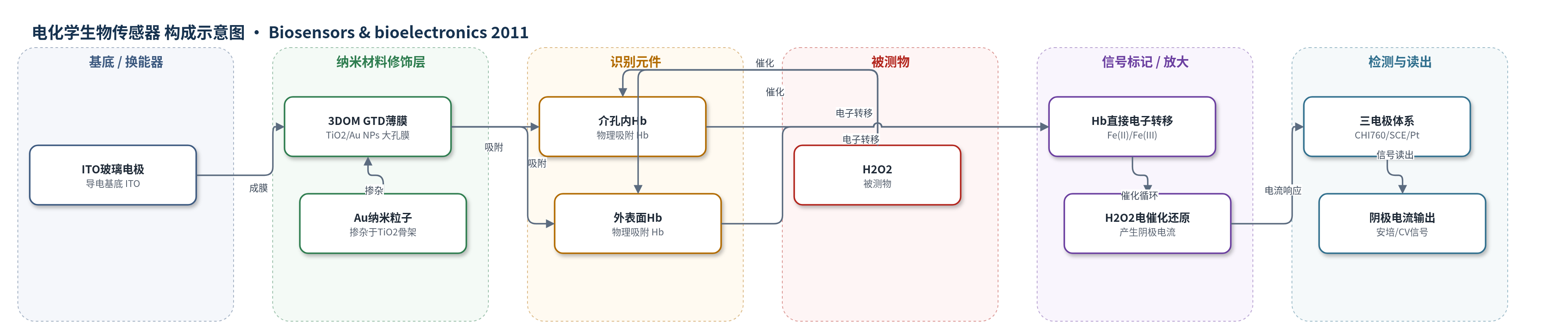
点击图片查看大图 · 依据论文自动绘制
传感器类型
电化学生物传感器
检测对象
过氧化氢(H2O2);样品基质为 0.1 M PBS(pH 7.0)缓冲溶液(含 0.1 M NaCl)
检测原理
该传感器基于 Hb 在 3DOM GTD/ITO 电极上的直接电化学与电催化。3DOM GTD 大孔膜提供高比表面积和连通孔道,Au 纳米粒子促进血红素铁与 ITO 间电子转移,Hb 保持天然构象。在 0.1 M PBS(pH 7.0)中,Hb 的 Fe(III)/Fe(II) 可在电极表面直接可逆电子转移,形成介孔内 Hb(E0'≈-0.48 V)和外表面 Hb(E0'≈-0.20 V)两对峰。施加 -0.52 V 时,HbFe(III) 被还原为 HbFe(II),H2O2 将 HbFe(II) 化学氧化回 HbFe(III) 并生成水,形成催化循环;H2O2 浓度越高,阴极电流越大,从而实现无介质电催化检测。
检测灵敏度
LOD: 0.6 μM (S/N = 3);线性范围: 5.0 μM–1.0 mM;灵敏度: 144.5 μA mM−1;R^2 = 0.9989 (n = 16)
效应效果
该传感器对 H2O2 响应快速,在 5.0 μM–1.0 mM 范围内线性良好。与 Hb/GTDNs/ITO 相比,Hb/3DOM GTD/ITO 的灵敏度由 8.53 μA mM−1 提高到 144.5 μA mM−1,峰电流更高,说明 3DOM 结构可负载更多 Hb 并改善电子转移。稳定性方面,电极在 4 ℃ PBS 中保存 1 个月无明显衰减,50 天后响应下降约 10%;对 100 μM H2O2 连续循环 50 次以上仍保持 98% 信号,RSD <5%;三个独立电极间 RSD <2%。其 LOD 0.6 μM 低于镍氧化物纳米粒子电极的 60 μM 和 Hb/TiO2 纳米管膜的 1.5 μM,作者认为可用于 H2O2 生物传感器。
传感器的构成
- 基底/换能器电极:ITO 玻璃电极(indium-tin oxide, ITO),导电基底与电子转能器。
- 纳米材料修饰层:三维有序大孔金纳米粒子掺杂二氧化钛(3DOM GTD)薄膜,由 PS 微球模板法制备,提供大孔通道、高比表面积并促进 Hb 电子转移。
- 识别元件:牛血红蛋白(Hb),物理吸附于 3DOM GTD 介孔内表面与外表面,作为 H2O2 电催化识别/催化元件。
- 信号标记物:无外加标记物,Hb 血红素 Fe(II)/Fe(III) 直接电子转移及 H2O2 电催化还原产生阴极电流。
- 电解质环境:0.1 M PBS(pH 7.0)含 0.1 M NaCl,维持 Hb 生物活性并提供质子/离子传导。
中文摘要
本研究将三维有序大孔金纳米粒子掺杂二氧化钛(3DOM GTD)薄膜修饰于氧化铟锡(ITO)电极表面,并成功将血红蛋白(Hb)固定于该薄膜上。拉曼光谱和紫外–可见光谱表征表明,固定化 Hb 保留了生物活性,其二级结构未被破坏。循环伏安结果显示,Hb/3DOM GTD/ITO 电极出现两对氧化还原峰,分别对应嵌入介孔中的 Hb 和吸附在薄膜外表面的 Hb,形式电位为 −0.20 V 和 −0.48 V。该电极对 H2O2 具有优异的电催化活性,H2O2 线性范围为 5.0 μM–1.0 mM,检出限为 0.6 μM,灵敏度为 144.5 μA mM−1,并具有良好的稳定性和重现性。与 TiO2 纳米针修饰电极相比,GTD 修饰电极灵敏度和响应峰电流更高。3DOM GTD 为生物活性分子固定化提供了良好基质,在 H2O2 生物传感器领域具有应用潜力。
英文摘要
The three-dimensionally ordered macroporous gold-nanoparticle-doped titanium dioxide (3DOM GTD) film was modified on the indium-tin oxide (ITO) electrode surface. Hemoglobin (Hb) has been successfully immobilized on the 3DOM GTD film and the fabrication process was characterized by Raman and UV-vis spectra. The results indicated that the Hb immobilized on the film retained its biological activity and the secondary structure of Hb was not destroyed. The direct electrochemistry and electrocatalysis of Hb immobilized on this film have been investigated. The Hb/3DOM GTD/ITO electrode exhibited two couples of redox peaks corresponding to the Hb intercalated in the mesopores and adsorbed on the external surface of the film with the formal potential of -0.20 and -0.48 V in 0.1M PBS (pH7.0), respectively. The Hb/3DOM GTD/ITO electrode exhibits an excellent eletrocatalytic activity, a wide linear range for H(2)O(2) from 5.0 μM to 1.0mM with a limit of detection of 0.6μM, high sensitivity (144.5 μA mM(-1)), good stability and reproducibility. Compared with the TiO(2) nanoneedles modified electrode, the GTD modified electrode has higher sensitivity and response peak current. The 3DOM GTD provided a good matrix for bioactive molecules immobilization, suggesting it has the potential use in the fields of H(2)O(2) biosensors.