组成图示
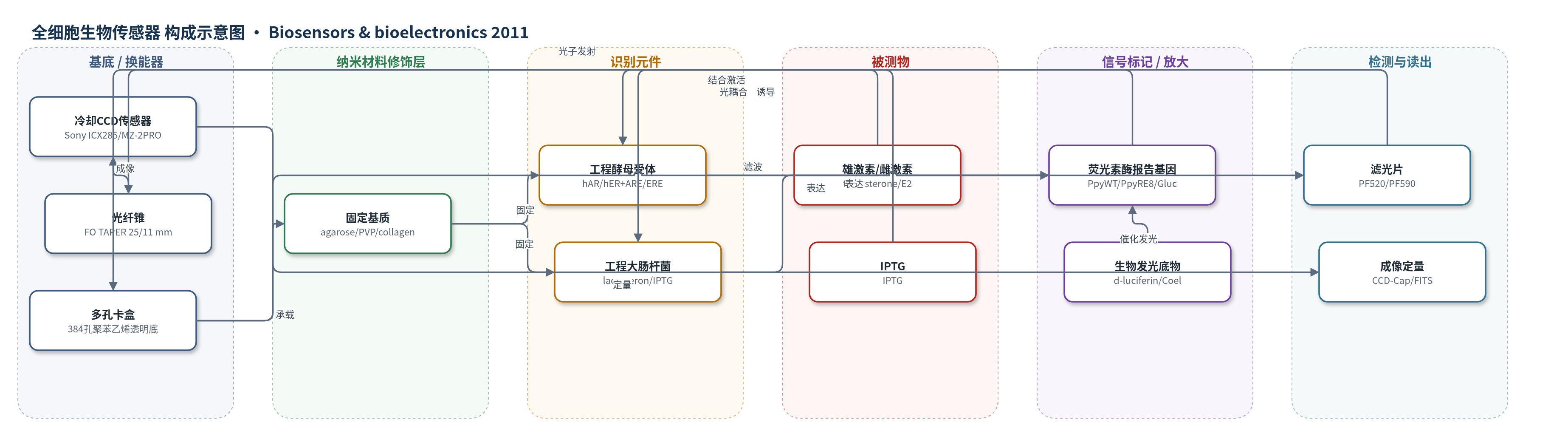
点击图片查看大图 · 依据论文自动绘制
传感器类型
全细胞生物传感器
检测对象
睾酮(testosterone)、17β-雌二醇(17β-estradiol)、异丙基-β-D-1-硫代半乳糖苷(IPTG);样品基质为水相标准溶液(无菌水或含10%乙醇的无菌水),文中亦讨论环境水样或食品样品筛查
检测原理
该传感器基于全细胞报告基因机制。分析物(如睾酮、雌二醇或IPTG)穿过细胞膜后,与细胞内识别元件结合:类固醇激素激活人雄激素受体或雌激素受体,进而结合雄激素/雌激素响应元件;IPTG诱导lac操纵子/lac启动子。识别事件启动报告基因转录,使细胞表达荧光素酶,实现基因表达级联放大。随后加入相应生物发光底物,PpyWT/PpyRE8催化d-荧光素氧化发光,Gluc催化coelenterazine发光。不同发射波长或不同底物实现多路信号分离。发光光子经多孔卡盒、滤光片和光纤锥进入冷却CCD,软件积分光子并扣除背景。分析物浓度越高,诱导的荧光素酶表达越多,BL信号越强;内部活力控制信号用于校正细胞状态波动。
检测灵敏度
睾酮:LOD: 0.5 nM(便携装置);LOD: 0.05 nM(台式仪器);线性范围: 10−11–10−6 M。17β-雌二醇:线性范围: 10−11–10−6 M。IPTG:LOD: 1.5 nM;线性范围: 10−9–10−4 M。
效应效果
固定细胞4℃保存35天后仍存活,细菌和酵母活力损失分别为20±5%和15±3%。新基质重现性优于海藻酸钙(CV<10%对CV<18%)。pH 2–12下活力基本稳定,仅pH 2下降约15±8%。BL信号约4–9 min内稳定。便携装置睾酮LOD 0.5 nM,台式仪器为0.05 nM;IPTG LOD 1.5 nM。双分析物检测中,17β-雌二醇可激活雄激素受体(EC50 1×10⁻⁸ M),睾酮可激活雌激素受体(EC50 1×10⁻⁷ M),反映总激素活性。相比需1–5天、高变异且需外部参考株的传统细胞检测,该装置更快、更稳健,适合环境/食品内分泌干扰物现场筛查。
传感器的构成
- 换能器/读出基底:冷却CCD传感器(Sony ICX285,MZ-2PRO)与光纤锥(FO TAPER 25/11 mm)直接接触,用于无透镜成像和光子采集
- 样品室/多孔卡盒:由黑色384孔聚苯乙烯透明底微孔板裁切成的4×3孔卡盒(3 mm直径,70 µL),承载固定细胞并允许光透过
- 细胞固定基质:1% (w/v) 琼脂糖(agarose)、2% (w/v) 聚乙烯吡咯烷酮(PVP)和0.1% (v/v) 胶原(collagen)水溶液,形成生物相容三维基质,固定细胞并维持活力
- 识别元件(酵母):工程化酿酒酵母(Saccharomyces cerevisiae BMA64-1A)表达人雄激素受体(hAR)或人雌激素受体(hER),并携带雄激素/雌激素响应元件(ARE/ERE)
- 识别元件(细菌):工程化大肠杆菌(E. coli JM109/BL21)携带lac操纵子/lac启动子,用于识别乳糖类似物IPTG
- 报告基因/信号酶:绿色发光P. pyralis野生型荧光素酶(PpyWT,λmax 557 nm)、红色突变体PpyRE8(λmax 618 nm)和Gaussia princeps荧光素酶(Gluc,λmax 490 nm)
- 信号底物:d-荧光素(d-luciferin,1 mM,pH 5)用于P. pyralis荧光素酶;海鳗素(coelenterazine,5 µM)用于Gluc
- 光学滤波与读出:打印透明膜滤光片(PF520带通520 nm、PF590截止590 nm)用于光谱分离;CCD-Cap软件V2.3.1积分光子并扣除背景
中文摘要
我们开发了一种基于遗传工程生物发光(BL)细胞的便携式生物传感装置。细胞通过新型生物相容性基质固定在4×3多孔卡盒中,并保持其活力。利用光纤锥,使卡盒与冷却CCD传感器直接接触,以成像并定量BL信号。酵母和细菌细胞被工程化表达识别元件,其与分析物相互作用后通过报告基因技术诱导荧光素酶表达。共开发三种生物传感器:第一种利用携带绿色发光P. pyralis荧光素酶(受人雄激素受体调控)及红色突变体作为内部活力控制的酵母检测雄激素化合物;第二种利用分别响应雄激素或雌激素而表达绿色或红色发光突变萤火虫荧光素酶的酵母检测两类化合物;第三种利用两种大肠杆菌检测乳糖类似物IPTG,其中一种利用lac操纵子表达P. pyralis荧光素酶,另一种表达Gaussia princeps荧光素酶作为活力控制,且需要不同底物。固定细胞可稳定保存至1个月。使用内部活力控制校正后,分析物可在纳摩尔水平以良好精密度和准确度检测。该便携装置可用于现场多路生物检测不同化合物类别。
英文摘要
We have developed a portable biosensing device based on genetically engineered bioluminescent (BL) cells. Cells were immobilized on a 4 × 3 multiwell cartridge using a new biocompatible matrix that preserved their vitality. Using a fiber optic taper, the cartridge was placed in direct contact with a cooled CCD sensor to image and quantify the BL signals. Yeast and bacterial cells were engineered to express recognition elements, whose interaction with the analyte led to luciferase expression, via reporter gene technology. Three different biosensors were developed. The first detects androgenic compounds using yeast cells carrying a green-emitting P. pyralis luciferase regulated by the human androgen receptor and a red mutant of the same species as internal vitality control. The second biosensor detects two classes of compounds (androgens and estrogens) using yeast strains engineered to express green-or red-emitting mutant firefly luciferases in response to androgens or estrogens, respectively. The third biosensor detects lactose analogue isopropyl β-d-1-thiogalactopyranoside using two E. coli strains. One strain exploits the lac operon as recognition element for the expression of P. pyralis luciferase. The other strain serves as a vitality control expressing Gaussia princeps luciferase, which requires a different luciferin substrate. The immobilized cells were stable for up to 1 month. The analytes could be detected at nanomolar levels with good precision and accuracy when the specific signal was corrected using the internal vitality control. This portable device can be used for on-site multiplexed bioassays for different compound classes.