组成图示
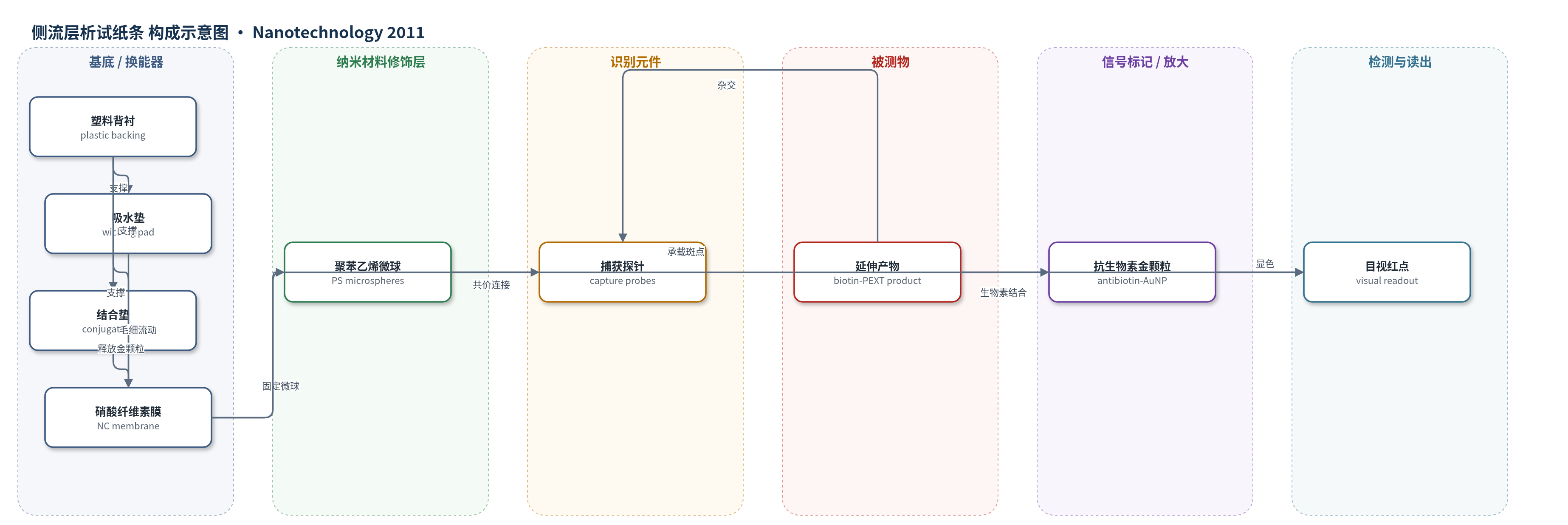
点击图片查看大图 · 依据论文自动绘制
传感器类型
侧流层析试纸条
检测对象
MBL2 G221C、MBL2 G550C、JAK2 G1849T (V617F)、TLR4 A896G、TLR4 C1196T 等单核苷酸多态性/突变(SNPs/mutations);样品基质为基因组 DNA(genomic DNA)经 PCR 扩增后的 PEXT 产物
检测原理
先 PCR 扩增含 SNP 的基因片段,再进行多重引物延伸(PEXT)。每个 SNP 设计两条等位基因特异性引物,3′端对应靶碱基,5′端带唯一序列标签。只有 3′端完全互补时,无外切活性的 Vent(exo-) DNA 聚合酶才延伸引物,并在 dTTP 中掺入 biotin-11-dUTP,使延伸产物带生物素;错配则不延伸、不掺入生物素。将 PEXT 产物加到试纸结合垫,运行缓冲液驱动毛细流动,产物经 5′序列标签与膜上对应捕获探针杂交,被固定在微球表面。结合垫中干燥的抗生物素金纳米颗粒随缓冲液迁移,通过生物素-抗生物素高亲和结合到已捕获的延伸产物上,使金颗粒在对应测试点聚集,形成肉眼可见红色斑点。未延伸引物虽可杂交但无生物素,不显色。斑点颜色强度随延伸产物量增加而增强,直至捕获探针饱和。
检测灵敏度
LOD: 2 fmol;分析范围: 2–80 fmol
效应效果
该传感器在 10 等位基因多重检测中表现出高特异性:单靶标系列中仅对应点显色,缺靶标系列中仅缺失点不显色,无交叉杂交。通过 55 mM 盐、20% 甲酰胺和 1% BSA 的运行缓冲液基本消除微球非特异结合。与被动吸附相比,微球固定提高杂交效率和可检测性。目视检测限为 2 fmol,分析范围至 80 fmol;PCR 产物 10–100 fmol 不影响特异性和检测。基因分型结果与 DNA 测序完全一致。正常和杂合样本各重复 3 次,检测步骤及 PEXT+检测均具可重复性。偶联物可 4°C 保存数月,PEXT 10 个循环约 13 min,试纸检测约 15 min。作者认为该设计可目视同时检测至少 10 个等位基因,适合小型实验室或现场基因分型。
传感器的构成
- 基底背衬:plastic adhesive backing,支撑与固定试纸条各层
- 吸水垫:wicking pad,浸入运行缓冲液并驱动毛细流动
- 结合垫:glass-fibre conjugate pad,干燥负载抗生物素金纳米颗粒(antibiotin-AuNP)
- 检测膜:nitrocellulose membrane(Immunopore FP,5 µm 孔径),承载多个测试点与控制点
- 捕获微球层:2 µm carboxylate-modified polystyrene microspheres,经 EDC 共价连接 5′-NH2 capture probes,被膜纤维固定形成不扩散测试点
- 识别元件:24 nt capture probes,与 PEXT 产物 5′ sequence tag 特异性杂交;控制点微球探针经 TdT 加尾 biotin-dUTP
- 信号标记物:40 nm gold nanoparticles (AuNP) 物理吸附 goat antibiotin,结合生物素化延伸产物形成红色斑点
- 运行缓冲/封闭:sodium citrate、NaCl、Tween-20、BSA、SDS、formamide,维持杂交并抑制非特异结合
中文摘要
一次性试纸型 DNA 生物传感器以侧流层析条形式用于基因分型,因简单、低成本、便携而适用于小型实验室或现场检测,其独特优势是无需仪器即可在数分钟内目视检测,干试剂形式减少移液、孵育和洗涤步骤。本研究在不牺牲简便性的前提下显著增强侧流层析条生物传感器的多重检测能力。多重基因分型通过 PCR 后针对所有目标等位基因进行单一引物延伸反应实现;只有当引物与靶序列完全互补时,引物才被延伸并掺入生物素。多等位检测通过传感器膜上的多个测试点实现,每个点包含功能化捕获探针的聚苯乙烯微球悬浮液。引物延伸产物通过特定序列标签与捕获探针杂交,并用抗生物素金纳米颗粒显色。该设计使小面积内可容纳多个点,因为微球被膜纤维捕获并固定于原位而不扩散;同时由于杂交物暴露在被捕获微球表面而非膜孔内,可检测性提高。我们展示了该生物传感器用于多等位基因分型的特异性和性能。
英文摘要
Disposable dipstick-type DNA biosensors in the form of lateral flow strips are particularly useful for genotyping in a small laboratory or for field testing due to their simplicity, low cost and portability. Their unique advantage is that they enable visual detection in minutes without the use of instruments. In addition, the dry-reagent format minimizes the pipetting, incubation and washing steps. In this work, we significantly enhance the multiplexing capabilities of lateral flow strip biosensors without compromising their simplicity. Multiplex genotyping is carried out by polymerase chain reaction (PCR) followed by a single primer extension reaction for all target alleles, in which a primer is extended and biotin is incorporated only if it is perfectly complementary to the target. Multiallele detection is achieved by multiple test spots on the membrane of the sensor, each comprising a suspension of polystyrene microspheres functionalized with capture probes. The products of the primer extension reaction hybridize, through specific sequence tags, to the capture probes and are visualized by using antibiotin-conjugated gold nanoparticles. This design enables accommodation of multiple spots in a small area because the microspheres are trapped in the fibres of the membrane and remain fixed in site without any diffusion. Furthermore, the detectability is improved because the hybrids are exposed on the surface of the trapped microspheres rather than inside the pores of the membrane. We demonstrate the specificity and performance of the biosensor for multiallele genotyping.