组成图示
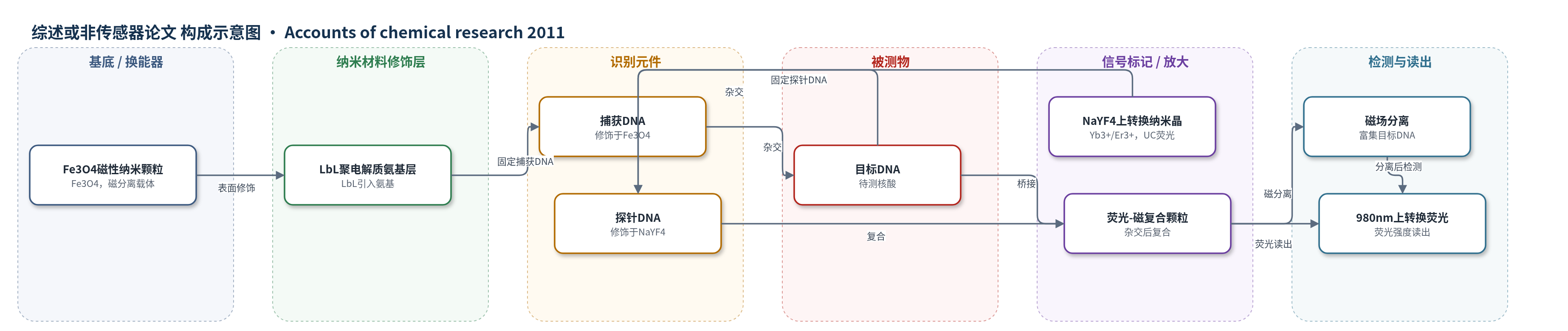
点击图片查看大图 · 依据论文自动绘制
传感器类型
综述或非传感器论文
检测对象
目标DNA(target DNA,溶液/缓冲液)、avidin(亲和素,溶液)、葡萄糖(glucose,溶液)
检测原理
以文中 DNA 检测为例:Fe3O4 磁性纳米颗粒经 LbL 聚电解质修饰后固定 capture DNA,NaYF4:Yb3+/Er3+ 上转换纳米晶经类似修饰固定 probe DNA。加入 target DNA 后,其先与 capture DNA 杂交,使目标序列被 Fe3O4 捕获;在磁场辅助下将含 target DNA 的磁性颗粒分离富集,降低背景。随后 probe DNA 与 target DNA 的悬垂区杂交,形成 Fe3O4–target DNA–NaYF4 荧光-磁复合颗粒。980 nm 激光激发下,Yb3+ 吸收能量并传递给 Er3+,产生绿色上转换荧光;复合颗粒数量随 target DNA 浓度增加,UC 荧光强度线性增强。该策略利用 DNA 杂交识别、磁分离富集和上转换荧光低背景读出实现无酶检测。文中还概述了基于 FRET 的 avidin 与葡萄糖检测:供体/受体纳米材料距离变化引起能量转移效率改变,从而产生荧光信号变化。
检测灵敏度
线性范围: 7.8–78.0 nM;线性方程: FUC = 292.4 + 15.7C
效应效果
文中未报告该 DNA 检测系统的 LOD、RSD、长期稳定性、抗干扰矩阵或实际样品加标回收率,也未与 ELISA、qPCR 等方法进行定量对比。已报告 target DNA 在 7.8–78.0 nM 范围内与 UC 荧光强度呈线性,线性方程为 FUC = 292.4 + 15.7C。作者强调 Fe3O4 磁分离可富集目标 DNA 并减少背景,NaYF4:Yb3+/Er3+ 上转换荧光具有窄发射、长寿命和抗光漂白优势,适合时间分辨荧光检测。FRET 生物传感器用于 avidin 和葡萄糖,被描述为简单、灵敏、非酶法。综述还指出稀土纳米晶可用于多模态生物成像、催化和染料敏化太阳能电池,但实际生物应用仍需提高水溶性、生物相容性、稳定性和多色多功能性。
传感器的构成
- 磁性载体/分离层:Fe3O4 磁性纳米颗粒,平均约150 nm,提供磁场辅助分离与富集。
- 表面功能化层:聚电解质层层自组装(LbL)引入氨基,用于连接核酸。
- 识别元件:capture DNA 修饰于 Fe3O4,与 target DNA 杂交。
- 识别元件:probe DNA 修饰于 NaYF4:Yb3+/Er3+,与 target DNA 悬垂区杂交。
- 荧光换能纳米晶:NaYF4:Yb3+/Er3+ 上转换纳米晶,平均约50 nm,980 nm 激发下发射绿色 UC 荧光。
- 信号标记/放大:上转换荧光(UC fluorescence)作为光学信号,随 target DNA 浓度增加而增强。
- 检测读出:磁场分离后采用 UC 荧光光谱检测复合纳米颗粒。
中文摘要
由于稀土掺杂纳米晶在显示器件、光通信、固态激光、催化和生物标记等应用中具有潜力,其可控合成受到广泛关注。本 Account 总结了清华大学李亚栋课题组在稀土掺杂纳米晶合成、光学-磁学性质及应用方面的进展。自2005年提出液-固-溶液(LSS)纳米晶合成策略以来,作者制备了一系列单分散胶体氟化物、氧化物、氢氧化物、正钒酸盐、硫氧化物、硼酸盐和磷酸盐纳米晶;通过调节反应条件,可得到空心微球、纳米棒、纳米线、六边形纳米片和纳米带等结构。通过混合不同胶体纳米晶并采用超声方法,作者构建了具有双模发光特性的二元纳米结构。通过三掺杂不同电子结构的稀土离子,实现了具有室温顺磁性和可调上转换发光的 β-NaYF4 纳米棒。文中还介绍了 NaYF4:Yb3+/Er3+ 与 Fe3O4 磁性纳米颗粒用于 DNA 灵敏检测、LaF3:Ce3+/Tb3+ 用于非酶葡萄糖 FRET 检测,以及基于 NaYF4 与金纳米颗粒 FRET 的 avidin 生物传感器,并初步探讨了催化和染料敏化太阳能电池应用。
英文摘要
Because of the potential applications of lanthanide-doped nanocrystals in display devices, optical communication, solid-state lasers, catalysis, and biological labeling, the controlled synthesis of these new nanomaterials has sparked considerable interest. Nanosized phosphorescent or optoelectronic devices usually exhibit novel properties, depending on their structures, shapes, and sizes, such as tunable wavelengths, rapid responses, and high efficiencies. Thus, the development of facile synthetic methods towards high-quality lanthanide-doped nanocrystals with uniform size and shape appears to be of key importance both for the exploration of their materials properties and for potential applications. This Account focuses on the recent development in our laboratory of the synthesis and applications of lanthanide-doped nanocrystals. Since 2005, when we proposed a general strategy for nanocrystal synthesis via a liquid-solid-solution process, a range of monodisperse and colloidal lanthanide-doped fluoride, oxide, hydroxide, orthovanadate, thiooxide, borate, and phosphate nanocrystals have been successfully prepared. By rationally tuning the reaction conditions, we have readily synthesized nanostructures, such as hollow microspheres, nanorods, nanowires, hexagonal nanoplates, and nanobelts. By adjusting the different colloidal nanocrystal mixtures, we fabricated unique binary nanostructures with novel dual-mode luminescence properties through a facile ultrasonic method. By tridoping with lanthanide ions that had different electronic structures, we successfully achieved β-NaYF(4) nanorods that were paramagnetic with tuned upconversion luminescence. We have also used NaYF(4):Yb(3+)/Er(3+) conbined with magnetite nanoparticles as a sensitive detection system for DNA: NaYF(4):Yb(3+)/Er(3+) and Fe(3)O(4) nanoparticles were modified with two different DNA sequences. Then, the modified NaYF(4):Yb(3+)/Er(3+) nanoparticles were conjugated to the modified Fe(3)O(4) nanoparticles. These binary nanoparticles can be hybridized with a third DNA (target DNA) molecule and separated with the assistance of a magnetic field. In addition, a novel fluorescence resonance energy transfer (FRET) method for nonenzymatic glucose determination has been developed by using the glucose-modified LaF(3):Ce(3+)/Tb(3+) nanocrystals. By using bioconjugated NaYF(4):Yb(3+)/Er(3+) nanoparticles as the energy donor and bioconjugated gold nanoparticles as the energy acceptor, we successfully developed a simple and sensitive fluorescence resonance energy transfer (FRET) biosensor for avidin. Meanwhile, we also carried out preliminary studies to investigate possible applications of lanthanide-doped nanocrystals in catalysis and in dye-sensitized solar cells.