组成图示
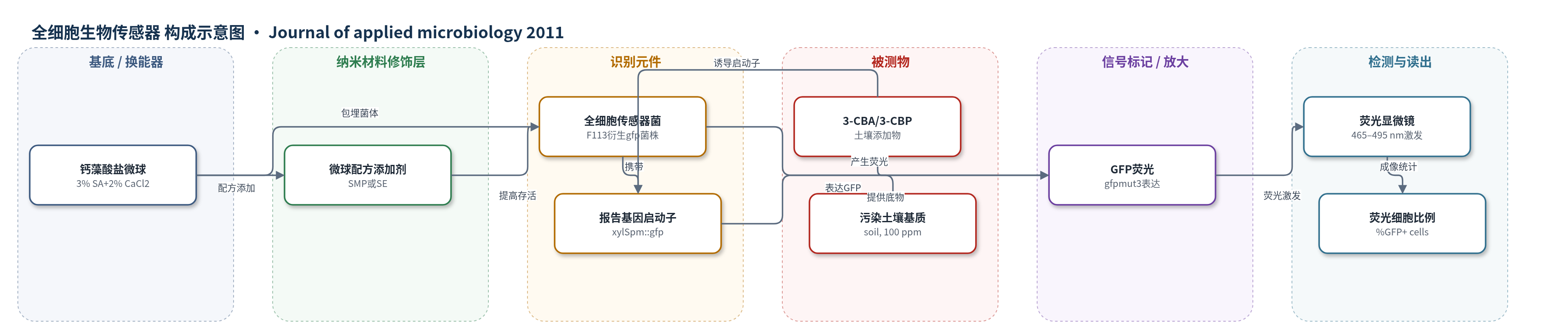
点击图片查看大图 · 依据论文自动绘制
传感器类型
全细胞生物传感器
检测对象
3-氯苯甲酸盐(3-chlorobenzoate, 3-CBA)、3-氯联苯(3-chlorobiphenyl, 3-CBP)/多氯联苯(polychlorinated biphenyls, PCBs);样品基质为土壤(含100 ppm 3-CBA或3-CBP的添加土及污染土壤)
检测原理
该传感器为全细胞荧光生物传感器。工程菌F113Rifgfp或F113L::1180gfp携带xylSpm::gfp报告基因,其中pm启动子来自TOL质粒,可被氯苯甲酸衍生物诱导。当土壤中存在3-CBA,或3-CBP/PCBs被降解产生3-CBA等中间产物时,诱导物扩散进入藻酸盐微球和菌体,激活pm启动子,驱动gfpmut3表达,产生绿色荧光。GFP荧光强度或GFP阳性细胞比例随诱导物浓度升高而增加。F113L::1180gfp自身可降解PCBs并产生CBA,因此能报告自身降解活性;F113Rifgfp不降解PCBs,仅检测外部CBA。藻酸盐微球允许底物扩散进入,同时限制土著CBA降解菌进入,使微球内CBA积累,增强诱导和荧光信号。最终通过荧光显微镜或荧光仪统计GFP阳性细胞比例完成读出。
检测灵敏度
原文未报告 LOD、线性范围、灵敏度斜率或相关系数。
效应效果
藻酸盐微球可长期保存工程菌:F113Rifpcb储存250 d后仍可回收100%活菌;第1 d约1.0×10^5 CFU/珠,第40 d降至35%。10% SMP显著提前释放。封装接种使非根际土中菌量降至0.01–0.08% TVC,降低GM菌扩散风险。封装不影响3-CBA检测:两株传感器GFP阳性率均为100%(SD 0);3-CBP土中F113L::1180gfp约30%(SD 11.6–11.9)。与降解菌共接种时封装组信号更高:3-CBA+B13 10 d后封装F113L::1180gfp 10%(SD 4.6),3-CBP+ITCBP 10 d后封装F113Rifgfp 50%(SD 14.2),游离组为0和30%(SD 14.9)。微球便于回收和可视化,可评估PCB污染土降解潜力。
传感器的构成
- 包容基质:3%海藻酸钠(sodium alginate, SA)与2%氯化钙(CaCl2)交联形成钙藻酸盐微球(calcium alginate beads),约3 mm,用于储存、递送和包容菌体。
- 配方添加剂:10% w/v脱脂奶粉(skim milk powder, SMP)或土壤提取物(soil extract, SE)加入SA,提高菌体存活与释放(可选)。
- 识别元件:全细胞生物传感器菌株Pseudomonas fluorescens F113Rifgfp或F113L::1180gfp,携带xylSpm::gfp报告基因,识别3-CBA/PCB代谢物。
- 信号标记物:绿色荧光蛋白(green fluorescent protein, GFP, gfpmut3),受pm启动子诱导表达,产生荧光信号。
- 读出换能:荧光显微镜/荧光仪(epi-fluorescent microscopy/fluorimetry),激发465–495 nm或450–490 nm,检测GFP荧光。
- 对照染色:0.1%吖啶橙(acridine orange)染非荧光细胞为红色,用于区分GFP阳性细胞。
中文摘要
本文评估藻酸盐微球作为储存、递送和包容系统,用于多氯联苯(PCBs)降解菌Pseudomonas fluorescens F113Rifpcb及两个PCB生物传感器菌株F113Rifgfp和F113L::1180gfp在污染土壤中的应用。F113Rifpcb为工程根际菌,可降解PCBs;F113Rifgfp和F113L::1180gfp为全细胞荧光生物传感器,可检测3-氯苯甲酸盐(3-CBA)和3-氯联苯(3-CBP)的生物可利用性与生物降解。研究评估了F113Rifpcb在藻酸盐微球中的存活与释放,并检测封装后生物传感器在添加3-CBA或3-CBP土壤中的响应。结果表明,室温非无菌储存250 d后仍可回收100%活F113Rifpcb细胞;通过添加脱脂奶粉或土壤提取物可调控释放。封装接种使非根际土中菌量降低,减少基因修饰微生物扩散风险。藻酸盐封装不干扰生物传感器检测3-CBA或3-CBP降解,且封装组对3-CBP降解的荧光响应增强。结论认为藻酸盐微球是PCB降解接种物和生物传感器的有效储存与递送系统,可促进其在PCB污染土壤检测与生物修复中的应用。
英文摘要
AIMS: Pseudomonas fluorescens F113Rifpcb is a genetically engineered rhizosphere bacterium with the potential to degrade polychlorinated biphenyls (PCBs). F113Rifpcbgfp and F113L::1180gfp are biosensor strains capable of detecting PCB bioavailability and biodegradation. The aim of this paper is to evaluate the use of alginate beads as a storage, delivery and containment system for use of these strains in PCB contaminated soils.
METHODS AND RESULTS: The survival and release of Ps. fluorescens F113Rifpcb from alginate beads were evaluated. Two Ps. fluorescens F113-based biosensor strains were encapsulated, and their ability to detect 3-chlorobenzoate (3-CBA) and 3-chlorobiphenyl (3-CBP) degradation in soil was assessed. After 250 days of storage, 100% recovery of viable F113Rifpcb cells was possible. Amendments to the alginate formulation allowed for the timed release of the inoculant. Encapsulation of the F113Rifpcb cells provided a more targeted approach for the inoculation of plants and resulted in lower inoculum populations in the bulk soil, which may reduce the risk of unintentional spread of these genetically modified micro-organisms in the environment. Encapsulation of the biosensor strains in alginate beads did not interfere with their ability to detect either 3-CBA or 3-CBP degradation. In fact, detection of 3-CBP degradation was enhanced in encapsulated biosensors.
CONCLUSIONS: Alginate beads are an effective storage and delivery system for PCB degrading inocula and biosensors.
SIGNIFICANCE AND IMPACT OF THE STUDY: Pseudomonas fluorescens F113Rifpcb and the F113 derivative PCB biosensor strains have excellent potential for detecting and bioremediation of PCB contaminated soils. The alginate bead delivery system could facilitate the application of these strains as biosensors.