组成图示
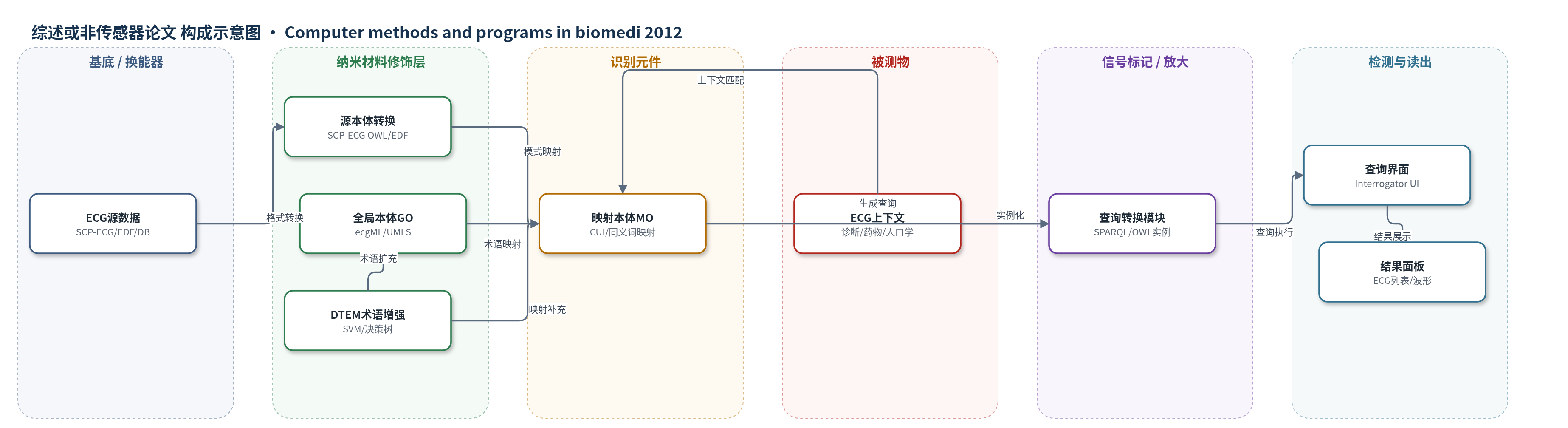
点击图片查看大图 · 依据论文自动绘制
传感器类型
综述或非传感器论文
检测对象
心电图信号(ECG,electrocardiogram);样品基质:SCP-ECG 文件、EDF+ 文件及关系数据库中的 ECG 记录
检测原理
本文不报道基于生物识别界面的传感检测,而是提出 ECG 生物信号数据库的统一访问与查询框架。其处理流程为:首先将 SCP-ECG、EDF+ 文件及关系数据库中的 ECG 记录转换为 OWL 实例或源本体;随后通过全局本体 GO 和映射本体 MO 建立源模式与统一术语之间的对应关系,并利用 UMLS 同义词、编辑距离和人工校验完成映射;用户基于 GO 拖拽概念与属性形成内容/上下文查询,查询转换模块将其转换为 SPARQL 等动态组合查询,再访问相应数据源并返回满足条件的 ECG 文件与波形。DTEM 方法通过 SVM、决策树等分类器将未映射医学术语动态纳入 GO,提高术语覆盖与查询扩展能力。
检测灵敏度
原文未报告传感器检测灵敏度(LOD、线性范围、灵敏度斜率、相关系数)。
效应效果
系统整合 SCP-ECG、EDF+ 与 INTERLIFE 数据库。映射实例化中,GO 有 244 类名、34 属性;INTERLIFE 有 585 记录、140 属性、40 表;SCP-ECG 有 213 类、131 属性;EDF 有 54 类、17 属性。DTEM 概念适宜性中,RBF SVM 灵敏度、特异度、准确率为 0.986842、0.777778、0.964706(82/85),线性 SVM 为 0.973684、0.666667、0.941176(80/85)。层级适宜性中,C4.5 与朴素贝叶斯为 1、0.8333、96.721%(59/61),ADTree 为 0.8、0.727、91.803%(56/61)。可支持研究、教育与临床决策。
传感器的构成
- 系统架构层:ROISES 三层架构(UI Layer、Mediation Layer、Repository Layer),用于统一访问 ECG 生物信号数据库
- 本体层:全局本体 GO(基于 ecgML、SCP-ECG、UMLS),用于统一 ECG 内容、上下文与医学术语
- 映射层:映射本体 MO 与 SCIC/SYIC/MIC 组件,用于建立源模式、同义词与全局本体之间的映射
中文摘要
纺织、生物传感器和心电图领域的技术进步推动了生物信号采集设备的广泛使用,并产生大量生物信号数据集。心电图(ECG)是生物信号监测与记录中历史最悠久、信号较强且相对稳健的信号之一。随着研究资源增加,研究社区希望从生物信号中提取新知识以支持新的医疗流程。然而,由于生物信号存储格式多样且异构,ECG 的统一访问、查询和管理受到限制。为此,本文提出一种面向生物信号数据库及其元数据统一访问的新方法,使信息检索与底层数据源结构解耦,并支持从多个数据资源进行透明的基于内容和上下文的检索。该方法基于交互式全局本体的定义,通过处理底层数据源之间的相似性与差异,建立相似性映射或丰富术语结构。作者还提出 ROISES(面向研究的 ECG 信号集成系统),用于针对多种异构生物信号数据源定义复杂的内容查询。
英文摘要
Technological advances in textile, biosensor and electrocardiography domain induced the wide spread use of bio-signal acquisition devices leading to the generation of massive bio-signal datasets. Among the most popular bio-signals, electrocardiogram (ECG) possesses the longest tradition in bio-signal monitoring and recording, being a strong and relatively robust signal. As research resources are fostered, research community promotes the need to extract new knowledge from bio-signals towards the adoption of new medical procedures. However, integrated access, query and management of ECGs are impeded by the diversity and heterogeneity of bio-signal storage data formats. In this scope, the proposed work introduces a new methodology for the unified access to bio-signal databases and the accompanying metadata. It allows decoupling information retrieval from actual underlying datasource structures and enables transparent content and context based searching from multiple data resources. Our approach is based on the definition of an interactive global ontology which manipulates the similarities and the differences of the underlying sources to either establish similarity mappings or enrich its terminological structure. We also introduce ROISES (Research Oriented Integration System for ECG Signals), for the definition of complex content based queries against the diverse bio-signal data sources.