组成图示
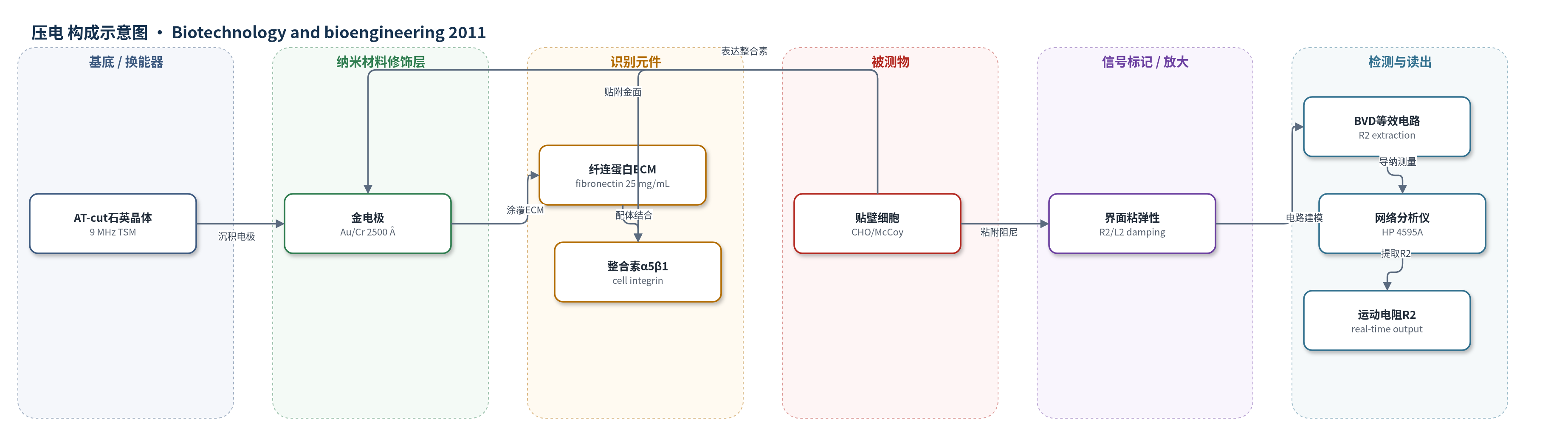
点击图片查看大图 · 依据论文自动绘制
传感器类型
压电(QCM)生物传感器
检测对象
贴壁细胞粘附浓度/细胞粘附过程(cell adhesion process,adherent cell concentration);样品基质:DMEM培养液中的细胞悬液/贴壁单层(CHO细胞、McCoy成纤维细胞)
检测原理
在交变电场下,AT-cut石英晶体以9 MHz厚度剪切模式振动,产生剪切声波。贴壁细胞通过表面整合素α5β1与金电极表面的纤连蛋白/金界面结合,经历沉降、铺展和增殖。细胞单层及其细胞外基质改变金-细胞界面的粘弹性和剪切阻尼,使负载谐振器在BVD等效电路中增加R2(阻尼)和L2(质量/频率偏移)。网络分析仪测量导纳并提取运动电阻R2;R2随贴壁细胞数量、铺展面积和整合素表达增加而升高,因此可无标记、实时定量细胞粘附过程。
检测灵敏度
相关系数: 0.976(CHO细胞数 vs R2)、0.988(McCoy细胞数 vs R2)、0.968(CHO细胞面积 vs R2)、0.991(McCoy细胞面积 vs R2)、0.992(CHO整合素荧光 vs R2)、0.995(McCoy整合素荧光 vs R2)
效应效果
传感器在37°C恒温下可重复使用,同一金表面内实验CHO细胞8 h运动电阻为207.5±2.5 Ω,CV 1.0%;不同金表面为242.7±10.7 Ω,CV 4.5%。培养液、单独纤连蛋白和非贴壁Jurkat细胞不引起R2变化,胰蛋白酶消化后R2急剧下降,证明响应特异于细胞粘附。R2与细胞计数相关系数为0.976(CHO)和0.988(McCoy),与细胞面积相关系数为0.968和0.991,与整合素荧光相关系数为0.992和0.995。金表面与聚苯乙烯表面细胞周期相关系数为0.997和0.999。作者认为可用于药物筛选、细胞毒性检测、生物材料评价和实时粘附监测。
传感器的构成
- 基底/换能器:AT-cut石英晶体(9 MHz,直径14 mm),厚度剪切模式压电换能器
- 电极/传感界面:金电极(2500 Å Au,蒸发沉积于薄铬粘附层),传导电信号并与溶液接触
- 识别/粘附层:纤连蛋白(fibronectin,25 mg/mL)涂覆金表面,提供细胞外基质结合位点
- 识别元件:细胞表面整合素(integrin α5β1)与纤连蛋白/金界面结合,介导细胞粘附
- 信号标记:无标记(label-free),细胞粘附引起界面粘弹性与阻尼变化
- 读出电路:BVD等效电路(C0、L1、R1、C1及负载R2、L2),将粘附转换为运动电阻R2
- 检测仪器:网络分析仪HP 4595A与PC控制软件,每30 s测量导纳并提取R2
中文摘要
Sauerbrey指出,厚度剪切模式(TSM)石英晶体传感器的共振频率偏移与沉积在其上的质量成正比。新型强电电路使TSM石英晶体传感器可在流体中工作,从而将该方法引入电化学和生物应用,包括检测病毒衣壳、细菌、哺乳动物细胞、DNA与RNA互补链相互作用、固定受体对蛋白配体的特异性识别以及完整免疫传感器。压电石英换能器可实现无标记分子识别;其响应不仅反映质量,还受吸附蛋白表面电荷、界面现象、表面粗糙度和粘附生物材料粘弹性影响。这些特性被用于研究细胞、脂质体和蛋白在表面的粘附,从而快速测定药物引起的细胞形态变化及生物聚合物含水量变化,避免耗时方法。作者验证了一种基于TSM的替代定量声学方法,用于实时监测细胞粘附过程;剪切声学参数(运动电阻)与细胞计数结果相关,并能实时反映粘附过程。
英文摘要
Sauerbrey [(1956), Z Phys 55:206-222] showed that the shift in resonance frequency of thickness shear mode (TSM) of a quartz crystal sensor is proportional to the mass, which is deposited on it. However, new powerful electrical circuits were developed that are capable of operating TSM quartz crystal sensors in fluids which enabled this method to be introduced into electrochemical and biological applications. These applications include the detection of virus capsids, bacteria, mammalian cells, the interaction of DNA and RNA with complementary strands, specific recognition of protein ligands by immobilized receptors, and last but not least the study of complete immunosensors. Piezoelectric quartz transducers allow a label-free identification of molecules; they are more than mass sensors since the biosensor response is also influenced by the surface charge of adsorbed proteins, interfacial phenomena, surface roughness and viscoelastic properties of the adhered biomaterial. These new characteristics have recently been used to investigate cell, liposome, and protein adhesion onto surfaces, thus permitting the rapid determination of morphological cell changes as a response to pharmacological substances, and changes in the water content of biopolymers avoiding of time-consuming methods. We validated an alternative quantitative acoustical engineering for cell adhesion process monitored by the TSM. Shear acoustical results (motional resistance) are further correlated to cell counting procedures and are sensitive of adhesion processes in real-time.