组成图示
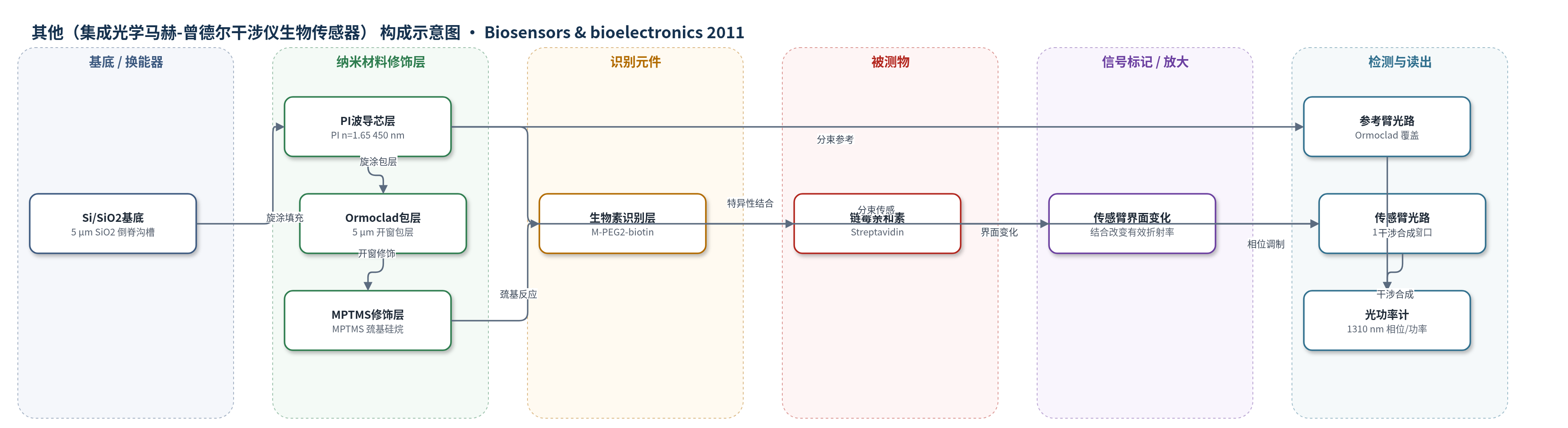
点击图片查看大图 · 依据论文自动绘制
传感器类型
其他(集成光学马赫-曾德尔干涉仪生物传感器)
检测对象
链霉亲和素(streptavidin,Chromeon 642-streptavidin),样品基质:磷酸盐缓冲液(PBS)
检测原理
该传感器基于集成马赫-曾德尔干涉仪(MZI)倏逝波原理。1310 nm光经单模光纤端面耦合进入PI波导,Y分支将光分为被Ormoclad覆盖的参考臂和暴露于样品流体的传感臂。传感臂PI表面经MPTMS和M-PEG2-biotin功能化后固定生物素,当PBS中的链霉亲和素流过时,生物素与链霉亲和素发生特异性结合,使传感臂表面生物分子层厚度和折射率增加,从而改变波导模式的有效折射率与传播相位。参考臂相位基本不变,两臂光在输出端重新干涉,输出光强和相位随结合量变化。链霉亲和素浓度越高,表面结合量越大,累积相位偏移越大;PBS冲洗后结合物不脱落,信号保持稳定。该过程不依赖额外荧光或放射性标记读出,直接通过光学相位/功率实现无标记检测。
检测灵敏度
LOD: 0.1 μg/ml(=1.66 nM)
效应效果
BSA封闭使最大响应降低约40%,但有效抑制非特异结合;未封闭时约40%响应来自非特异结合,PBS冲洗后未封闭样品相位下降约10%,封闭样品冲洗后相位基本不变。重复测量同一浓度不同样品的标准偏差约12%,插入损耗优于-18 dB,MZI最大与最小传输比大于15 dB。0.1 μg/ml链霉亲和素在500 s和1000 s分别产生约1 dB和3 dB可分辨传输变化。作者认为其灵敏度与SOI环谐振器报道的0.1 μg/ml和1 μg/ml水平相当,明显优于此前聚合物Bragg光栅的33.2 nM和聚苯乙烯环谐振器的1 μM。该设计兼容注塑成型和旋涂,适合低成本一次性生物传感器。
传感器的构成
- 基底/换能器:硅片上5 μm SiO2层,UV光刻与SF6反应离子刻蚀形成倒脊波导沟槽,承载MZI光路
- 波导芯层:聚酰亚胺(PI,n=1.65)旋涂450 nm,UV活化并200 ℃热固化,填充SiO2沟槽形成单模倒脊波导
- 包层:Ormoclad旋涂5 μm,UV曝光除1 cm传感窗口,Ormodev显影并150 ℃固化,覆盖参考臂并保护波导
- 表面活化与硅烷修饰层:氧等离子体处理1 min活化PI表面,随后3-巯基丙基三甲氧基硅烷(MPTMS)溶液室温浸渍1 h,形成含巯基硅烷化界面
- 识别元件:马来酰亚胺-PEG2-生物素(M-PEG2-biotin,5 μM)室温浸渍2 h,通过巯基-马来酰亚胺反应固定生物素
- 封闭剂:100 μg/ml牛血清白蛋白(BSA)PBS溶液浸渍30 min,抑制链霉亲和素非特异结合
- 流体与读出:PDMS流室、注射泵、1310 nm可调激光器、单模光纤端面对接和光功率计,用于样品输送与MZI相位/功率读出
中文摘要
本文报道了一种基于高折射率对比聚合物材料体系的集成马赫-曾德尔干涉仪(MZI)生物传感器,并实现了生物素-链霉亲和素结合过程的无标记在线检测。传感器以硅片上5 μm二氧化硅(SiO2)为基底,采用聚酰亚胺(PI,n=1.65)作为波导芯层,Ormoclad作为包层,形成倒脊波导结构。PI表面经氧等离子体活化后,用3-巯基丙基三甲氧基硅烷(MPTMS)和马来酰亚胺-PEG2-生物素(M-PEG2-biotin)功能化,并用牛血清白蛋白(BSA)封闭。将不同浓度的Chromeon 642-链霉亲和素磷酸盐缓冲液(PBS)溶液经流体系统冲洗过传感臂,在1310 nm波长下监测MZI输出信号。尽管聚合物体系折射率对比低、表面灵敏度有限,仍可分辨低至0.1 μg/ml的链霉亲和素。该聚合物光学传感器设计与注塑成型、旋涂等低成本量产工艺兼容,是无标记生物分子检测的潜在替代方案。
英文摘要
We report the development of a Mach-Zehnder interferometer biosensor based on a high index contrast polymer material system and the demonstration of label-free online measurement of biotin-streptavidin binding on the sensor surface. The surface of the polyimide waveguide core layer was functionalized with 3-mercaptopropyl trimethoxy silane and malemide tagged biotin. Several concentrations of Chromeon 642-streptavidin dissolved in phosphate buffered saline solution were rinsed over the functionalized sensor surface by means of a fluidic system and the biotin-streptavidin binding process was observed in the output signal of the interferometer at a wavelength of 1310 nm. Despite the large wavelength and the comparatively low surface sensitivity of the sensor system due to the low index contrast in polymer material systems compared to inorganic material systems, we were able to resolve streptavidin concentrations of down to 0.1 μg/ml. The polymer-based optical sensor design is fully compatible with cost-efficient mass production technologies such as injection molding and spin coating, which makes it an attractive alternative to inorganic optical sensors.