组成图示
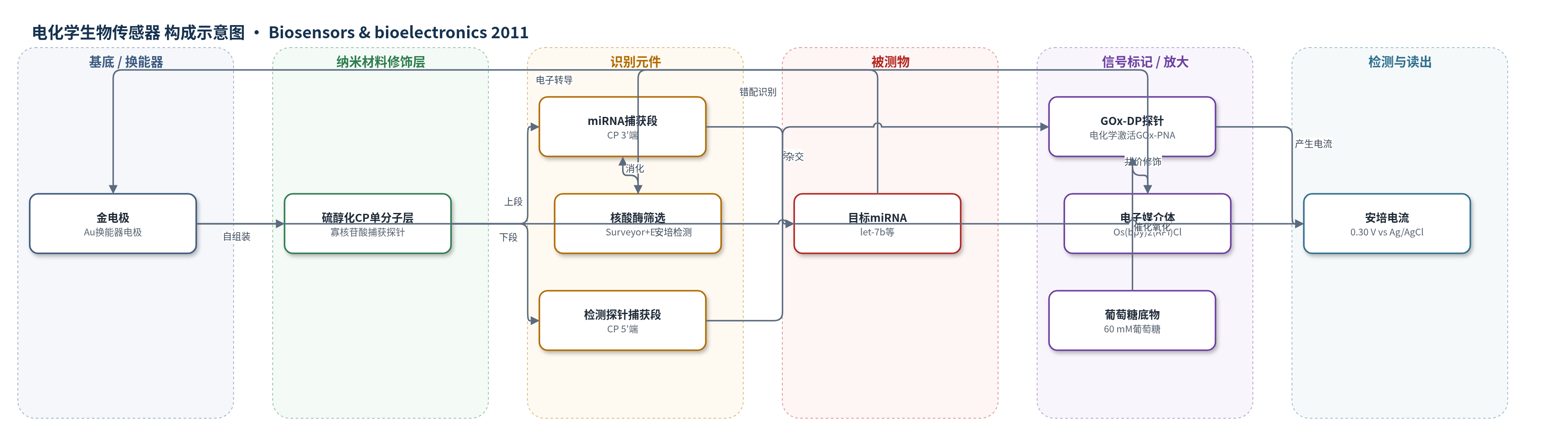
点击图片查看大图 · 依据论文自动绘制
传感器类型
电化学生物传感器
检测对象
微小RNA(microRNA, miRNA;let-7b、let-7a、let-7c、miR-720、miR-1248),样品基质为细胞系总RNA(total RNA extracted from cell lines,如HeLa、肺癌细胞、正常细胞)
检测原理
硫醇化CP在金电极自组装,3′端捕获目标miRNA。杂交后Surveyor核酸酶识别并切割错配miRNA/CP双链,核酸外切酶I消化未杂交CP,仅完全互补双链保留,实现单碱基错配区分。随后GOx-DP与CP 5′端杂交,每个杂交miRNA引入一个GOx。GOx经Os(bpy)2(API)Cl共价修饰实现电化学激活,在0.30 V下催化葡萄糖氧化,电子经Os媒介体快速传递至金电极,产生安培电流。高葡萄糖浓度和高电位使电流受GOx催化周转控制,因此电流与表面GOx数量及miRNA浓度成正比。无需PCR或连接,酶催化氧化提供信号放大。
检测灵敏度
LOD: ~10 fM (20 zmol, S/N=3.0);线性上限: 10 pM;动态范围: 20 fM–10 pM
效应效果
传感器对let-7家族具有强选择性:let-7b传感器对单碱基错配let-7c电流下降约98%,选择性约50/1;对双碱基错配let-7a下降约99%,选择性约99/1;三碱基及以上错配信号与背景不可区分。在1.0 pM下6次重复RSD<15%;100 fM–10 pM相对误差一般<15%。与qRT-PCR相比,灵敏度提高两个数量级,且无需连接、克隆或PCR扩增;总RNA用量从微克降至纳克(<100细胞)。对HeLa、肺癌细胞和正常细胞总RNA中let-7a/b/c的检测结果与qRT-PCR一致。作者认为其适合分子诊断、早期癌症诊断、即时检测与现场使用,并可构建低密度生物传感器阵列。
传感器的构成
- 基底/换能器电极:金电极(Au electrode),经Nanostrip清洗,提供电子转导与安培检测界面
- 识别元件:硫醇化长寡核苷酸捕获探针(thiolated oligonucleotide capture probes, CPs),自组装单分子层,3′端miRNA捕获段、5′端检测探针捕获段
- 识别/筛选元件:Surveyor核酸酶与核酸外切酶I(exonuclease I)混合酶,消化未杂交CP和错配miRNA/CP双链,保留完全互补双链
- 信号标记物:电化学激活葡萄糖氧化酶-亲和素-肽核酸检测探针(electrochemically activated GOx–avidin–PNA detection probes, GOx–DP),通过生物素-亲和素连接,杂交到CP底端,携带GOx
- 电子媒介体:Os(bpy)2(API)Cl(osmium redox mediator),共价修饰GOx,促进电子从GOx到电极
- 底物/电子供体:葡萄糖(glucose, 60 mM),被GOx催化氧化产生电子
- 检测缓冲液:PBS(10 mM phosphate + 139 mM NaCl + 2.7 mM KCl),用于固定、消化和安培检测
- 杂交缓冲液:TEM buffer(10 mM Tris-HCl、1.0 mM EDTA、0.10 M NaCl、50 mM MgCl2,pH 8.5),用于杂交和洗涤
中文摘要
本文报道了一种无需连接和PCR扩增的高灵敏miRNA生物传感器。传感器由长寡核苷酸捕获探针(CP)单分子层构成,CP的3′端为miRNA捕获段,5′端为检测探针捕获段。目标miRNA杂交后,用Surveyor核酸酶和核酸外切酶I在pH 7.4 PBS中处理,未杂交CP及错配miRNA/CP双链被消化,完全互补双链保留。随后,经电化学激活的葡萄糖氧化酶标记肽核酸检测探针(GOx-DP)与CP底端杂交,使GOx数量与杂交miRNA数量一一对应。在含60 mM葡萄糖的PBS中,于0.30 V(vs Ag/AgCl)安培检测葡萄糖氧化电流。优化条件下检出限为10 fM,电流-浓度线性关系可达10 pM。传感器有效避免化学/生物连接和PCR,对let-7家族单碱基错配仍有良好区分,并成功用于细胞系总RNA中miRNA检测。
英文摘要
A highly sensitive microRNA (miRNA) biosensor for both ligation- and PCR-free detection of miRNAs is described in this work. The biosensor was made of a monolayer of long oligonucleotide capture probes (CPs) comprising of miRNA capturing segments at the top (3' termini) and detection probe capturing segments at the bottom (5' termini). Following hybridization with a target miRNA, a cocktail of Surveyor(®) and exonuclease I in pH 7.4 phosphate buffered saline was applied to the biosensor. Unhybridized CP strands and mismatched miRNA/CP duplexes were digested while complementarily hybridized ones remained intact. Thereafter, electrochemically activated glucose oxidase-tagged peptide nucleic acid detection probes (GOx-DP) were hybridized to the bottom segments of the CPs on the biosensor. The number of GOx molecules found at the biosensor surface coincides with the number of miRNA strands hybridized and therefore correlates directly to the concentration of the target miRNA. A detection limit of 10 fM and a linear current-concentration relationship up to 10 pM were attained under optimized conditions. The biosensor effectively eliminated the needs for chemical/biological ligation and PCR. It was showed that there is little cross-hybridization among closely related miRNA family members even at single-base-mismatched levels. Successful attempts were made in applying the biosensor to the detection of miRNAs in total RNA extracted from cell lines.