组成图示
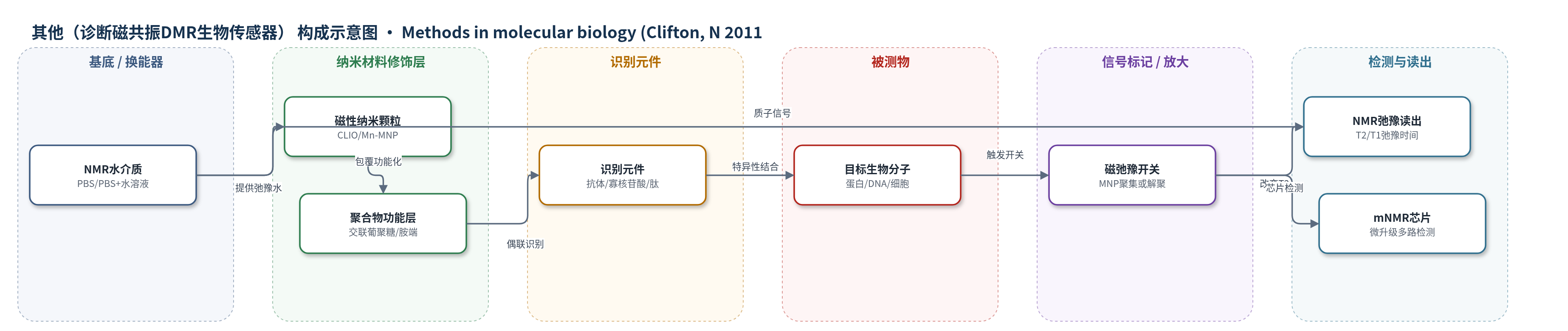
点击图片查看大图 · 依据论文自动绘制
传感器类型
其他(诊断磁共振DMR生物传感器)
检测对象
DNA/mRNA(DNA/mRNA)、蛋白质(proteins,如GFP、β-HCG、CA-125、VEGF、AFP)、酶活性(enzymes,如caspase 3、BamH1、MMP-2)、小分子/药物(drugs、folate、glucose、calcium)、病原体(pathogens,如HSV-1、Adenovirus-5、Staphylococcus aureus、MTB/BCG)、肿瘤细胞(tumor cells,如Her2/neu/EGFR/EpCAM阳性细胞);样品基质:细胞裂解液、痰液、全血、细胞培养上清、牛奶、细针穿刺样本等。
检测原理
DMR以超顺磁MNP作为邻近磁探针。MNP表面偶联抗体、寡核苷酸、肽等识别元件后,在溶液中与目标分子或细胞表面标志物结合。对于MRSw模式,目标分子诱导MNP自组装成簇,或使预聚簇MNP解聚;聚集态MNP使邻近水分子核自旋失相效率更高,导致整体横向弛豫时间T2缩短。对于细胞标记模式,MNP结合细胞后赋予与颗粒数成正比的磁矩,洗涤去除未结合MNP后,T2随细胞数量下降。信号放大来自单个MNP可影响大量邻近水分子质子,无需固相固定或扩散步骤。最终用NMR弛豫仪、mNMR芯片或MRI测量T2/T1弛豫时间,通常以T2为主,因为多数MNP的横向弛豫率r2大于纵向弛豫率r1。
检测灵敏度
检测阈值: femtomolar biomarker concentration; near single-cell range;细胞检测阈值: 10,000 cells (CLIO, benchtop Minispec), 1,000 cells (CLIO, mNMR), as few as two cells (Mn-MNP);R^2 > 99%
效应效果
DMR利用生物样品几乎无磁背景的优势,可在浑浊样品中测量,且比依赖固相固定、扩散或离散放大步骤的方法更快。文中报道在细胞裂解液、痰液和全血等复杂基质中可达到飞摩尔级生物标志物浓度和近单细胞检测阈值。选择性方面,GFP检测不受BSA影响,caspase 3信号可被抑制剂阻断。细胞检测中,Mn-MNP可检测少至2个细胞,优于细胞学和组织学等既有临床方法;台式Minispec与mNMR分别对应约10,000和1,000个高表达标记细胞。mNMR芯片支持微升级样品和多路并行检测,作者认为DMR有望成为临床和即时检测中高通量、低成本、便携的并行传感平台。
传感器的构成
- 换能介质:PBS/PBS+水溶液中的质子,作为NMR/MRI弛豫信号源
- 磁性纳米颗粒核心:超顺磁氧化铁纳米颗粒(SPION/CLIO,MION核心)或Mn-MNP、Fe核/氧化铁壳(CB),作为邻近磁探针
- 聚合物功能化层:交联葡聚糖(cross-linked dextran)或胺端涂层,提供水溶性、防聚集和偶联位点
- 识别元件:抗体、寡核苷酸、肽、生物素/亲和素、凝集素或金属螯合剂,特异性结合目标分子或细胞表面标志物
- 磁弛豫开关元件:互补寡核苷酸、肽链(如DEVD)、生物素-亲和素或多价交联剂,诱导MNP聚集或解聚
- 封闭/清洗缓冲液:PBS+(含BSA)、EDTA、氨盐或半胱氨酸,降低非特异结合并封闭未反应基团
- 读出器件:台式NMR弛豫仪(Bruker Minispec)、微型NMR(mNMR)芯片或MRI扫描仪,测量T1/T2弛豫时间
中文摘要
在生物样品中快速、灵敏地检测蛋白质、细胞和病原体等分子靶标是医学研究的重要方向,有助于早期疾病诊断和个体化治疗。磁性纳米颗粒(MNP)因生物样品磁化率极低、背景信号极小,成为分子生物传感的理想材料。基于磁共振效应的诊断磁共振(DMR)已发展为通用检测平台,可检测DNA/mRNA、蛋白质、酶、药物、病原体和肿瘤细胞,并达到极高灵敏度。DMR的核心原理是将MNP作为邻近传感器,通过改变邻近水分子的横向弛豫时间(T2)产生可量化信号。该信号可用MRI或NMR弛豫仪测量,也可用微型NMR(mNMR)芯片在微升级样品中实现多路检测。DMR具有快速、灵敏、简单等优势,结合NMR生物传感器技术进步,有望成为临床和即时检测中高通量、低成本、便携的大规模并行传感平台。
英文摘要
The rapid and sensitive detection of molecular targets such as proteins, cells, and pathogens in biological specimens is a major focus of ongoing medical research, as it could promote early disease diagnoses and the development of tailored therapeutic strategies. Magnetic nanoparticles (MNP) are attractive candidates for molecular biosensing applications because most biological samples exhibit negligible magnetic susceptibility, and thus the background against which measurements are made is extremely low. Numerous magnetic detection methods exist, but sensing based on magnetic resonance effects has successfully been developed into a general detection platform termed diagnostic magnetic resonance (DMR). DMR technology encompasses numerous assay configurations and sensing principles, and to date magnetic nanoparticle biosensors have been designed to detect a wide range of targets including DNA/mRNA, proteins, enzymes, drugs, pathogens, and tumor cells with exquisite sensitivity. The core principle behind DMR is the use of MNP as proximity sensors that modulate the transverse relaxation time of neighboring water molecules. This signal can be quantified using MR imagers or NMR relaxometers, including miniaturized NMR detector chips that are capable of performing highly sensitive measurements on microliter sample volumes and in a multiplexed format. The speed, sensitivity, and simplicity of the DMR principle, coupled with further advances in NMR biosensor technology should provide a high-throughput, low-cost, and portable platform for large-scale parallel sensing in clinical and point-of-care settings.