组成图示
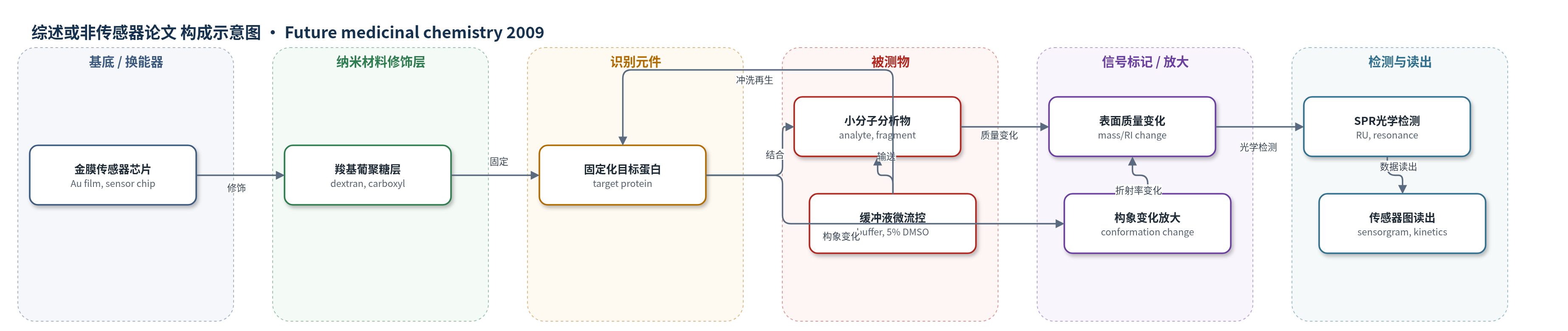
点击图片查看大图 · 依据论文自动绘制
传感器类型
综述或非传感器论文
检测对象
低分子量化合物/药物样化合物(small-molecule analytes, drug-like compounds)、片段(fragments)、离子(ions,如 Ca2+);样品基质:缓冲液(buffer,常含 5% DMSO)
检测原理
SPR 生物传感器将目标蛋白固定在金膜芯片表面的羧基葡聚糖层上,缓冲液携带低分子量分析物流过表面。分析物与固定蛋白结合后,界面质量增加;若结合诱导蛋白构象变化,还可引起更大折射率变化。平面偏振光在金膜表面发生全内反射,表面附近折射率变化会改变表面等离子共振条件,仪器以折射单位(RU)实时记录结合与解离过程。信号随分析物浓度升高而增大,稳态响应可用于亲和力分析;结合/解离曲线可拟合结合与解离速率常数(kon、koff)及 KD。该技术为无标记检测,灵敏度和时间分辨使其适用于小分子与片段筛选。
检测灵敏度
原文未报告 LOD、线性范围、灵敏度斜率或 R^2。
效应效果
SPR 可检测低分子量分析物及伴随构象变化的离子,灵敏度主要受固定蛋白功能性和稳定性限制。其蛋白消耗较低,930 个片段库验证仅需 0.025–0.8 mg 蛋白;HIV 逆转录酶筛选中每个酶变体少于 0.5 mg。Biacore A100 可并行 4–16 个蛋白,16 h 可筛 960 个化合物,22 h 可筛 1400 个样品(6 个浓度)。通过参考蛋白和竞争实验可排除非特异结合,识别选择性或慢解离命中化合物;原始传感器图还能提示聚集、胶束或沉淀导致的假阳性。与 NMR、X 射线晶体学、量热法相比,SPR 提供动力学分辨并互补结构信息。
传感器的构成
- 基底/换能器:传感器芯片上的薄金膜(Au film)与微流控系统,用于产生表面等离子共振并检测表面折射率变化
- 修饰层:羧基功能化葡聚糖层(carboxyl-functionalized dextran / carboxymethyldextran),提供共价固定蛋白的位点
- 识别元件:固定化目标蛋白/酶/受体(immobilized target protein),通过胺偶联、亲和标签或高亲和非共价方式固定
- 样品层:缓冲液中的低分子量分析物/片段/药物候选物(analyte, fragments, drug-like compounds),常含 5% DMSO
- 信号标记物:无(label-free),结合事件直接改变表面质量或构象,无需标记物
- 读出层:SPR 光学检测(refractive units, RU),记录结合/解离传感器图并提取动力学参数
中文摘要
表面等离子共振(SPR)生物传感器技术已趋于成熟,成为药物发现的重要工具。它是一种无标记生物物理技术,用于分子相互作用的动力学分析,可提供信息量极高的数据。近年来在灵敏度、实验设计、数据分析与样品通量方面的改进,使其适用于药物发现全过程。本文概述 SPR 生物传感器技术在小分子药物发现中的应用,并说明其如何与其他技术互补。该技术对基于片段的先导化合物发现尤为有价值,因为具备筛选片段库所需的灵敏度与通量。可根据筛选实验设计定义的多项标准识别命中化合物;利用技术的动力学分辨能力,可通过多种实验扩展命中化合物,并对先导化合物进行表征与优化。由此获得的先导化合物可围绕其与靶标蛋白及非靶标蛋白的相互作用进行系统表征。尽管方法普及和研究人员熟练掌握尚需时间,但预计该技术将在近期广泛用于药物发现,尤其在片段策略中,并与其他实验技术及计算方法整合。
英文摘要
Surface plasmon resonance biosensor technology has come of age and become an important tool for drug discovery. It is a label-free biophysical technique for the kinetic analysis of molecular interactions that provides exceptionally information-rich data. Recent improvements in sensitivity, experimental design, data analysis and sample throughput makes it suitable for use throughout the drug-discovery process. This article outlines the use of SPR biosensor technology for small-molecule drug discovery and exemplifies how it complements other techniques. The technology is especially valuable for fragment-based lead discovery since it has the required sensitivity and throughput for screening of fragment libraries. Hits can be identified with respect to multiple criteria, defined by the experimental design used for screening. Expansion of hits and subsequent characterization and optimization of leads can be performed with a variety of experiments exploiting the kinetic resolution of the technology. Leads identified by this strategy can therefore be extensively characterized with respect to their interactions, with their target as well as with nontarget proteins. Although it may take some time for the methods to become well established, and for the research community to reach proficiency and fully embrace the information-rich data that can be obtained, it can be predicted that this technology will be widely used for drug discovery within the near future. It is expected that the technology will be particularly important for fragment-based strategies and integrated with other experimental technologies as well as with computational methods.