组成图示
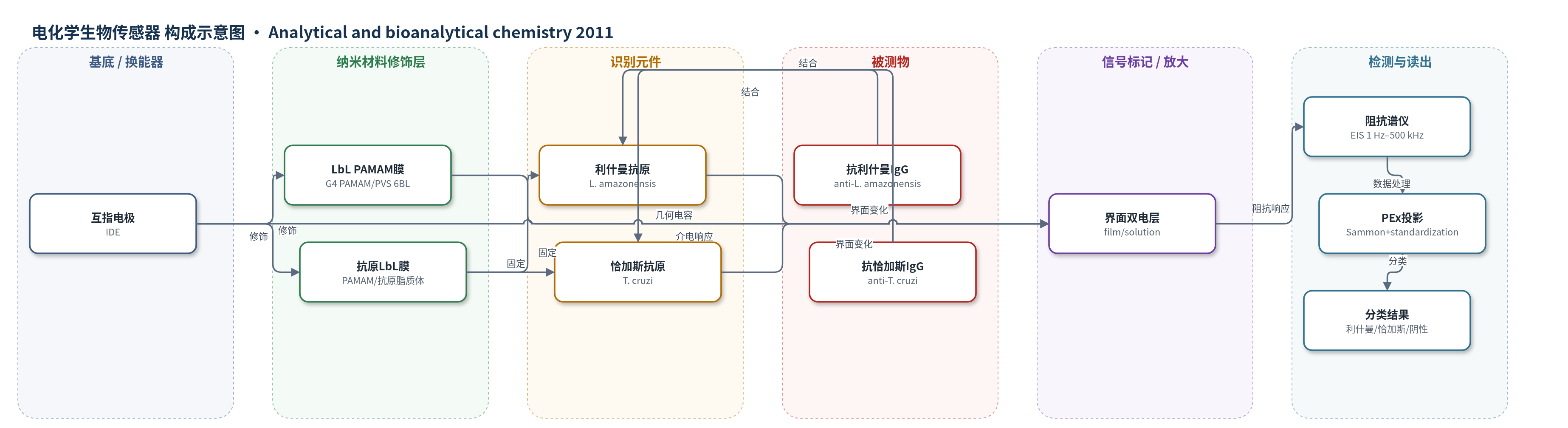
点击图片查看大图 · 依据论文自动绘制
传感器类型
电化学生物传感器
检测对象
抗利什曼原虫(Leishmania amazonensis)IgG 抗体、抗克氏锥虫(Trypanosoma cruzi)IgG 抗体;样品基质为血清(含阴性、利什曼病、恰加斯病及混合抗体血清)和 TRIS 缓冲液加标样品
检测原理
传感器阵列中固定有 Leishmania amazonensis 或 Trypanosoma cruzi 抗原的 LbL 膜,当血清中的相应 IgG 抗体与抗原特异性结合时,膜/溶液界面的双电层、介电性质和电荷存储能力发生改变。阻抗谱在 1 Hz–500 kHz 范围内采集 58 个频率点:高频响应主要受互指电极几何电容控制,低频响应主要受界面双电层控制,因此抗体结合引起的界面变化会在全频率阻抗/电容谱中形成特征性变化。四个传感器(裸电极、PAMAM/PVS 膜、两种抗原膜)的响应共同构成高维数据向量,经标准化后用 PEx 的 Sammon 映射投影到二维/三维空间,使相似样本靠近、不同疾病样本分离,从而实现分类。
检测灵敏度
可区分血清抗体浓度: 10−7 mg/mL(原文未明确标注为 LOD;原文:distinction could be made of blood serum samples containing 10−7 mg/mL of the antibody)
效应效果
裸电极无法区分不同血清和抗体样品;仅使用含利什曼抗原的传感器时区分能力明显增强。将四个传感器的阻抗数据转换为电容,并采用标准化 Sammon 映射后,阴性、利什曼病、恰加斯病及混合抗体血清均完全分离,而 PCA 即使使用全部电极和电容数据也不能达到同等区分。数据集包含 25 种物质、每种 9 个样本、共 225 个实例,每个样本在 1 Hz–500 kHz 采集 58 个频率点。高抗体浓度样本彼此靠近但仍可区分。作者认为该方法测量仅需数分钟,是快速、低成本的临床诊断途径,但尚未给出未知样本浓度校准,也未报告 RSD、回收率或与 ELISA 对比。
传感器的构成
- 基底/换能器电极:互指电极(interdigitated electrode,50 指对,指宽 10 μm、高 0.1 μm、间距 10 μm),提供阻抗测量界面
- 纳米材料修饰层:6 双分子层层层组装(LbL)膜,由 G4 PAMAM 树状分子与 PVS 交替吸附构成,作为固定基质与介电/电荷存储层
- 识别修饰层:6 双分子层 LbL 膜,由 G4 PAMAM 与 Leishmania amazonensis 或 Trypanosoma cruzi 蛋白脂质体抗原交替吸附构成,提供抗原固定界面
- 识别元件:Leishmania amazonensis 蛋白脂质体抗原或 Trypanosoma cruzi 蛋白脂质体抗原,特异性识别相应 IgG 抗体
- 对照电极:裸互指电极及 PAMAM/PVS LbL 膜电极,用于排除非特异性响应并构成传感器阵列
中文摘要
分子工程架构的进步使生物传感中的分子识别能力显著提升,对临床诊断和环境监测具有前景。然而,电学、光学或电化学测量产生大量数据,需要复杂数据处理以优化传感性能。本研究展示,基于投影的信息可视化系统 Projection Explorer(PEx)可用于提升由固定抗原纳米结构膜构成的生物传感器性能。作为概念验证,作者利用传感器阵列的阻抗谱数据获得多种可视化结果;该阵列因分子识别过程而对特定抗体(分析物)产生特异性电响应。文章讨论了不同的投影与数据归一化方法,并证明可很好地区分真实恰加斯病和利什曼病阳性样本,而传统统计方法无法实现。这种高性能可能源于对全频率范围数据的处理。系统分析表明,采用标准化归一化的 Sammon 映射效果最佳,可区分含 10−7 mg/mL 抗体的血清样本。PEx 内置方法及阻抗数据分析流程具有通用性,可扩展用于优化各类传感器或生物传感器。
英文摘要
Recent advances in the control of molecular engineering architectures have allowed unprecedented ability of molecular recognition in biosensing, with a promising impact for clinical diagnosis and environment control. The availability of large amounts of data from electrical, optical, or electrochemical measurements requires, however, sophisticated data treatment in order to optimize sensing performance. In this study, we show how an information visualization system based on projections, referred to as Projection Explorer (PEx), can be used to achieve high performance for biosensors made with nanostructured films containing immobilized antigens. As a proof of concept, various visualizations were obtained with impedance spectroscopy data from an array of sensors whose electrical response could be specific toward a given antibody (analyte) owing to molecular recognition processes. In addition to discussing the distinct methods for projection and normalization of the data, we demonstrate that an excellent distinction can be made between real samples tested positive for Chagas disease and Leishmaniasis, which could not be achieved with conventional statistical methods. Such high performance probably arose from the possibility of treating the data in the whole frequency range. Through a systematic analysis, it was inferred that Sammon's mapping with standardization to normalize the data gives the best results, where distinction could be made of blood serum samples containing 10(-7) mg/mL of the antibody. The method inherent in PEx and the procedures for analyzing the impedance data are entirely generic and can be extended to optimize any type of sensor or biosensor.