组成图示
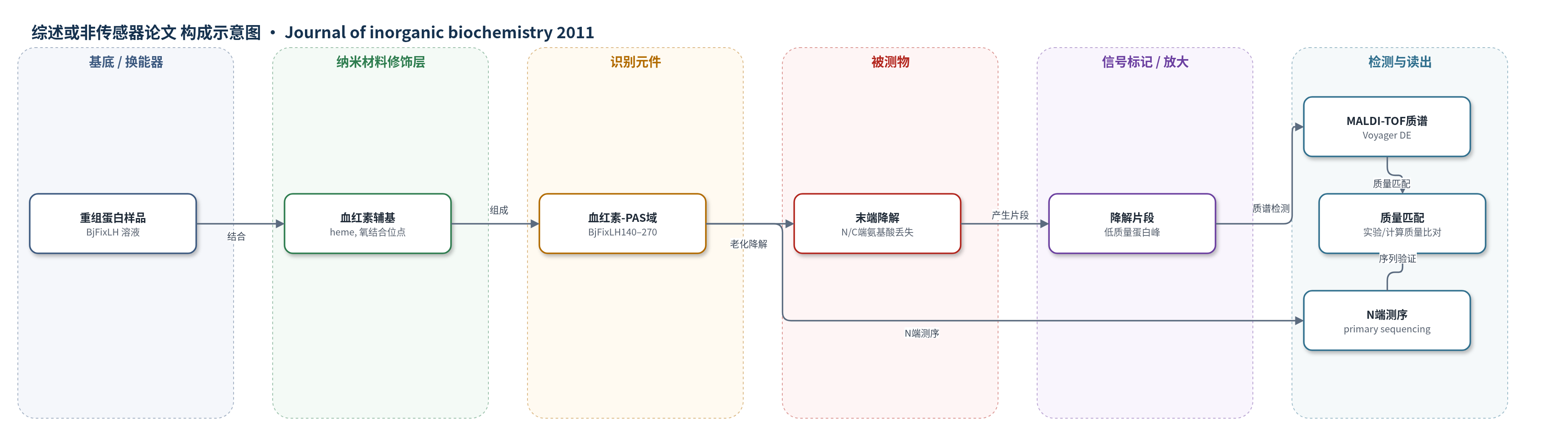
点击图片查看大图 · 依据论文自动绘制
传感器类型
综述或非传感器论文
检测对象
重组蛋白质量损失/降解片段(BjFixLH140–270 mass loss/degradation products),样品基质:重组蛋白溶液(含血红素/去血红素、蛋白酶抑制剂、无菌水)
检测原理
BjFixLH140–270 是天然氧传感血红素-PAS 域,氧与二价血红素的配位/解离可触发域内构象变化并向激酶域传递信号;但本文并非构建氧传感读出,而是研究该蛋白域在无菌室温老化过程中的质量损失。老化过程中,蛋白 N 端和/或 C 端发生氨基酸截断,产生一系列低质量片段。MALDI-TOF 将蛋白离子化并按质荷比分离,峰质量对应特定末端缺失序列;通过与理论计算质量匹配,并结合 N 端 Edman 测序,可唯一指认降解位点。该过程没有信号放大,信号表现为质谱中低质量峰的出现和强度增加,反映末端降解程度。
检测灵敏度
原文未报告 LOD、线性范围、灵敏度斜率或相关系数。
效应效果
本文未评价选择性、抗干扰、RSD、实际样品回收率或与 ELISA/HPLC/qPCR 等方法的对比。主要表现是揭示重组 BjFixLH 血红素-PAS 域在纯化后 1–3 天内即出现显著质量损失,且该降解在三个地理分离实验室独立制备样品中一致出现,不受氧、血红素、蛋白酶抑制剂、AEBSF/PMSF、光照、配体、灭菌、还原剂、容器材质及血红素铁氧化态等影响。稳定截短核心 BjFixLH151–256(106 aa)在溶液中可保持一年以上无明显质量损失。MALDI-TOF 质量匹配中 15/19 峰偏差 <1.0 m/z,其余 4 峰 1.0–1.7 m/z,多次测定标准差 1.47–2.97 m/z,95% 置信区间 0.54–1.71 m/z,支持末端降解解释。
传感器的构成
- 样品基质:重组 BjFixLH140–270 蛋白溶液,含血红素/去血红素、蛋白酶抑制剂(P2714/P8465、AEBSF/PMSF)和 18 MΩ 无菌水
- 识别元件:BjFixLH140–270 血红素-PAS 域,天然氧传感与信号转导蛋白域
- 检测读出:MALDI-TOF 质谱仪(Voyager DE,Perseptive Biosystems),线性模式,监测蛋白及降解片段质量
- 序列验证:N 端一级测序(Edman 测序),确定 N 端截断序列
中文摘要
此前已证明来自日本慢生根瘤菌的九种重组 FixL 血红素域在纯化后出现与环境因素无关的质量不稳定。本文针对全长血红素-PAS 域 BjFixLH140–270 的衰老质量损失来源,利用 N 端一级测序和 MALDI-TOF 质谱对三个末端缺失变体进行监测。质量损失在分离完成后即开始,并在储存和处理 1–3 天内占样品相当比例,因此降解发生在实验和结晶的时间尺度内。全长 BjFixLH140–270 的质谱在分离后 1–3 天变得复杂,出现宽峰和大量重叠峰,使单个峰归属困难,阻碍对质量损失来源的直接定量解释。通过比较 −14C、−11N 和 −6C 变体的老化质谱与计算质量,并结合 N 端测序,证实实验观察到的质量损失主要来源于 PAS 蛋白序列的 N 端和 C 端氨基酸丢失。该结果建立了解释更复杂的全长 BjFixLH140–270 老化质谱的基础,也为设计更稳定的血红素-PAS 传感域提供依据。
英文摘要
Nine recombinant FixL heme domains from Bradyrhizobium japonicum previously were shown to exhibit mass instability independent of many environmental factors (J.D. Satterlee, C. Suquet, A. Bidwai, J. Erman, L. Schwall, R. Jimenez, Biochemistry 47 (2008) 1540-1553). Two of those recombinant proteins were produced in remote laboratories. Mass losses begin appearing at completion of isolation and comprise a substantial proportion of samples within 1-3 days of storage and handling. Thus, degradation occurs during the time frame of experiments and crystallization. Detailed understanding of this instability is desired in order to formulate stable heme-PAS sensor domains for experimentation and for a mechanistic interpretation. However, mass spectra of the full length heme-PAS domain, BjFixLH(140-270), are complex by 1-3 days following isolation due to broad features and a high density of overlapping peaks, so that individual peak assignments are at present ambiguous. This stymies direct, quantitative interpretation of the source of the observed mass losses. To solve this dilemma amino-terminal primary sequencing and MALDI-TOF (Matrix Assisted Laser Desorption Ionization-Time of Flight) mass spectrometry monitoring of three terminal variants of BjFixLH(140-270) have been achieved. The working hypothesis, that the experimentally observed mass losses originate in the PAS protein sequence termini, has been substantiated. This establishes a basis for interpreting the more complex results from aging full length BjFixLH(140-270).