组成图示
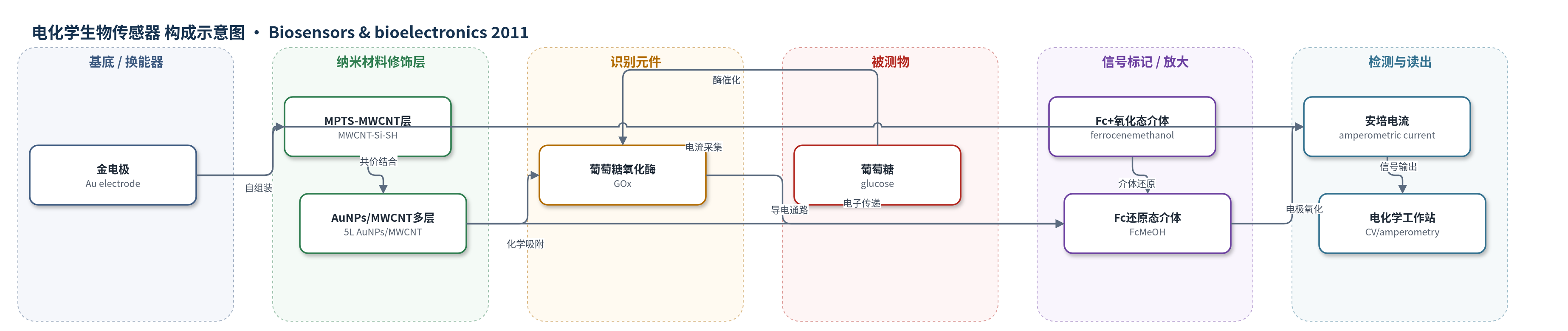
点击图片查看大图 · 依据论文自动绘制
传感器类型
电化学生物传感器
检测对象
葡萄糖(glucose, Glu);样品基质:PBS 缓冲液、人血清(稀释 10 倍)
检测原理
葡萄糖在固定于 AuNPs/MWCNT 多层膜中的葡萄糖氧化酶(GOx)催化下被氧化为葡萄糖内酯,同时 GOx 的 FAD 辅基被还原为 FADH2。还原态 FADH2 将电子传递给溶液中的氧化态介体甲醇二茂铁(ferrocenemethanol, Fc+),使其还原为 Fc,同时 GOx 恢复氧化态。Fc 在 Au 电极表面被电化学氧化为 Fc+,释放电子并形成安培电流。葡萄糖浓度越高,单位时间内生成的 Fc 越多,稳态电流越大。高密度 AuNPs/MWCNT 共价多层结构提供三维导电网络、降低界面阻抗、固定大量 GOx 并促进底物与介体扩散,从而实现快速响应和高灵敏度。
检测灵敏度
LOD: 2.3 μM (S/N = 3);线性范围: 20 μM–10 mM;灵敏度: 19.27 ± 0.5 μA mM−1 cm−2
效应效果
该传感器对常见生理干扰物抗干扰性良好:在 0.3 V 下,0.5 mM 抗坏血酸(AA)、0.5 mM 对乙酰氨基酚(AP)和 1 mM 尿酸(UA)引起的电流变化可忽略,而 0.5 mM 葡萄糖产生明显响应。稳定性方面,30 次循环伏安测量中阳极电流无明显下降;4 °C 0.1 M PBS 中保存一周后仍保持初始电流的 95.4%。6 个平行电极的相对标准偏差小于 4.2%。人血清样品中葡萄糖测定加标回收率为 96%–105%,RSD 为 2.9%–4.2%。其灵敏度约为多层 GOx/AuNPs 电极的 3 倍、多层 GOx/MWCNT 电极的 2 倍,Kapp_m 为 6.7 mM,低于文献报道的 10.5、14.9 和 20 mM,表明酶活性保持良好且对葡萄糖亲和力高。
传感器的构成
- 基底/换能器电极:金电极(Au electrode),提供导电基底与电子转移动态。
- 纳米材料修饰层:MPTS 功能化多壁碳纳米管(MWCNT-Si-SH)自组装层,通过 Au–S 共价键结合,提供 –SH 结合位点与三维骨架。
- 纳米材料修饰层:金纳米粒子(AuNPs,约 13 nm)共价结合于 MWCNT 端/侧壁,形成 5 层 AuNPs/MWCNT 纳米杂化膜,提供高导电通路、高比表面和酶结合位点。
- 识别元件:葡萄糖氧化酶(GOx),化学吸附于 AuNPs 表面,催化葡萄糖氧化。
- 电子介体/信号标记物:甲醇二茂铁(ferrocenemethanol, FcMeOH),在溶液中循环传递电子,将酶催化产生的电子传至电极。
中文摘要
本文报道了一种基于金纳米粒子(AuNPs)与多壁碳纳米管(MWCNT)纳米杂化材料的高稳定、高灵敏葡萄糖生物传感器。该传感平台通过硫醇功能化 MWCNT 与 AuNPs 的交替共价自组装构建高密度 AuNPs/MWCNT 多层结构,随后化学吸附葡萄糖氧化酶(GOx)。场发射扫描电镜(FE-SEM)表征了多层 AuNPs/MWCNT 的表面形貌,循环伏安(CV)测定 AuNPs 表面覆盖率,结果显示 5 层组装时电极表面粒子密度最大,AuNPs 覆盖率约 90%。电化学阻抗谱(EIS)监测 GOx 固定过程。在生理 pH 7.4 下,采用 CV 和安培法研究葡萄糖的电化学氧化。修饰有 5 层 AuNPs/MWCNT 复合膜和 GOx 的金电极对葡萄糖氧化表现出优异的电催化活性,线性范围为 20 μM 至 10 mM,灵敏度为 19.27 μA mM−1 cm−2,检出限为 2.3 μM(S/N=3)。该传感器还具有较快的安培响应(3 s 内)和较低的表观 Michaelis–Menten 常数(Kapp_m)。研究表明,高密度 AuNPs 修饰 MWCNT 是构建酶基电化学生物传感器的有前景纳米杂化材料。
英文摘要
We describe the development of a highly stable and sensitive glucose biosensor based on the nanohybrid materials derived from gold nanoparticles (AuNPs) and multi-walled carbon nanotubes (MWCNT). The biosensing platform was developed by using layer-by-layer (LBL) self-assembly of the nanohybrid materials and the enzyme glucose oxidase (GOx). A high density of AuNPs and MWCNT nanocomposite materials were constructed by alternate self assembly of thiol functionalized MWCNTs and AuNPs, followed by chemisoption of GOx. The surface morphology of multilayered AuNPs/MWCNT structure was characterized by field emission-scanning electron microscope (FE-SEM), and the surface coverage of AuNPs was investigated by cyclic voltammetry (CV), showing that 5 layers of assembly achieves the maximum particle density on electrode. The immobilization of GOx was monitored by electrochemical impedance spectroscopy (EIS). CV and amperometry methods were used to study the electrochemical oxidation of glucose at physiological pH 7.4. The Au electrode modified with five layers of AuNPs/MWCNT composites and GOx exhibited an excellent electrocatalytic activity towards oxidation of glucose, which presents a wide liner range from 20 μM to 10 mM, with a sensitivity of 19.27 μA mM(-1) cm(-2). The detection limit of present modified electrode was found to be 2.3 μM (S/N=3). In addition, the resulting biosensor showed a faster amperometric current response (within 3 s) and low apparent Michaelis-Menten constant (K(m)(app)). Our present study shows that the high density of AuNPs decorated MWCNT is a promising nanohybrid material for the construction of enzyme based electrochemical biosensors.