组成图示
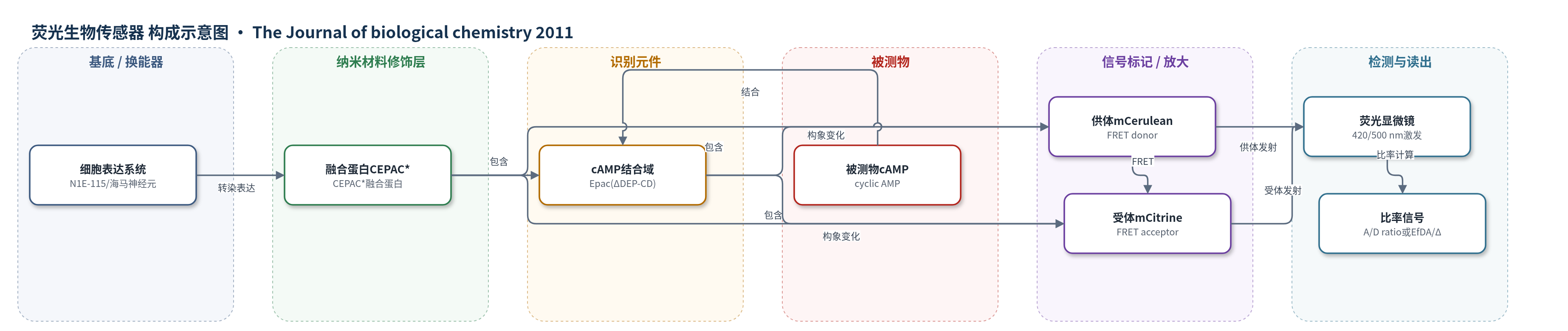
点击图片查看大图 · 依据论文自动绘制
传感器类型
荧光生物传感器
检测对象
环磷酸腺苷(cAMP,cyclic adenosine monophosphate);样品基质:活细胞胞质(N1E-115 神经母细胞瘤细胞、原代海马神经元)及细胞裂解液校准
检测原理
CEPAC* 由 mCerulean、Epac1 cAMP 结合域 Epac(ΔDEP-CD) 和 mCitrine 串联组成。cAMP 结合 Epac 域后引起融合蛋白构象变化,改变 mCerulean 供体与 mCitrine 受体之间的距离和取向,从而改变 FRET 效率。在单激发 420 nm 下,cAMP 结合使供体荧光增强、受体荧光减弱,供体/受体比率发生可定量变化;双激发方案可进一步计算 EfDA/Δ。该传感器不依赖酶催化或纳米材料放大,信号直接来自 FRET 效率变化。mCerulean/mCitrine 对 pH、Cl− 以及 Ca2+ 经质子释放产生的间接效应不敏感,因此可在离子浓度波动的活细胞中减少伪信号,实现长期定量比率测量。
检测灵敏度
未报告 LOD、线性范围、灵敏度斜率或 R^2;报告 EC50: 23.6 ± 12.2 μM (CEPAC*)、30.8 ± 6.9 μM (EPAC*);nH: 1.13 ± 0.6 (CEPAC*)、0.96 ± 0.18 (EPAC*)。
效应效果
CEPAC* 在 pH 6.8–7.5 内供体/受体比率仅变化约 14%,EPAC* 约 71%;30 nM–1 μM Ca2+ 间接效应下,CEPAC* 变化 6±2%,EPAC* 42±8%;400 μM–80 mM Cl− 下,CEPAC* 约 1%,EPAC* 下降 34±2%。CEPAC* FRET 效率动态范围 ΔE 13.6%,高于 EPAC* 6.5%。转染后 6 h 可见 CEPAC*,20 h 无明显聚集;EPAC* 10 h 表达,16 h 后聚集并降低活力。单细胞 5-HT1AR 测试中,1 μM 5-HT 使 cAMP 从约 70 μM 降至 7 μM,WAY 100635 恢复至约 50 μM;CEPAC* 响应率 89±9%,EPAC* 33±7%。作者认为其适合活细胞及病理生理条件下 cAMP 定量。
传感器的构成
- 识别元件:Epac1 cAMP 结合域 Epac(ΔDEP-CD),结合 cAMP 并引起构象变化
- 供体荧光蛋白:mCerulean(对照 EPAC* 为 eCFP),作为 FRET 供体,其发射随 cAMP 结合增强
- 受体荧光蛋白:mCitrine(对照 EPAC* 为 eYFP),作为 FRET 受体,其发射随 cAMP 结合减弱
- 融合蛋白骨架:mCerulean–Epac(ΔDEP-CD)–mCitrine(CEPAC*),将识别域与 FRET 对串联连接
- 表达载体:pcDNA3.1 哺乳动物表达载体,用于转染 N1E-115 细胞或原代海马神经元表达 CEPAC*
- 功能验证受体:5-HT1A 受体(5-HT1AR,HA 标签),与 CEPAC* 共表达,经激动剂/拮抗剂调节胞内 cAMP
- 读出系统:荧光显微镜或荧光光谱仪,测量供体/受体通道比率或 EfDA/Δ 信号
中文摘要
活细胞中单激发波长的比率型 FRET 生物传感器测量常受离子敏感性和 FRET 对聚集影响,影响定量分析。本文比较不同 FRET 对,研究生理离子浓度变化对 cAMP 生物传感器定量比率测量的影响。作者将 Epac1 型 cAMP 生物传感器中的 eCFP/eYFP 荧光对替换为 mCerulean/mCitrine。结果显示,eCFP/eYFP 体系中质子及氯离子浓度变化会引起错误比率 FRET 信号,幅度可能超过传感器动态范围;钙离子无直接效应,但可通过释放质子产生间接 pH 效应。改用 mCerulean/mCitrine 后,上述离子依赖性大幅降低,传感器可在不同生理条件下一致测量 cAMP。此外,FRET 对替换提高了 FRET 效率动态范围,并因表达更快、聚集减少而延长稳定实验窗口、降低细胞毒性。这些特性在共表达生物传感器与 5-HT1A 受体的单细胞功能测试中得到验证。
英文摘要
Ratiometric measurements with FRET-based biosensors in living cells using a single fluorescence excitation wavelength are often affected by a significant ion sensitivity and the aggregation behavior of the FRET pair. This is an important problem for quantitative approaches. Here we report on the influence of physiological ion concentration changes on quantitative ratiometric measurements by comparing different FRET pairs for a cAMP-detecting biosensor. We exchanged the enhanced CFP/enhanced YFP FRET pair of an established Epac1-based biosensor by the fluorophores mCerulean/mCitrine. In the case of enhanced CFP/enhanced YFP, we showed that changes in proton, and (to a lesser extent) chloride ion concentrations result in incorrect ratiometric FRET signals, which may exceed the dynamic range of the biosensor. Calcium ions have no direct, but an indirect pH-driven effect by mobilizing protons. These ion dependences were greatly eliminated when mCerulean/mCitrine fluorophores were used. For such advanced FRET pairs the biosensor is less sensitive to changes in ion concentration and allows consistent cAMP concentration measurements under different physiological conditions, as occur in metabolically active cells. In addition, we verified that the described FRET pair exchange increased the dynamic range of the FRET efficiency response. The time window for stable experimental conditions was also prolonged by a faster biosensor expression rate in transfected cells and a greatly reduced tendency to aggregate, which reduces cytotoxicity. These properties were verified in functional tests in single cells co-expressing the biosensor and the 5-HT(1A) receptor.