组成图示
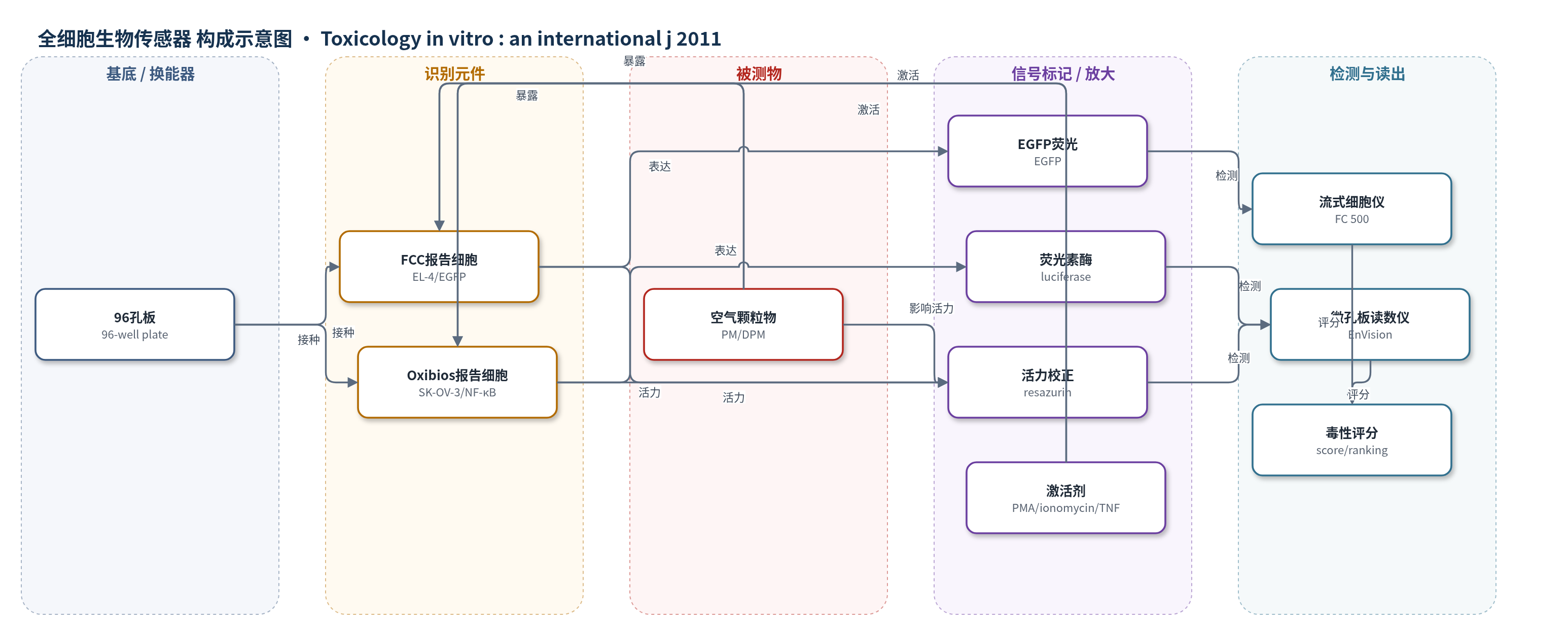
点击图片查看大图 · 依据论文自动绘制
传感器类型
全细胞生物传感器
检测对象
空气颗粒物生物活性/毒性(airborne particulate matter, PM;含标准参考材料 SRM 1648、SRM 1649b、SRM 1650b、SRM 2584、SRM 2585、柴油尾气颗粒物 DPM、铝厂/铜厂室内空气 PM),样品基质:无菌细胞培养液中的 PM 水悬浮液。
检测原理
FCC 中,PM 悬浮液与稳定转染细胞因子启动子-EGFP 报告基因的 EL-4 细胞共孵育,PM 中的金属、PAH 等成分通过细胞膜/受体及信号通路激活或抑制 β-actin、IL-2、IL-4、IFN-γ、IL-10 启动子,改变 EGFP 转录水平;PMA/ionomycin 可预先激活细胞。18 h 后用流式细胞术检测活细胞 EGFP 荧光,荧光强度随 PM 浓度呈剂量依赖升高或降低,并以 resazurin 活力校正。Oxibios 中,PM 作用于含 6×NF-κB 结合位点-荧光素酶报告基因的 SK-OV-3 细胞,激活或抑制 NF-κB 通路,改变荧光素酶表达;裂解后加入 luciferin,发光强度由 EnVision 读数仪检测,TNF 作为阳性激活对照。两种体系均通过报告基因转录放大将 PM 生物活性转换为荧光或发光信号。
检测灵敏度
未报告
效应效果
实验以三次独立重复进行,数据以均值±SE 表示,并用 ANOVA 和 Holm–Sidak 检验显著性。FCC 此前已用 63 种化合物完成免疫毒性预验证;Oxibios 每板含 1 ng/ml TNF 阳性对照,诱导比稳定。两种传感器对参考 PM、柴油尾气 PM 和工业空气 PM 均产生可重复响应,能区分不同工业地点及同一地点内差异,并识别刺激/抑制模式。生物活性评分与含 Al、As、Ba、Be、Cd、Co、Cu、Sr、V、Zn 的有毒元素含量呈显著正相关(Spearman 相关系数 0.714,p=0.0374)。作者认为该细胞生物传感器组合可用于环境 PM 毒性风险的快速、经济、常规评估。
传感器的构成
- 检测载体:96-well plate,用于细胞接种、PM 孵育和微孔板读数。
- 报告细胞层:EL-4 衍生 FCC 报告细胞系(β-actin、IL-2、IL-4、IFN-γ、IL-10 启动子-EGFP)和 SK-OV-3 衍生 IS23-NFkBRE-SK-OV-3(NF-κB 响应荧光素酶)。
- 识别元件:基因改造哺乳动物细胞及其信号通路(细胞因子启动子、NF-κB 通路),响应 PM 生物活性。
- 信号标记物:EGFP(FCC)和荧光素酶(Oxibios)。
- 信号底物/激活剂:luciferin(Oxibios 发光底物);PMA/ionomycin(FCC 激活)和 TNF(Oxibios 激活/对照)。
- 活力校正层:resazurin,被活细胞还原为 resorufin,用于校正细胞活力。
- 读出装置:Beckman-Coulter Cytomics FC 500 MPL 流式细胞仪(EGFP 荧光)和 Perkin Elmer EnVision 微孔板读数仪(发光/荧光)。
中文摘要
空气颗粒物(PM)暴露是许多环境和职业场景中不良健康效应的已知风险因素。PM 介导毒性的病理机制取决于颗粒的粒径和成分,而不同排放源导致其差异。PM 的化学组成包含多种生物可利用性不同的组分,可作用于多个分子和细胞靶点,因此仅依靠化学分析难以预测 PM 相关毒性。本研究旨在开发基于基因改造哺乳动物细胞的稳健、灵敏且经济的环境污染物检测方法。我们测试了两种生物传感器检测法——荧光细胞芯片(FCC)和 Oxibios——用于评估空气 PM 潜在毒性的适用性。采用统一实验方案,对标准参考 PM、柴油尾气采样 PM 以及波兰铝厂和铜厂室内空气采样 PM 进行检测。结果显示,不同 PM 呈现复杂的刺激性和抑制性活性模式,与 PM 来源一致,并可能与其化学组成相关。该分析能够反映特定 PM 可能毒性的类型和程度,可检测不同工业地点之间以及同一工业地点内不同位置 PM 的显著差异,并基于化学分析对毒性风险进行总体排序。
英文摘要
Exposure to airborne particulate matter (PM) is a known risk factor for adverse health effects observed in many environmental and occupational settings. The pathological mechanisms involved in PM-mediated toxicity depend on the size and contents of particles that vary depending on the source of emission. Chemical compositions of PM show multiple components with different bioavailabilities that are capable of acting on multiple molecular and cellular targets, making it difficult to predict PM-associated toxicity based solely on chemical analysis. The aim of the study was to develop robust, sensitive and economical assays for environmental pollutants based on genetically modified mammalian cells. We tested the suitability of two biosensor assays, Fluorescent Cell Chip and Oxibios, developed in part in our laboratories, for assessment of the potential toxicity of airborne PM. Reference PM and PM obtained by sampling of diesel exhaust and indoor air in aluminum and copper facilities in Poland were tested with the two bioassays using unified experimental protocols. Resultant data showed complex patterns of stimulatory and inhibitory activities that were consistent with the origin of PM and might be correlated with their chemical composition. The analysis was informative with regard to type and extent of possible toxicity associated with specific PM and allowed for detection of significant differences between PM from different industrial sites and particular locations within the same industrial sites as well as overall ranking of toxicity risk based on chemical analysis.