组成图示
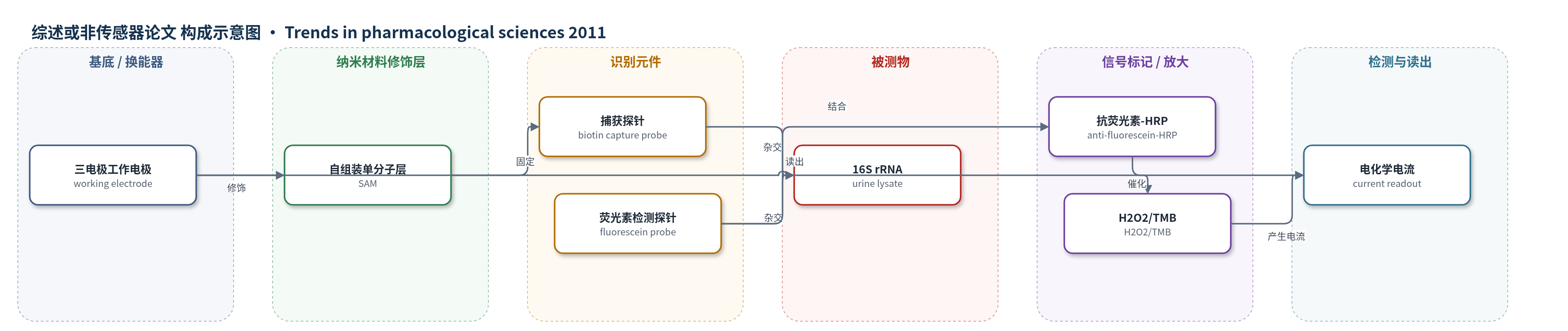
点击图片查看大图 · 依据论文自动绘制
传感器类型
综述或非传感器论文
检测对象
尿路致病菌(uropathogens,如大肠杆菌 E. coli、奇异变形杆菌 P. mirabilis、铜绿假单胞菌 P. aeruginosa、肺炎克雷伯菌 K. pneumoniae、肠球菌属 Enterococcus spp.)的16S rRNA;样品基质:尿液(urine,裂解后)
检测原理
尿液样品裂解释放细菌16S rRNA。固定于工作电极SAM上的捕获探针与16S rRNA杂交,荧光素标记检测探针再与之结合,形成三明治杂交结构。抗荧光素抗体-HRP偶联物结合荧光素标记探针,使HRP靠近电极界面。在固定电位下,HRP催化H2O2与TMB发生氧化还原反应,产生可测电流。16S rRNA拷贝数与细菌浓度相关,因此电流大小随病原菌浓度增加而增大。该法无需核酸扩增,依靠三明治杂交和酶催化实现信号放大;多重探针可区分不同尿路致病菌。
检测灵敏度
LOD: 10^4 cfu/ml
效应效果
在患者尿液样本中,UTI Sensor Array与尿培养相比,病原体检测总体灵敏度为92%,特异性为97%。生物传感器药敏试验(b-AST)总体准确率为94%,接近FDA对新药敏系统允许的最大误差率。病原体鉴定约1小时,b-AST约3.5小时,明显快于标准培养1–3天和标准AST超过18小时。文章认为该平台无需核酸扩增、可多重检测,并与微流控兼容,有望用于POC,减少经验性广谱抗生素使用;但样品前处理、尿液基质效应和系统集成仍是转化瓶颈。
传感器的构成
- 换能器电极:三电极体系(工作电极、参比电极、对电极),用于施加电位并检测电流
- 表面修饰层:自组装单分子层(SAM),固定捕获探针并降低背景噪声
- 识别元件:生物素标记捕获寡核苷酸探针(biotin-labeled capture probes),固定于工作电极表面,特异性结合细菌16S rRNA
- 识别/信号元件:荧光素标记检测寡核苷酸探针(fluorescein-labeled detector probes),与16S rRNA杂交形成三明治结构
- 信号标记物:抗荧光素抗体-辣根过氧化物酶偶联物(anti-fluorescein antibody-HRP conjugate),识别荧光素并催化底物反应
- 底物/电子介质:过氧化氢(H2O2)与四甲基联苯胺(TMB),在HRP催化下发生氧化还原反应产生电化学信号
中文摘要
尿路感染(UTI)是最常见的细菌感染之一,标准培养法诊断通常需2–3天,导致经验性广谱抗生素使用并促进耐药菌出现。生物传感器有望成为感染性疾病即时检测(POC)的有力平台。本文综述了用于UTI诊断的生物传感器技术,重点介绍病原体鉴定和抗菌药物敏感性试验(AST)中的电化学DNA传感器阵列(UTI Sensor Array)。该阵列以细菌16S rRNA为靶标,通过捕获探针与荧光素标记检测探针的三明治杂交,再结合抗荧光素抗体-辣根过氧化物酶(HRP)偶联物,利用H2O2/TMB电化学体系产生与菌量相关的电流信号。文章还讨论了微流控样品处理、尿液基质效应、多重检测、成本效益及从实验室到临床转化的关键挑战。
英文摘要
Urinary tract infection (UTI) is among the most common bacterial infections and poses a significant healthcare burden. The standard culture-based diagnosis of UTI has a typical delay of two to three days. In the absence of definitive microbiological diagnosis at the point of care, physicians frequently initiate empirical broad-spectrum antibiotic treatment, and this has contributed to the emergence of resistant pathogens. Biosensors are emerging as a powerful diagnostic platform for infectious diseases. Paralleling how blood glucose sensors revolutionized the management of diabetes, and how pregnancy tests are now conducted in the home, biosensors are poised to improve UTI diagnosis significantly. Biosensors are amenable to integration with microfluidic technology for point-of-care (POC) applications. This review focuses on promising biosensor technology for UTI diagnosis, including pathogen identification and antimicrobial susceptibility testing, and hurdles to be surpassed in the translation of biosensor technology from bench to bedside.