组成图示
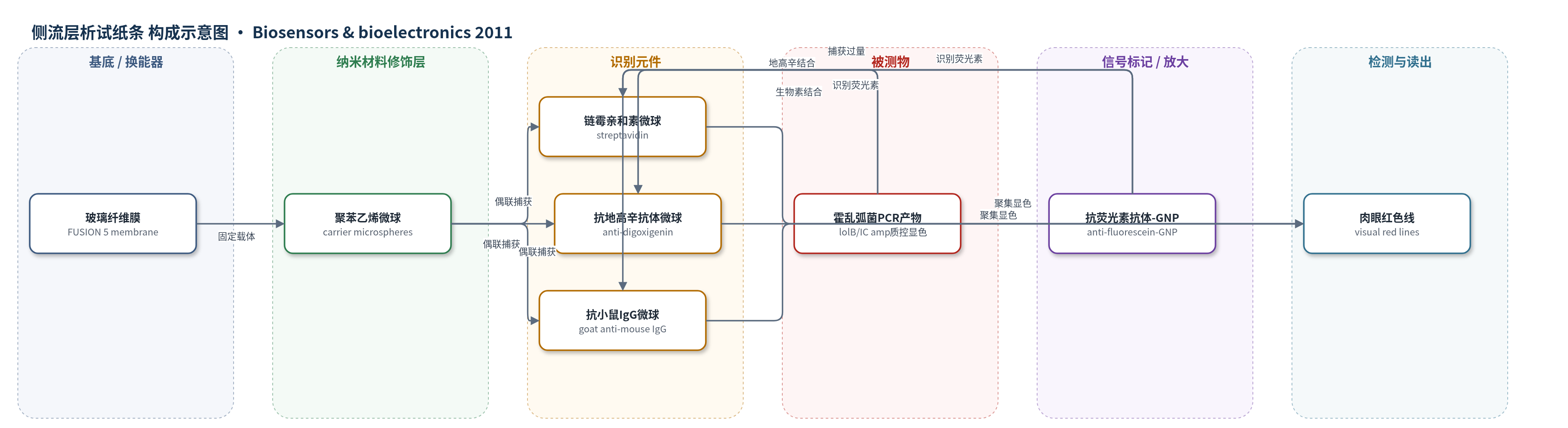
点击图片查看大图 · 依据论文自动绘制
传感器类型
侧流层析试纸条
检测对象
霍乱弧菌(Vibrio cholerae)lolB基因PCR扩增子及内部扩增对照(IC)扩增子;样品基质为粪便加标临床标本的PCR产物。
检测原理
该传感器先以霍乱弧菌特异性引物进行PCR,目标引物5′端分别标记生物素和荧光素,内部对照(IC)引物标记地高辛和荧光素。将PCR产物加至样品区后,运行缓冲液沿FUSION 5玻璃纤维膜毛细迁移,复水结合区中抗荧光素抗体偶联金纳米颗粒(GNP)检测试剂。目标扩增子经生物素—链霉亲和素作用被检测线链霉亲和素微球捕获;IC扩增子经抗地高辛抗体被IC线微球捕获。检测试剂识别被捕获扩增子上的荧光素标记并在相应线位聚集,40 nm GNP聚集产生肉眼红色线;过量检测试剂被质控线山羊抗小鼠IgG微球捕获,形成质控线。目标DNA浓度越高,检测线红色越明显,5 ng时可见清晰线。
检测灵敏度
LOD: 5 ng of target DNA
效应效果
该传感器在174株细菌加标粪便标本中评价,包括102株霍乱弧菌和72株非霍乱弧菌,与琼脂糖凝胶电泳金标准比较,敏感性和特异性均为100%。在5 ng目标DNA浓度下,传感器显示清晰红色线,而琼脂糖凝胶仅见很淡条带。扫描电镜显示捕获试剂在膜基质中结合前后保持相对稳定,说明固定方式稳定。加速老化实验显示试纸条在37 ℃保存30天仍保持活性,估算24 ℃货架期约103.87天。该装置一次性、操作简便、无需专用仪器和溴化乙锭等致癌试剂,适合霍乱等传染病快速分子诊断,但结果目前为定性红色线。
传感器的构成
- 基底/膜:Whatman FUSION 5玻璃纤维膜,作为结合垫、样品垫和反应垫,提供毛细迁移通道并固定捕获试剂
- 载体微球:聚苯乙烯微球(polystyrene microspheres),作为锚定载体,将捕获试剂固定在膜内
- 检测线捕获元件:链霉亲和素包被微球(streptavidin-coated microspheres),通过生物素—链霉亲和素作用捕获目标PCR扩增子
- IC线捕获元件:抗地高辛抗体偶联羧基修饰聚苯乙烯微球(anti-digoxigenin antibody-coated carboxylate-modified polystyrene microspheres),识别并捕获地高辛标记IC扩增子
- 质控线捕获元件:山羊抗小鼠IgG抗体偶联羧基修饰聚苯乙烯微球(goat anti-mouse IgG antibody-coated carboxylate-modified polystyrene microspheres),捕获过量检测试剂并验证装置功能
- 检测试剂/信号标记:40 nm金纳米颗粒(GNPs)偶联抗荧光素抗体(anti-fluorescein antibody),识别扩增子5′端荧光素标记并聚集显红色
- 封闭/稳定剂:BSA封闭金纳米颗粒偶联物,NaN3作防腐剂,结合区含蛋白封闭剂和糖稳定剂
- 运行缓冲液/吸收垫:10 mM PBS(pH 7.4)含0.5% Tween-20用于毛细迁移,Millipore吸收垫吸收多余缓冲液
中文摘要
本研究报道了一种基于玻璃纤维膜的侧流式DNA生物传感器,用于食源性病原体霍乱弧菌(Vibrio cholerae)的快速分子诊断。该传感器采用载体微球偶联捕获试剂、金纳米颗粒偶联检测试剂,包含检测线、内部扩增对照(IC)线和质控线。目标PCR扩增子由生物素和荧光素标记,在检测线经生物素—链霉亲和素作用被捕获;IC扩增子由地高辛和荧光素标记,在IC线经抗地高辛抗体识别被捕获。检测试剂为抗荧光素抗体偶联40 nm金纳米颗粒,可识别扩增子上的荧光素标记并聚集形成肉眼可见红色线;质控线捕获过量检测试剂以验证装置功能。扫描电镜显示捕获试剂在膜基质中保持相对稳定。该传感器对目标DNA的检出限为5 ng,在174株霍乱弧菌及非霍乱弧菌加标粪便标本中,与琼脂糖凝胶电泳相比敏感性和特异性均为100%。该装置一次性、无需专用设备和致癌试剂,可作为琼脂糖凝胶分析的简便替代方法。
英文摘要
Treating patients with infectious diseases relies heavily on rapid and proper diagnosis. Molecular detection such as PCR has become increasingly important and efforts have been made to simplify these detection methods. This study reports the development of a glass fibre-based lateral flow DNA biosensor that uses capture reagents coupled to carrier beads and detector reagent bioconjugated to gold nanoparticles, for the detection of foodborne pathogen, Vibrio cholerae. The DNA biosensor contains a test line which captures target PCR amplicons, an internal amplification control (IC) line which captures IC amplicons and a control line which acts as membrane control to validate the functionality of this device. The test line captures biotin labelled DNA, while the IC line captures digoxigenin labelled DNA. The detector reagent recognizes the fluorescein haptens of the amplified DNA and produces visual red lines. Scanning electron microscopy (SEM) studies performed indicated that the capture reagents remained relatively immobile within the matrix of the membrane even after binding of the detector reagent. The DNA biosensor recorded a limit of detection (LoD) of 5 ng of target DNA. A clinical evaluation was carried out with 174 strains of V. cholerae and non V. cholerae bacteria and the DNA biosensor recorded 100% for both sensitivity and specificity when compared to conventional agarose gel detection of DNA. Thus it is a viable alternative to agarose gel analysis and is easy-to-use, disposable and do not require any specialized equipment and use of carcinogenic chemicals.