组成图示
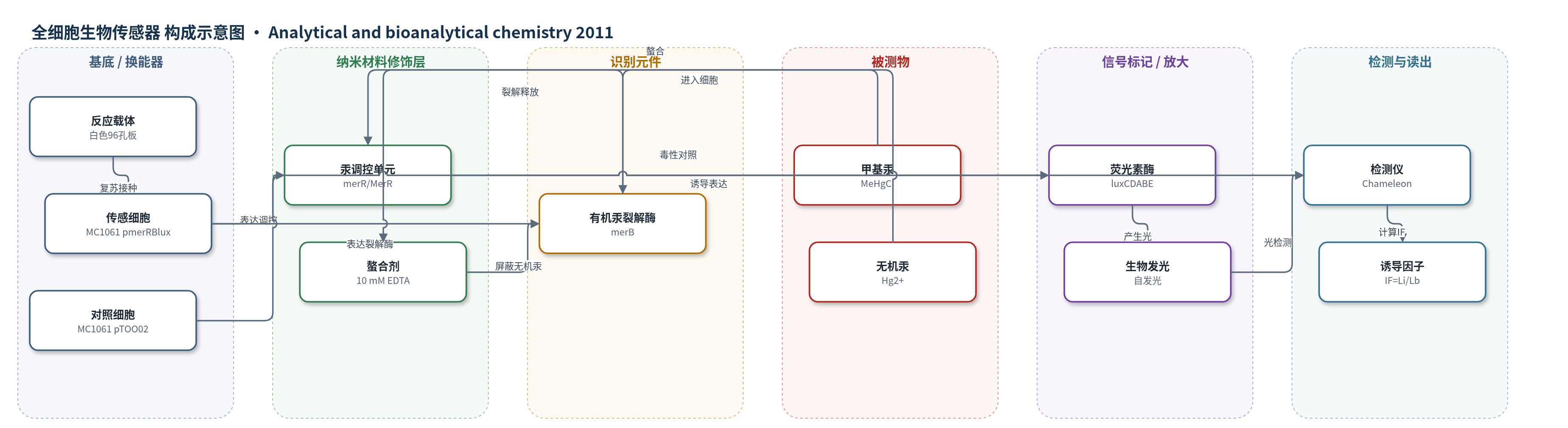
点击图片查看大图 · 依据论文自动绘制
传感器类型
全细胞生物传感器
检测对象
甲基汞(methylmercury, MeHg/MeHgCl);干扰物:无机汞(Hg2+)。样品基质:水样、环境样品、LB 培养介质标准溶液。
检测原理
甲基汞(MeHg)进入冻干复苏的全细胞传感菌 E. coli MC1061 (pmerRBlux) 后,被细胞内共表达的 merB 有机汞裂解酶识别并裂解其碳—汞键,生成 Hg2+。释放的 Hg2+ 激活 merR 汞抗性调控蛋白 MerR,使 luxCDABE 细菌荧光素酶操纵子转录表达。luxCDABE 可自产发光底物,无需外源添加,因此细胞产生自发光。发光强度随 MeHg 浓度在亚纳摩尔至百纳摩尔范围内增加,高浓度时因细胞毒性而下降。样品中加入 10 mM EDTA 可优先螯合无机 Hg2+,减少其进入细胞或诱导报告基因,从而提高对 MeHg 的选择性。最终通过多标签检测仪读取发光强度,并以诱导因子 IF=Li/Lb 表示响应。
检测灵敏度
LOD: 75 ng/l (300 pM);线性范围: 300 pM–100 nM;动态范围: 0.3–100 nM
效应效果
在 10 mM EDTA 存在下,方法对无机汞的选择性显著提高:非生理浓度 100 nM Hg2+ 的交叉反应仅为 0.2%;在 MeHgCl 100 nM 的混合体系中,Hg2+ 增至 10 μM 才引起约 2 倍诱导。发光信号标准偏差为 1.95%–15.7%(EDTA 优化实验)和 2.3%–11.6%(选择性分析实验)。冻干细胞诱导系数降至约 15%,但检测灵敏度与新鲜培养细胞相当,并可在 -20 °C 长期保存。方法 1 h 可初步读数,3 h 完成。LOD 为 75 ng/l(300 pM),与色谱-光谱等传统化学方法的 ng/l 级灵敏度相当,但可测定生物可利用甲基汞,适用于水样和环境风险评价。
传感器的构成
- 传感细胞:重组大肠杆菌 E. coli MC1061 (pmerRBlux),冻干全细胞传感器,响应总汞并产生生物发光
- 识别/调控元件:merR 汞抗性调控单元(MerR 转录因子),识别 Hg2+ 并启动报告基因表达
- 转化识别元件:merB 有机汞裂解酶,裂解 MeHg 的 C–Hg 键并释放 Hg2+
- 信号报告元件:细菌荧光素酶操纵子 luxCDABE,无需外源底物,产生自发光
- 选择性螯合剂:EDTA(10 mM),螯合无机汞 Hg2+,提高 MeHg 选择性
- 反应介质:LB 培养基(Luria–Bertani medium),用于细胞复苏、培养与发光反应
- 对照细胞:组成型发光菌株 E. coli MC1061 (pTOO02),用于评估样品总体细胞毒性
- 检测载体:白色 96 孔微孔板,承载样品与细胞混合液,用于发光读出
中文摘要
本文报道了一种基于发光细菌的全细胞生物传感器方法,用于选择性测定环境中生物可利用的有机汞化合物甲基汞。研究采用重组发光大肠杆菌 E. coli MC1061 (pmerRBlux) 作为总汞响应菌株,并将其冻干保存,使其可像普通试剂一样使用,减少批次差异。该菌株以细菌荧光素酶操纵子 luxCDABE 作为报告基因,无需外源底物即可自发光,从而支持均相、实时监测报告基因表达。方法中平行使用组成型发光对照菌株 E. coli MC1061 (pTOO02) 评估样品总体细胞毒性。总汞传感器对甲基汞的特异性来自共表达的有机汞裂解酶 merB,该酶裂解甲基汞的碳—汞键并释放 Hg2+,进而激活 merR 调控系统并诱导发光。通过优化浓度 EDTA 螯合样品中的无机汞,可实现甲基汞的选择性检测;在非生理无机汞浓度 100 nM 下,与离子汞的交叉反应为 0.2%。方法优化为 3 h 完成,1 h 即可读取结果。该菌株在优化条件下具有亚纳摩尔级灵敏度和约两个数量级的动态范围,检出限为 75 ng/L(300 pM),可用于自然样品中甲基汞的测定。
英文摘要
A bacterial biosensor method for the selective determination of a bioavailable organomercurial compound, methylmercury, is presented. A recombinant luminescent whole-cell bacterial strain responding to total mercury content in samples was used. The bacterial cells were freeze-dried and used as robust, reagent-like compounds, without batch-to-batch variations. In this bacteria-based sensing method, luciferase is used as a reporter, which requires no substrate additions, therefore allowing homogenous, real-time monitoring of the reporter gene expression. A noninducible, constitutively light-producing control bacterial strain was included in parallel for determining the overall cytotoxicity of the samples. The specificity of the total mercury sensor Escherichia coli MC1061 (pmerRBlux) bacterial resistance system toward methylmercury is due to a coexpressed specific enzyme, organomercurial lyase. This enzyme mediates the cleavage of the carbon-mercury bond of methylmercury to yield mercury ions, which induce the reporter genes and produce a self-luminescent cell. The selective analysis of methylmercury with the total mercury strain is achieved by specifically chelating the inorganic mercury species from the sample using an optimized concentration of EDTA as a chelating agent. After the treatment with the chelating agent, a cross-reactivity of 0.2% with ionic mercury was observed at nonphysiological ionic mercury concentrations (100 nM). The assay was optimized to be performed in 3 h but results can already be read after 1 h incubation. Total mercury strain E. coli MC1061 (pmerRBlux) has been shown to be highly sensitive and capable of determining methylmercury at a subnanomolar level in optimized assay conditions with a very high dynamic range of two decades. The limit of detection of 75 ng/l (300 pM) allows measurement of methylmercury even from natural samples.