组成图示
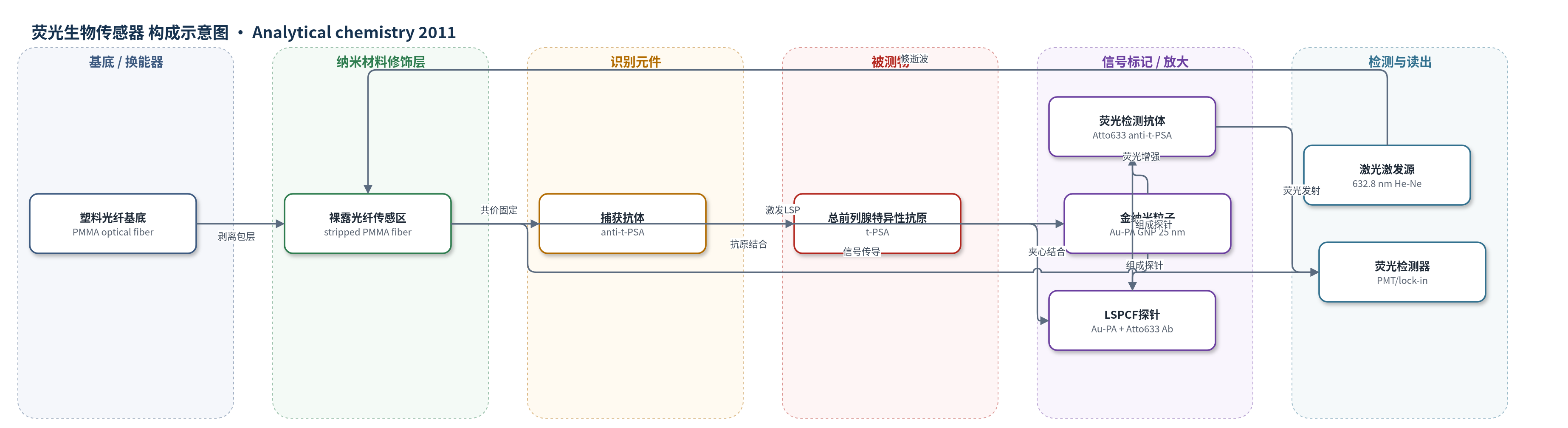
点击图片查看大图 · 依据论文自动绘制
传感器类型
荧光生物传感器
检测对象
总前列腺特异性抗原(total PSA, t-PSA),样品基质为 PBS 或 10 倍稀释健康人血清;小鼠免疫球蛋白 G(mouse IgG),样品基质为 PBS
检测原理
捕获抗体固定于 PMMA 光纤裸露区,目标 t-PSA 结合后,加入由 Atto633 标记检测抗体与 Protein A 偶联金纳米粒子(Au-PA)组成的 LSPCF 探针,形成夹心复合物。632.8 nm 激光经光纤全内反射在表面产生倏逝波,激发 Au-PA 的局域表面等离子体(LSP),在纳米粒子近场增强 Atto633 荧光;只有位于倏逝波传感体积内的复合物贡献信号。荧光强度随表面 t-PSA 浓度增加而线性增加。基于双室模型和准稳态近似,由时间分辨荧光曲线及不同浓度下的准稳态信号计算 ka、kd、KD。
检测灵敏度
线性范围: 0.1 pg/mL–1 ng/mL(t-PSA,PBS 或 10 倍稀释人血清);线性范围: 1 pg/mL–1 ng/mL(mouse IgG,PBS)
效应效果
夹心双抗体策略可显著降低复杂基质中非特异性结合干扰。在 PBS 中,t-PSA/anti-t-PSA 的 KD 为 1.2×10^-9 M,ka 为 (1.6±0.4)×10^7 M^-1 s^-1,kd 为 (1.8±0.5)×10^-2 s^-1;在 10 倍稀释健康人血清中,KD 为 1.0×10^-9 M,ka 为 (1.9±0.6)×10^7 M^-1 s^-1,kd 为 (1.9±0.6)×10^-2 s^-1,与 PBS 结果相近,说明方法适用于临床样品。mouse IgG 验证体系 KD 为 2.0 nM。作者认为该方法可用于低丰度生物标志物、药物与血清蛋白相互作用及药代动力学研究。
传感器的构成
- 基底/换能器:PMMA 多模塑料光纤(PMMA optical fiber),剥离包层形成倏逝波传感区并传导荧光
- 表面修饰/识别元件:anti-t-PSA 捕获抗体(或 goat anti-mouse IgG)经化学共价固定于裸露光纤表面,识别目标抗原
- 定向固定层:Protein A(PA)可选固定于光纤表面,使捕获抗体 Fc 区定向结合,减少位点异质性
- 封闭层:BSA-PBS(10 mg/mL BSA)封闭非特异性结合位点
- 信号探针:LSPCF probe,由 Atto633 标记 anti-t-PSA(或 Cy5 标记 rabbit anti-mouse IgG)与 Protein A 偶联金纳米粒子(Au-PA, GNP 25 nm)组成
- 信号读出:He-Ne 激光(632.8 nm)/二极管激光(658 nm)、长通或带通滤光片、PMT 与锁相放大器检测荧光
中文摘要
测量蛋白质-蛋白质相互作用在超低浓度下的动力学常数,对表征生物特异性亲和力以及评估临床诊断的灵敏度、效率和准确性至关重要。本研究提出一种基于局域表面等离子体耦合荧光光纤生物传感器(LSPCF-FOB)的方法,用于在夹心免疫检测中计算 pg/mL 级蛋白质-蛋白质相互作用的结合常数。该方法采用双室模型,在反应室静止条件下实现反应限制动力学,使质量传输效应可忽略。以总前列腺特异性抗原(t-PSA)与抗-t-PSA 为模型体系,在 PBS 或人血清中测量了 0.1 pg/mL 至 1 ng/mL 浓度范围内的结合速率常数 ka、解离速率常数 kd 和平衡解离常数 KD。结果表明,该方法可在复杂临床样品中实现超低浓度蛋白质相互作用的实时动力学监测,为低丰度生物标志物检测和药物药代动力学研究提供新途径。
英文摘要
Measuring the kinetic constants of protein-protein interactions at ultralow concentrations becomes critical in characterizing biospecific affinity, and exploring the feasibility of clinical diagnosis with respect to detection sensitivity, efficiency and accuracy. In this study, we propose a method that can calculate the binding constants of protein-protein interactions in sandwich assays at ultralow concentrations at the pg/mL level, using a localized surface plasmon coupled fluorescence fiber-optic biosensor (LSPCF-FOB). We discuss a two-compartment model to achieve reaction-limited kinetics under the stagnant conditions of the reaction chamber. The association rate constant, dissociation rate constant, and the equilibrium dissociation constant, that is, k(a), k(d), K(D), respectively, of the kinetics of binding between total prostate-specific antigen (t-PSA) and anti-t-PSA at concentrations from 0.1 pg/mL to 1 ng/mL, were measured either in PBS or in human serum. This is the first time that k(a), k(d), and K(D) have been measured at such a low concentration range in a complex sample such as human serum.