组成图示
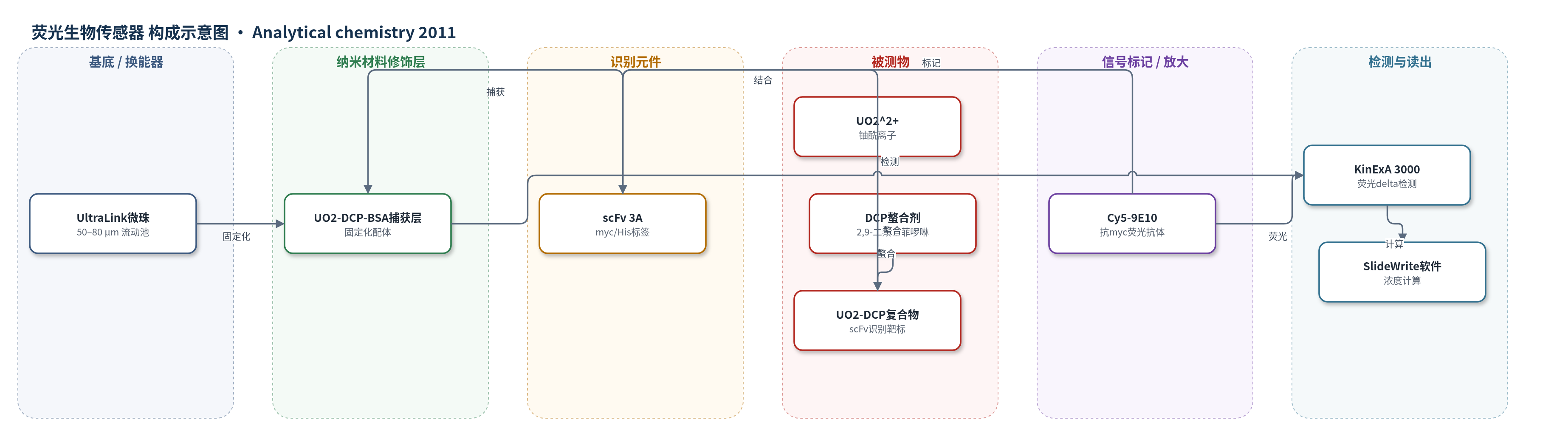
点击图片查看大图 · 依据论文自动绘制
传感器类型
荧光生物传感器
检测对象
铀酰离子(UO2^2+,Uranium);样品基质:环境地下水/人工地下水(Rifle artificial groundwater)
检测原理
DCP 螯合剂将环境水样中的 UO2^2+ 捕获为 UO2^2+-DCP 非共价复合物。重组 scFv 3A 经噬菌体展示筛选后,对该“负载”复合物具有高亲和(Kd 19.6 nM),而对无金属 DCP 亲和显著降低(Kd 23.5 μM),从而降低螯合剂背景干扰。检测时,scFv 与含 DCP 的样品在流动池中达到结合平衡;未结合配体的游离 scFv 被固定在 UltraLink 微珠上的 UO2^2+-DCP-BSA 捕获,已结合 UO2^2+-DCP 的 scFv 则不被捕获。随后 Cy5 标记的抗 myc 抗体 9E10 结合被捕获 scFv 的 myc 标签,KinExA 3000 读取荧光 delta 值。UO2^2+ 浓度越高,游离 scFv 越少,捕获荧光越低;通过标准曲线和 SlideWrite 软件反算样品浓度。
检测灵敏度
MDL: 2.2 nM
效应效果
该 scFv 3A 免疫传感器对 Ca2+、Cd2+、Ni2+、Cu2+、Mg2+ 及 Zn2+-DCP 等干扰物在 KinExA 中交叉反应均低于 1%;Zn2+ 在竞争 ELISA 中约 6.8% 交叉反应。标准曲线各点精密度可接受,CV 多低于 10%,重复实验平均 CV 为 4.7–6.2%。在含 10% Rifle 人工地下水的加标样品中,UO2^2+ 回收率为 88.3%、124.5%、107.7% 和 84.93%;两个环境水样回收率为 96.42% 和 91.46%,平均 98.89%,与独立 KPA 结果良好相关。MDL 2.2 nM 低于 EPA 126 nM 限值。相比 12F6 单抗,3A 对无金属 DCP 耐受提高 31 倍,允许更高螯合剂浓度并简化现场前处理,适合快速、低成本环境铀监测。
传感器的构成
- 流动池/微珠基底:UltraLink Biosupport 微珠(50–80 μm)置于 flow/capillary cell,作为固定化捕获基质与流动检测通道。
- 捕获配体层:UO2^2+-DCP-BSA 偶联物固定于微珠表面,用于捕获未结合配体的 scFv。
- 识别元件:重组单链可变片段抗体 scFv 3A(含 myc/His 标签),特异性结合 UO2^2+-DCP 复合物。
- 被测物/螯合剂:UO2^2+ 与环境水样中 DCP(2,9-二羧基-1,10-菲啰啉)形成 UO2^2+-DCP 复合物,作为 scFv 识别靶标。
- 信号标记物:Cy5 标记抗 myc 单克隆抗体 9E10(Cy5-9E10),结合被捕获 scFv 的 myc 标签产生荧光信号。
- 缓冲/封闭体系:HBS 缓冲液及 BSA(50 μg/mL)维持反应环境并降低非特异背景。
- 读出装置:KinExA 3000 动力学排阻分析仪,通过荧光 delta 值经 SlideWrite 软件计算 UO2^2+ 浓度。
中文摘要
本研究为环境铀的抗体传感器特异性构建并筛选了重组单链可变片段抗体(scFv)。以UO2^2+与2,9-二羧基-1,10-菲啰啉(DCP)形成的螯合物偶联钥孔海鞘血蓝蛋白(KLH)免疫兔,从脾细胞提取RNA,扩增免疫球蛋白重链和轻链可变区基因,克隆至噬菌体pSD3载体,构建重组抗体库并进行噬菌体展示。通过五轮逐步加严的竞争性生物筛选,优先保留高亲和结合“负载”UO2^2+-DCP复合物、同时排除结合“未负载”无金属DCP的克隆。阳性克隆感染大肠杆菌TG1,表达并纯化可溶性scFv。结合实验显示,最佳克隆3A对UO2^2+-DCP的解离常数Kd为19.6 nM,对无金属DCP的Kd为23.5 μM,亲和差异约1200倍。随后,3A被用于基于动力学排阻分析(KinExA)的传感器,准确测定环境水样中的UO2^2+浓度。结果表明,噬菌体展示可制备具有应用导向结合特性的重组scFv,为快速、低成本检测环境水样残余铀提供基础。
英文摘要
Recombinant single-chain variable fragment antibodies (scFv) were specifically generated and selected for the measurement of environmental uranium with an antibody-based sensor. These sFvs, which recognized UO(2)(2+) complexed to 2,9-dicarboxyl-1,10-phenanthroline-acid (DCP), were produced using genetic material obtained from the spleen cells of rabbits immunized with UO(2)(2+)-DCP conjugated to keyhole limpet hemocyanin. Immunoglobulin light chain and heavy chain genes were amplified and cloned into the phagemid pSD3 for generation of a recombinant antibody library and phage-displayed antibodies. The screening process was designed to isolate antibodies that bound to a "loaded" noncovalent complex with high affinity, while selecting against binding to an "unloaded" complex. After five rounds of panning, individual positive scFv clones were used to infect E. coli TG1 and soluble scFv antibodies were purified and characterized. Binding studies showed that the best scFv bound tightly to the UO(2)(2+)-DCP complex (K(d), 19.6 nM). However, because of the depletion experiments performed on this library during the panning process, this scFv bound 1200-fold less tightly (K(d), 23.5 μM) to metal-free DCP. This scFv (clone 3A) was subsequently used to accurately determine the UO(2)(2+) concentrations in environmental water samples using a sensor based on kinetic exclusion analysis. The present studies demonstrate that recombinant scFvs with properties engineered for specific applications (i.e., biosensor-based measurement of metals in groundwater) can be prepared if the correct genetic material and techniques are employed. The phage display system permitted the generation of proteins with very specific binding properties (in this case, high affinity for a metal-chelate complex and low affinity for metal-free chelator). The recombinant scFvs isolated in these studies will be the basis for rapid and affordable assays for the detection of residual uranium in environmental water samples.