组成图示
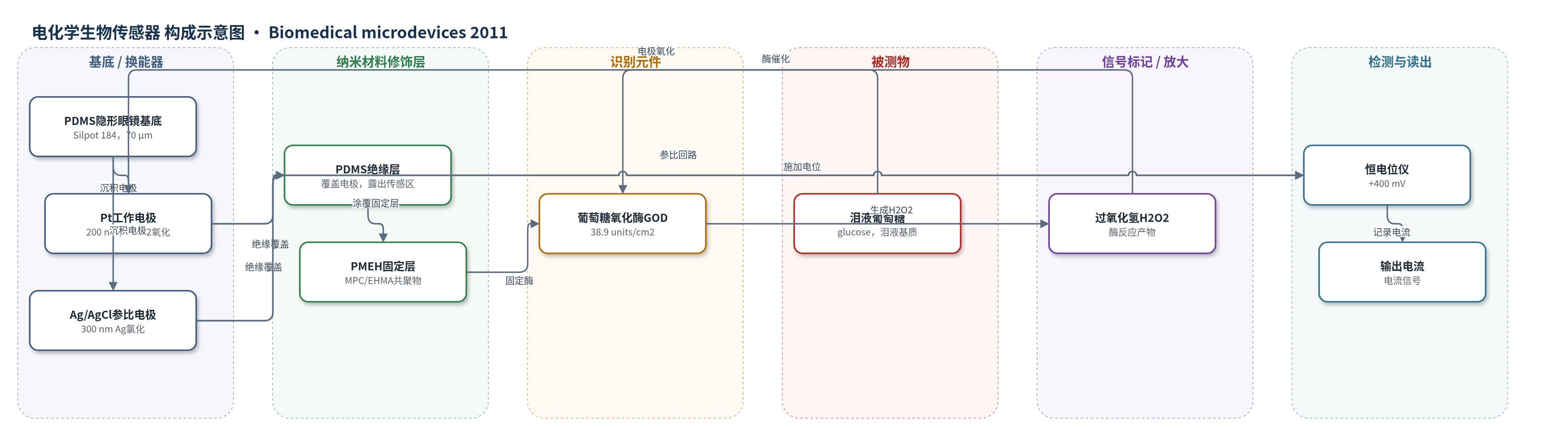
点击图片查看大图 · 依据论文自动绘制
传感器类型
电化学生物传感器
检测对象
泪液葡萄糖(glucose),样品基质为兔眼泪液(in situ);体外使用磷酸盐缓冲液PB和标准葡萄糖溶液。
检测原理
泪液中的葡萄糖扩散至传感区,被PMEH固定层中的葡萄糖氧化酶(GOD)催化氧化,生成葡萄糖酸和过氧化氢(H2O2)。H2O2进一步扩散到Pt工作电极表面,在恒电位仪施加的+400 mV电位下发生电化学氧化,产生与H2O2浓度成正比的电流。由于GOD反应中H2O2生成量与葡萄糖浓度相关,输出电流随泪液葡萄糖浓度升高而增大,从而通过校准曲线反推葡萄糖浓度。滴注葡萄糖或生理盐水会改变眼表葡萄糖浓度,电流快速上升或下降并随泪液分泌稀释恢复,据此可计算泪液更新率。该体系无额外信号放大,主要依赖酶催化与H2O2电化学氧化。
检测灵敏度
线性范围: 0.03–5.0 mmol·L-1;R^2 = 0.994
效应效果
体外T95约21 s,平均标准差5.1 s(13–26 s)。重现性良好,1.0和3.0 mmol·L−1下平均电流为0.135和0.374 μA,CV为3.7%和4.5%;0.03–5.0 mmol·L−1平均标准差0.03 μA,正常/糖尿病泪液浓度下约0.0028 μA。兔眼佩戴时电流约0.022 μA且稳定,估计泪液葡萄糖0.127 mmol·L−1,实验前后校准范围和灵敏度无显著差异,眼部未见炎症。动态滴注0.5、1.0、1.5 mmol·L−1葡萄糖及生理盐水后,平均泪液更新率29.6±8.42% min−1,估算葡萄糖浓度准确率98.8%–99.3%(平均99.1%)。作者认为可用于泪液葡萄糖与动态监测,抗坏血酸干扰需选择性膜改善。
传感器的构成
- 基底/柔性膜:PDMS(Silpot 184,70 μm厚)作为柔性基底与导线载体,提供柔韧支撑
- 工作电极:Pt(200 nm,经Ti掩膜沉积)作为H2O2氧化换能电极
- 参比电极:Ag/AgCl(由300 nm Ag电化学氯化形成)提供稳定电位参考
- 绝缘封装层:PDMS覆盖电极,仅露出传感区与接触区,防止短路并固定结构
- 固定基质:PMEH(MPC与EHMA共聚物)涂覆于传感区,用于固定葡萄糖氧化酶
- 识别元件:葡萄糖氧化酶GOD(38.9 units/cm2)催化葡萄糖生成H2O2
- 信号产物:H2O2为酶反应产物,在Pt电极氧化产生电流
- 样品介质:泪液或磷酸盐缓冲液PB(pH 7.4,20 mmol·L−1)提供反应环境
中文摘要
本研究制备并测试了一种用于泪液非侵入性生物监测的软性隐形眼镜生物传感器(SCL-biosensor)。该传感器在聚二甲基硅氧烷(PDMS)隐形眼镜表面构建酶固定化电极,采用功能聚合物微加工技术,以PDMS和2-甲基丙烯酰氧乙基磷酸胆碱(MPC)聚合物为主要材料。体外表征显示,输出电流与葡萄糖浓度在0.03–5.0 mmol·L−1范围内呈良好线性关系,相关系数为0.994,校准范围覆盖已报道的泪液葡萄糖浓度(约0.14 mmol·L−1)。随后在兔眼上进行原位佩戴监测,传感器在静态和动态状态下均有效工作。兔泪液葡萄糖初始浓度估计为0.12 mmol·L−1,并通过滴注葡萄糖溶液成功计算泪液更新率为29.6±8.42% min−1。结果表明,该软性隐形眼镜生物传感器可用于眼部先进生物监测。
英文摘要
A soft contact-lens biosensor (SCL-biosensor) for novel non-invasive biomonitoring of tear fluids was fabricated and tested. Wearing a biosensor on eye enabled the in situ monitoring of tear contents. The biosensor has an enzyme immobilized electrode on the surface of a polydimethyl siloxane (PDMS) contact lens. The SCL-biosensor was fabricated using microfabrication techniques for functional polymers (PDMS and 2-methacryloyloxyethyl phosphorylcholine (MPC) polymer). In investigation of in vitro characterization, the SCL-biosensor showed excellent relationship between the output current and glucose concentration from 0.03 to 5.0 mmol·L(-1), with a correlation coefficient of 0.994. The calibration range covered the reported tear glucose concentrations (0.14 mmol·L(-1)). Based on the result, ocular biomonitoring with the SCL-biosensor was carried out. The SCL-biosensor well worked both in the static state and the dynamic state. The tear glucose level of rabbit was estimated to 0.12 mmol·L(-1) at first and then the tear turnover was successfully calculated to be 29.6 ± 8.42% min(-1). The result indicated that SCL-biosensor is useful for advanced biomonitoring on eye.