组成图示
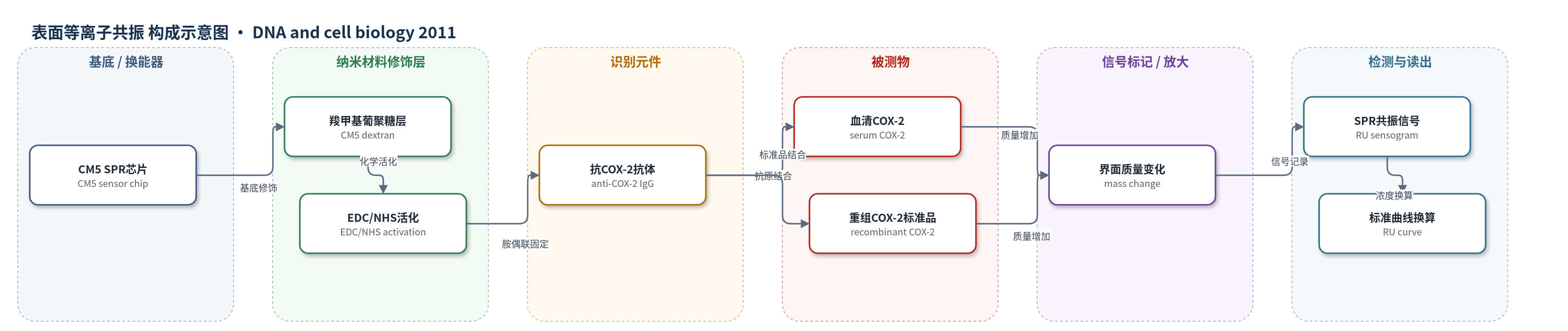
点击图片查看大图 · 依据论文自动绘制
传感器类型
表面等离子共振(SPR)生物传感器
检测对象
环氧合酶-2(COX-2,cyclooxygenase-2);样品基质:人血清、乳腺癌组织裂解液
检测原理
CM5芯片表面的羧甲基葡聚糖经EDC/NHS活化后,人抗COX-2 IgG抗体通过胺偶联固定,乙醇胺封闭剩余基团。样品中的COX-2与固定抗体特异性结合,使传感器界面质量与折射率发生变化,改变表面等离子体共振条件。SPR仪器实时记录共振单位(RU),结合量越大,RU变化越大。实验用纯化重组COX-2建立RU-浓度标准曲线,将1:99稀释的血清或组织裂解液获得的RU换算为COX-2浓度。该过程为无标记、实时检测,不依赖荧光或酶标记放大。
检测灵敏度
标准曲线范围: 3.3–49.5 μg;灵敏度斜率: y = 17.149x + 20111;1 RU = 1 pg/mm²
效应效果
患者血清COX-2为14.55±5.74 μg/mL,健康人3.5±1.3 μg/mL,约升高5倍(p<0.0001)。淋巴结转移组17.5±4.7 μg/mL高于无转移组13.5±3.7 μg/mL(p<0.0061);III期16.6±6.02 μg/mL高于I+II期13.73±3.4 μg/mL(p<0.015)。肿瘤大小无显著差异(p=0.24),与ER、PR、HER2无显著相关。新辅助化疗48例中33例(68.75%)COX-2下降,化疗前14.55±5.6 μg/mL,第二周期后8.87±3.97 μg/mL(p<0.0025)。辅助化疗术后10.07±3.5 μg/mL,术前15.15±5.89 μg/mL。癌组织16.03±3.08 μg/mL,正常组织9.84±2.85 μg/mL(p<0.0001)。Western blot验证血清COX-2。作者认为SPR实时无标记,可用于预后和疗效监测。
传感器的构成
- 基底/换能器:CM5 SPR传感器芯片,提供羧甲基葡聚糖修饰表面并产生表面等离子共振信号
- 活化层:EDC/NHS(N-ethyl-N'-(3-dimethylaminopropyl) carbodiimide / N-hydroxysuccinimide)活化羧甲基葡聚糖表面
- 识别元件:人抗COX-2 IgG抗体(Human IgG-COX-2,Santa Cruz),通过胺偶联固定以捕获COX-2
- 封闭剂:乙醇胺(ethanolamine)封闭未反应基团
- 校准物:纯化重组COX-2(purified recombinant COX-2),用于建立RU-浓度标准曲线
- 样品缓冲液:HBS-EP缓冲液(0.01 M HEPES、0.15 M NaCl、2 mM EDTA、0.005% surfactant P20,pH 7.4),用于稀释血清和组织裂解液
- 读出:SPR仪器记录共振单位(RU),依据标准曲线换算COX-2浓度
中文摘要
环氧合酶-2(COX-2)是一种诱导性酶,参与乳腺癌进展和血管生成。本研究旨在定量检测COX-2浓度,并分析其与侵袭性导管癌患者临床病理参数及化疗反应的关系。作者采用基于表面等离子共振(SPR)的新型生物传感器,检测84例乳腺癌患者(48例新辅助化疗、36例辅助化疗)和40例年龄、性别匹配健康人血清中的COX-2水平。结果显示,患者血清COX-2水平显著高于健康人;存在淋巴结转移的患者COX-2水平更高;68%(33/48)接受新辅助化疗的患者COX-2水平显著下降。研究提示,新辅助和辅助化疗均可显著降低乳腺癌患者血清COX-2水平,血清COX-2可作为乳腺癌肿瘤标志物,用于疾病预后评估和化疗疗效监测。
英文摘要
Cyclooxygenase-2 (COX-2), an inducible enzyme, has been implicated in the progression and angiogenesis of breast cancer. The aim of the study is to quantify the concentration of COX-2 and its association with clinico-pathological parameters and response to treatment in patients with invasive ductal carcinoma receiving both neo-adjuvant and adjuvant chemotherapy. The level of COX-2 was estimated using a novel biosensor-based surface plasmon resonance technique in serum of 84 patients with breast cancer (48 patients of neo-adjuvant chemotherapy and 36 patients of adjuvant chemotherapy) and 40 age- and gender-matched normal individuals. A significant increase in COX-2 level was observed in patients compared with normal individuals (p>0.0001). The COX-2 level in serum was found to be significantly higher in patients with lymph node involvement (p<0.0061). 68% (33/48) of the patients receiving neo-adjuvant chemotherapy showed significantly (p<0.0025) reduced COX-2 levels. This study shows significant decrease of COX-2 level in patients with breast cancer treated with both neo-adjuvant and adjuvant chemotherapy. Estimation of COX-2 level in serum may serve as a tumor biomarker in patients with breast cancer.