组成图示
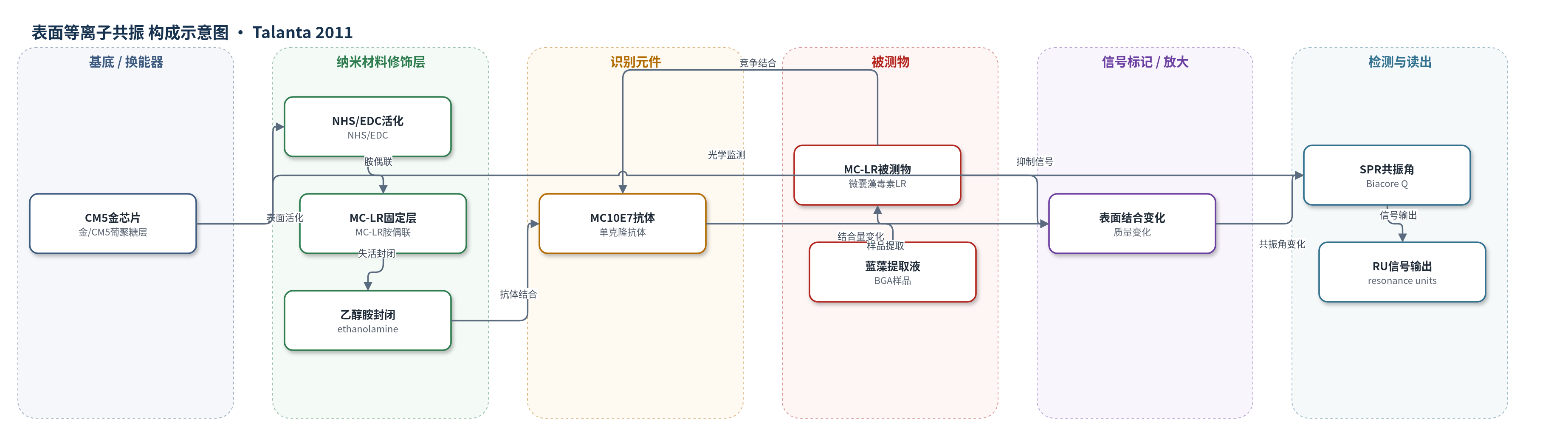
点击图片查看大图 · 依据论文自动绘制
传感器类型
表面等离子共振(SPR)生物传感器
检测对象
微囊藻毒素(microcystins, MCs,主要MC-LR);样品基质:蓝藻食品补充剂(螺旋藻Spirulina、Aphanizomenon flos-aquae粉/胶囊/片剂)
检测原理
MC-LR通过胺偶联固定在CM5芯片的羧甲基葡聚糖表面,形成抗原捕获层;样品提取液中的MC-LR与流动相MC10E7单克隆抗体竞争结合。当样品MC-LR浓度升高时,抗体被样品毒素占据,到达芯片后与固定MC-LR的结合量降低,界面质量变化减小。SPR通过监测金膜表面共振角变化,将结合量变化转换为共振单位(RU)信号,并用四参数抑制曲线换算浓度。方法采用长进样时间提高灵敏度,无需酶或荧光标记放大。
检测灵敏度
LOD: 0.561 mg kg−1;CCα: ≤0.85 mg kg−1;线性范围: 0–2 ng mL−1(相当于0–2 mg kg−1 BGA补充剂);R^2 = 0.9893(与LC-MS/MS比较,slope = 0.9455,intercept = 0.0568)
效应效果
方法选择性良好:MC10E7抗体对MC-LR交叉反应100%,对MC-RR、MC-YR、nodularin分别为69%、61%、73%,对MC-LA、MC-LW、MC-LF无交叉反应,假阳性风险低。传感器芯片稳定,至少可再生1000次;5天校准曲线重现性好。加标Spirulina回收率为0.85、1.00、1.50 mg/kg时101%、100%、97%,CV约3.1%–6.7%;天然样品重复性通常<5%。与LC-MS/MS比较,13个爱尔兰市场样品结果一致,R^2=0.9893(slope=0.9455,intercept=0.0568),检出MC-LR <0.5–2.21 mg/kg。作者认为其前处理简单、可自动无人值守、溶剂消耗少,适合蓝藻补充剂快速筛查。
传感器的构成
- 基底/换能器:CM5传感器芯片(金表面羧甲基葡聚糖层,提供SPR换能与偶联位点)
- 表面活化层:NHS/EDC(N-羟基琥珀酰亚胺/碳二亚胺,活化表面羧基用于胺偶联)
- 固定抗原层:MC-LR(5 mg/mL,CTAB助溶,胺偶联固定,作为竞争捕获物)
- 封闭/失活层:1 M ethanolamine-HCl(pH 8.5,失活剩余活化位点)
- 识别元件:MC10E7单克隆抗体(1 μg/mL,与表面MC-LR结合,样品MC-LR竞争抑制)
- 信号标记物:无(label-free SPR,无酶/荧光标记)
- 分析缓冲液:HBS-EP(10 mM HEPES pH 7.4、0.05 M NaCl、3.4 mM EDTA、0.005% P20,样品稀释与流动相)
中文摘要
本研究开发并验证了一种基于表面等离子共振(SPR)的竞争性抑制免疫生物传感器方法,用于螺旋藻和Aphanizomenon flos-aquae蓝藻食品补充剂中微囊藻毒素(MC)的检测。该传感器利用抗MC-LR单克隆抗体MC10E7,将MC-LR通过胺偶联固定在CM5传感器芯片表面,样品中的MC-LR与抗体竞争结合,导致表面结合量下降,从而通过共振角变化实现无标记检测。粉末样品经甲醇-水溶液提取、离心并用HBS-EP缓冲液稀释后分析。方法按欧盟2002/657/EC法规进行验证,基于20个阴性样品计算检出限为0.561 mg/kg,MC-LR检测能力CCα≤0.85 mg/kg。该方法成功应用于爱尔兰零售市场蓝藻补充剂中MC-LR检测,检出水平为<0.5至2.21 mg/kg,结果与LC-MS/MS方法一致。与化学分析相比样品前处理简单,与ELISA相比可自动无人值守分析。
英文摘要
A surface plasmon resonance (SPR) immunobiosensor assay was developed and validated to detect microcystin toxins in Spirulina and Aphanizomenon flos-aquae blue-green algae (BGA) food supplements. A competitive inhibition SPR-biosensor was developed using a monoclonal antibody to detect microcystin (MC) toxins. Powdered BGA samples were extracted with an aqueous methanolic solution, centrifuged and diluted in HBS-EP buffer prior to analysis. The assay was validated in accordance with the performance criteria outlined in EU legislation 2002/657/EC. The limit of detection (LOD) of the assay was calculated from the analysis of 20 known negative BGA samples to be 0.561 mg kg(-1). The detection capability (CCβ) of the assay was determined to be ≤ 0.85 mg kg(-1) for MC-LR. The biosensor assay was successfully applied to detect MC-LR toxins in BGA samples purchased on the Irish retail market. MC-LR was detected in samples at levels ranging from <0.5 to 2.21 mg kg(-1). The biosensor results were in good agreement with an established LC-MS/MS assay. The assay is advantageous because it employs a simple clean-up procedure compared to chemical assays and allows automated unattended analysis of samples unlike ELISA.