组成图示
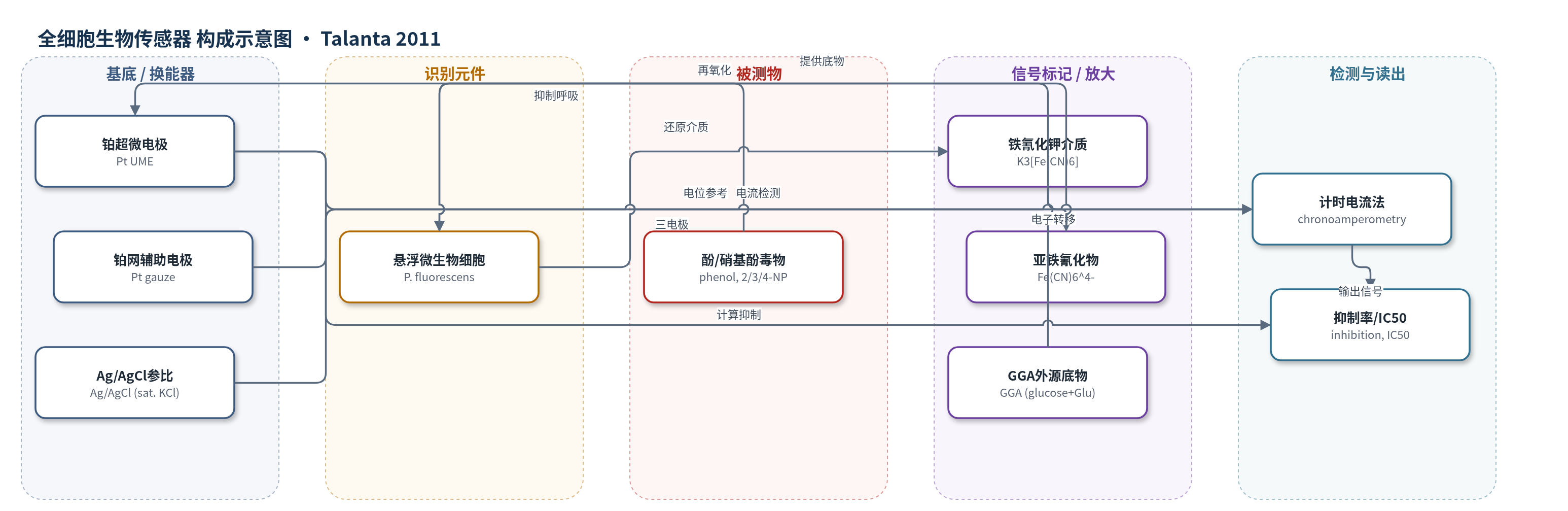
点击图片查看大图 · 依据论文自动绘制
传感器类型
全细胞生物传感器
检测对象
酚(phenol)、2-硝基酚(2-NP)、3-硝基酚(3-NP)、4-硝基酚(4-NP)、3,5-二氯酚(DCP,参考毒物);样品基质为含PBS、GGA和铁氰化钾的溶液/模拟水样
检测原理
微生物细胞作为全细胞识别元件,在含GGA底物和铁氰化钾介质的无氧体系中,细胞呼吸链将电子传递给铁氰化钾,将其还原为亚铁氰化物;亚铁氰化物在铂超微电极上于450 mV再氧化,产生与还原介质量成正比的极限电流。酚、硝基酚或DCP等毒物进入细胞或干扰呼吸链,抑制细胞代谢,使铁氰化钾还原量降低,电流下降。通过有/无GGA和毒物对照的极限电流计算抑制率,绘制剂量-响应曲线,取IC50作为毒性指标。GGA作为外源底物增强呼吸电流,提高响应;无氧氮封减少溶解氧干扰。
检测灵敏度
IC50: 4.2 mg/L (DCP, P. fluorescens);IC50: 291.4 mg/L (phenol);IC50: 64.1 mg/L (2-NP);IC50: 71.4 mg/L (3-NP);IC50: 14.0 mg/L (4-NP)(60 min)
效应效果
该传感器以IC50评价毒性,未报告RSD、回收率和长期稳定性。与已发表方法比较,对4-NP的IC50为14.0 mg/L,与Microtox(13.6 mg/L)相近,低于ToxAlert(25.51 mg/L)和ASRIT(57.0 mg/L);对2-NP为64.1 mg/L,高于Microtox(34.9 mg/L);对3-NP为71.4 mg/L,高于ToxAlert(43.05 mg/L);对酚为291.4 mg/L,约为Microtox(21.1 mg/L)的10倍,但低于ASRIT(783.0 mg/L)。加入GGA后DCP在2.0–8.0 mg/L即可使抑制率超过85%,无GGA需20.3 mg/L,说明外源底物增强响应。作者认为方法简单、快速、可重复、低成本,适合化学毒性筛查和环境水样监测。
传感器的构成
- 工作电极:9片25 μm单铂超微电极(Pt UME),用于计时电流法检测介质再氧化电流
- 辅助电极:铂网(Pt gauze),与参比电极构成三电极体系
- 参比电极:Ag/AgCl(饱和KCl),提供稳定电位参考
- 全细胞识别元件:悬浮微生物细胞(P. fluorescens等),其呼吸链活性作为毒性响应
- 电子介质:铁氰化钾(K3[Fe(CN)6],ferricyanide),穿梭细胞呼吸电子并被还原为亚铁氰化物
- 外源底物:标准葡萄糖-谷氨酸溶液(GGA,150 mg/L葡萄糖+150 mg/L谷氨酸),提供代谢底物增强呼吸电流
- 缓冲/样品基质:PBS(磷酸盐缓冲液)与含毒物样品,维持细胞环境并引入被测物
- 信号读出:计时电流法(chronoamperometry),450 mV、10 s脉冲测极限电流并计算抑制率/IC50
中文摘要
本文开发了一种基于电化学技术、成本低的全细胞生物传感器,用于检测酚和硝基酚的毒性。该方法利用毒物对微生物呼吸链活性的抑制效应,以铁氰化钾为电子介质,通过计时电流法测量悬浮微生物代谢产生的亚铁氰化物在微电极上的再氧化电流。将电流信号直接转化为呼吸抑制率,并采用50%抑制浓度(IC50)作为毒性定量指标。研究采用大肠杆菌、阴沟肠杆菌、粪产碱杆菌、荧光假单胞菌、腐生假单胞菌和皮肤毛孢子菌等微生物,以3,5-二氯酚(DCP)为参考毒物。结果表明,同科微生物对呼吸活性的抑制趋势和IC50相似;比较IC50,荧光假单胞菌对DCP最敏感,IC50为4.2 mg/L。在pH 7.0并加入标准葡萄糖-谷氨酸(GGA)外源底物的最佳条件下,以荧光假单胞菌为模型微生物评估酚和硝基酚毒性,60 min时酚、2-硝基酚、3-硝基酚和4-硝基酚的IC50分别为291.4、64.1、71.4和14.0 mg/L。与已发表数据比较,该全细胞电化学生物传感器可作为化学毒性筛查的敏感、快速替代方法。
英文摘要
A cost-effective whole cell biosensor based on electrochemical technique to detect toxicities of phenol and nitrophenols has been developed. This method relied on the inhibition effect for respiratory chain activity of microorganism by toxicant, which was measured by chronoamperometry using mediator (ferricyanide). The current signals produced by suspended microorganisms and reoxidation of ferrocyanide were transformed to inhibiting efficiency directly, and 50% inhibiting concentration (IC(50)) was chosen as the quantitative standard of toxicity. The test microorganisms used here consist of three bacilli (Escherichia coli, Enterobacter cloacae and Alcaligenes faecalis), two pseudomonas (Pseudomonas fluorescens and Pseucomonas putida) and one fungus (Trichosporon cutaneum). 3,5-Dichlorophenol (DCP) was taken as the reference toxicant. The results showed that the microorganisms which belong to the same bacterial family had similar trends of inhibitions on respiratory activity and similar IC50 values. By comparing the IC(50) values, P. fluorescens was the most sensitive one to DCP toxicity, its IC(50) was estimated to be 4.2mg/L. pH 7.0 and together with the standard glucose-glutamic acid (GGA) as an exogenous material were taken for optimum conditions in this study. Here, P. fluorescens as model test microorganism was employed to assess toxicities of phenol and nitrophenols under the optimum conditions. IC(50) values of 291.4 mg/L for phenol, 64.1mg/L for 2-NP, 71.4 mg/L for 3-NP and 14.0mg/L for 4-NP were determined at 60 min, respectively. Comparison with the results of published data has confirmed that this cell biosensor is a sensitive and rapid alternative to toxicity screening of chemicals.